

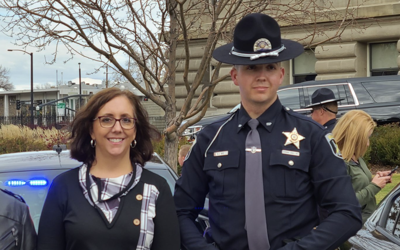
On any given night shift, Jodi Rogers sits at her console at the Idaho State Police Regional Communications Center in Meridian and does what she has done for years — listens, responds, coordinates, and keeps people safe. The voices that come through her radio belong to troopers scattered across a vast stretch of Idaho, from the southwestern corner of the state to the southeast. She is their calm in the chaos, their lifeline when things go sideways.
One of those voices belongs to her own Idaho State Police trooper son.
This week, April 12–18, is National Public Safety Telecommunications Week — a time set aside each year to recognize the dispatchers and communications professionals who serve as the invisible backbone of public safety. They are the first to hear a cry for help. They are the last voice a trooper hears before heading into danger. And in Jodi Rogers’ case, one of those troopers is the person she raised.
Rogers’ son serves as an ISP trooper in the Twin Falls region, and when his calls come through, it is sometimes his mother on the other end of the radio — coordinating, communicating, watching over him in the only way her job allows.
“I understand the dangers of the job, and so does he,” Rogers said. “But it’s fun. I don’t get to see him a lot, so I love getting to hear his voice.”
Think about what that means for a moment. A mother, working the overnight hours while most of Idaho sleeps, tracking her son’s location, routing his calls, and carrying in the back of her mind the full weight of what can happen on a dark Idaho highway. She knows that weight better than most. Before she became a dispatcher, Rogers spent 15 years as a sheriff’s deputy, patrolling those same kinds of roads, answering those same kinds of calls.
An injury eventually took her off patrol. But it didn’t take her out of service.
“After I was injured, I didn’t really know what I wanted to do,” Rogers said. “But law enforcement is where I belong, so I decided to become a dispatcher.”
That decision brought her full circle — and then some. Her years on the road didn’t just prepare her for the headset. They gave her something most dispatchers don’t have: a bone-deep understanding of what troopers face when they pull onto a highway shoulder at 2 in the morning.
“Because I worked on the other side, I think that has helped me in here,” she said. “I understand what the troopers are going through out on the road.”
Now a night supervisor at the ISP Meridian dispatch center, Rogers carries all of that experience — the patrol years, the injury, the transition, the hard-earned understanding of danger — into every shift. And on the nights when her son’s call sign crackles through the radio, she carries something else too: the particular, irreplaceable relief of a mother who gets to hear that her child is OK.
That is the quiet gift buried inside a job that most people never think about. National Public Safety Telecommunications Week exists to change that — to pull back the curtain on the professionals who make every other act of public safety possible.
People like Rogers, who gave 15 years to the road, survived an injury that could have ended her career, and found her way to a console where she now guides the next generation of troopers — including one she knows by heart.

(0) comments
Welcome to the discussion.
Log In