

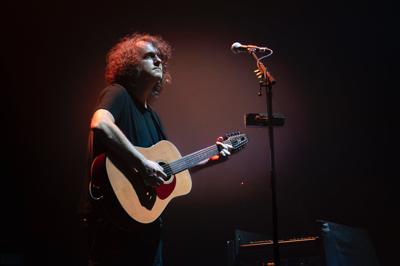

POCATELLO — Dave Fowler was not supposed to be a rock star.
He was the quiet kid — the one who ducked into the music practice room at lunch to avoid the crowds, guitar in hand mostly out of habit. He had been playing since he was 10, picking things up by ear, never thinking much of it.
Then one afternoon, a group of older kids walked in.
“They were a bit scary,” Fowler recalled with a laugh. “They said, ‘Can you play Come As You Are by Nirvana?’ and I just sort of played it. I’m not quite sure how I did, but I played it, and they were like, ‘Oh cool, do you want to do a band?’”
That band played Pink Floyd covers. And from that lunch room in England, something clicked.
One of those kids challenged Fowler to work out the solo to “Another Brick in the Wall, Part 2.” He spent weeks on it. Then, in 1994, Pink Floyd’s Division Bell Tour was televised on the BBC and Fowler recorded it to VHS.
“I must have worn that tape out,” he said. “I learned my trade as a guitarist by playing Pink Floyd, working it out from that VHS tape.”
He went out and bought “Dark Side of the Moon.” Then “Wish You Were Here.” Then “The Wall.” The introverted kid hiding from his classmates had found his direction.
What he could not have known then was that at 17, seeing Aussie Floyd perform in a small venue, he would make a prediction he would not forget — that if he had not made it in his own music by the time he turned 30, he wanted to be in that band.
“It sounds like one of those made-up media soundbite stories,” Fowler said. “But there were people with me at that gig who remembered me saying that.”
The path from that prediction to actually joining the band was, as Fowler put it, a weird set of meetings and coincidences.
At 29, a mutual friend invited him along for a weekend following The Australian Pink Floyd Show across three European festival dates. A couple of band members rode along in the Winnebago. The conversation turned to guitar, and before the weekend was over, guitarist Steve asked Fowler to send him a recording.
Fowler dug out an old track of himself playing “Coming Back to Life” and sent it over. Ten minutes later his phone rang.
“He said, ‘Is that Dave Fowler or Davey Gilmour?’” Fowler recalled. “’Jeez mate, that was amazing.’”
When his predecessor eventually left, Fowler auditioned against eight others and got the spot. He joined at 30, exactly as he had predicted 13 years earlier.
“To take advantage of luck, you have to be prepared,” Fowler said.
He is now 46, and 16 years into what has become one of the most demanding and detail-obsessed jobs in tribute music — and on July 30, he and The Australian Pink Floyd Show are bringing that show to Pocatello.
What separates Fowler from most lead guitarists is what he does when he is not playing. Long before he joined the band, Fowler was deep into computers — self-taught programmer, IT worker, lifelong tech obsessive. When he got into the band and started watching the video animations behind the performances, he saw things that bothered him. So he started making them himself.
“I’m kind of the weird one,” he said. “I pretty much do all of the circle screen animations and videos.”
His approach is meticulous, and his passion for the production comes through in every detail..
For a “Welcome to the Machine” animation, Fowler built a sequence set on a Monopoly board, with roads renamed after thinly veiled versions of Spotify, Apple Music and Google — commentary on the modern music industry machine the song was written to critique.
The processor at the center was a real chip released in 1975, the same year “Wish You Were Here” came out. The computer code scrolling across a surveillance room in the video was actual assembler code written for that processor.
Nobody in the arena would ever catch it.
“I try and get all these details right in the way that I think Floyd would have done,” Fowler said.
He acknowledged it can go too far. Early on, lettering he built into a flickering brick wall animation looked sharp up close but vanished from the back of an arena.
“Halfway down the arena you can’t see it’s a brick wall, because you need the bricks to be massive,” he said.
Fowler is not performing original work and has never pretended otherwise. But what it means to spend 16 years playing another artist’s catalog with genuine care is something he has thought about deeply.
“My personal opinion is that it’s better that the band do something that gives the listener the feeling that they’re listening to Pink Floyd, rather than try and play an exact note-for-note copy of something that doesn’t have the feeling of Pink Floyd,” he said.
There are tribute acts made up of musicians who rotate through different bands — Led Zeppelin one night, Pink Floyd the next. That approach makes it nearly impossible to capture the feel of anything.
“If you’re diverting around to lots of different types of music, you never get to make it feel like it’s your own,” he said. “Even though we know we didn’t write the music.”
Pink Floyd’s catalog has an unusual reach — audiences span from children to grandparents, and Fowler said a good 30 to 40 percent are his age or younger. He recalled a six-year-old once telling him her favorite song was “Sheep,” a nearly 11-minute track buried deep on “Animals.”
“I love that,” Fowler said. “I think it’s amazing.”
He attributed Pink Floyd’s durability partly to how the band found its voice in the music industry during that time.
“They listened and went, ‘We can’t do that, so what can we do,’ and kind of went in another direction,” Fowler said. “By going their own way, that’s why they stood out, because there was nothing like it.”
Building a setlist for a Pink Floyd tribute show is its own art form. About an hour and 20 minutes of any given show is essentially fixed — “Comfortably Numb,” “Another Brick in the Wall, Part 2,” “Wish You Were Here,” “Money,” “Time.” Skip any of them and it stops feeling like a Pink Floyd show. What remains is maybe 15 to 20 minutes where the band makes its choices, and those choices carry real risk.
Lean too safe and the diehard’s revolt online. Go too deep into the catalog and the partner who got dragged along starts planning to skip next year.
One year, the band performed all nine parts of “Shine On You Crazy Diamond” as a single unbroken 30-minute piece. The crowd realized midway through that they were getting everything.
“It kind of gave an excitement,” Fowler said.
That same attention to the audience experience is what Pocatello can expect when the band takes the stage at The Port on July 30. Fowler had simple advice for anyone who has never seen the show.
“Just come in and don’t have any preconceived ideas,” he said. “Almost treat it like you’re watching a film, and you’re just soaking it all in.”
The Australian Pink Floyd Show, which has sold more than five million tickets worldwide since its founding in Adelaide, Australia in 1988, is a different proposition than most tribute acts. The production includes a full laser and light show, high-resolution LED screens, massive inflatables — among them a giant pig and the band’s own Pink Kangaroo — and live sound precision that defined classic-era Pink Floyd performances.
The audience member Fowler most wants to reach is the skeptic — the one who does not see the point of a tribute act and got talked into buying a ticket by someone else.
“I’d love it, which is the feedback I do hear, when people go, ‘Well, I was not expecting it to be like that,’” he said. “’All right, OK, I totally get it now.’”
For Fowler, that moment of conversion is the whole point. People are choosing how to spend a limited entertainment budget, and the band takes that responsibility seriously — whether they are playing an arena in Europe or a stage in Pocatello.
“All those tiny little attention-to-detail moments on the sounds and everything — they all accumulate together to become something that just kind of works,” he said.
Sixteen years in, the quiet kid from the lunchroom is still chasing that feeling. Pocatello gets to be next.
Tickets for The Australian Pink Floyd Show at The Port in Pocatello on July 30 are available at www.aussiefloyd.com/tour-dates.


(0) comments
Welcome to the discussion.
Log In