

POCATELLO — Just shy of a year since his daughter Sara received a lifesaving heart transplant, Pocatello City Councilman Steve Brown said his role in celebrating National Donate Life Month on Wednesday was “personal.”
Based on his perspective as a person dramatically affected by organ donation, Brown said he would seize the moment to express an opinion not often extolled.
“Our donor program should be an opt-out program, and not an opt-in program,” Brown said, often becoming emotional when he spoke. “If we can influence one person today, then this event has been successful.
But you need to know that one person is not enough.”
Brown was speaking in the Pocatello City Council Chambers Wednesday afternoon during a ceremony that marked the city’s observance of Donate Life Month. It included raising a Donate Life flag which will fly beneath the U.S. Flag at the Pocatello City Hall during the month of April.
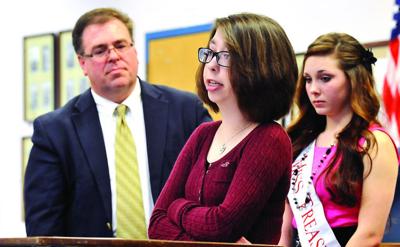
On hand were two dozen observers. They included Brown’s daughter, Sara, Lance and Diane Peck, who own Downard Funeral Home in Pocatello, representatives from Intermountain Donor Services, and Megan Moore, Miss Treasure Valley, who is advocating for organ, eye and tissue donation during her reign.
Alex MacDonald of Intermountain Donor Services, the entity that oversees organ and tissue donation throughout Utah, Southern Idaho and the Southwest corner of Wyoming, started off the event by letting those in attendance know just what it is they are up against.
“Right now we’ve got 121,000 on the transplant list waiting for a life-saving transplant nationally,” he said. “Everyday 18 to 20 of those people die waiting because there is not enough transplantable organs to help everyone. That’s what we need to end.”
Representing that tragic reality was Miss Treasure Valley Moore, who lost her brother last year. She explained that in April of 2012 her family was told that her brother had a liver ailment that would require transplant and he was given a seven-year window.
“We were told seven years and we were cut short six because he unexpectedly took a turn for the worse,” she said, fighting back tears. “Every day people are in need of some sort of organ transplant and each day people are dying because there are not enough organs available. Unfortunately, my brother is one of those who didn’t make it.”
Prior to Moore and just after her father spoke, Sara Brown talked about her ordeal. She shared some of her personal likes and favorite foods, saying that she “could not live without music.” She also said that when told she would be getting a heart transplant, she was on so many medications she simply can’t remember the moment.
“But I do know how grateful I am for my donor’s selflessness,” she said. “I do know that I wake up every day hoping that if I live life to the fullest and find some little blessing in it. I hope that that will some how be a way to thank that special person. I do know how someone else’s decision saved my life. I can now wake up feeling wonderful and go throughout the day and go to bed feeling just as fantastic.”
Sara was born with several heart defects. The surgeries and medications she endured and the weakened state she was often left in also led to the development of a condition that prohibited her body from absorbing protein.
The condition left her gravely ill during the latter part of 2012 and early 2013.
MacDonald said that two opposing stories summed up the difficult nature of what he did and that with each happy ending, there are also many sad ones.
The Pecks were on hand in their role as advocates for organ and tissue donation. Diane frequently speaks on the topic. Lance said he too sees both sides of the issue. He says organ donation is a topic families should discuss before the need to make a decision arises.
“I often see how families are approached about organ and tissue donation,” he said. “Many times, the family hasn’t given it any thought. Unfortunately, many times, because people don’t give it thought, they decide not to donate.”
Brown talked about the day Sara’s cardiologist came to their room and said she would get a transplant.
“We never expected, in Sara’s life, to be able to have a transplant,” Brown said. “To have that news delivered was grateful jubilation. In that moment that we received that news, it only took a second to realize that another family had heartbreak and tragedy in their lives. We continue to pray earnestly for that family. I will never be able to adequately express the complete love and appreciation and gratitude for this most special gift.”
Moore said her brother’s story and his sudden death for the lack of an available donor is what led her to take on organ and tissue donation as a platform.
In just a sentence or two, she may have best summed up the need and the simple solution.
“I don’t think anyone really understands the importance of organ donation,” Moore said. “Did you know that to become an organ donor, all you have to do is check yes when signing up for a license? Who knew it was that simple?”
Moore also said that although her brother was not able to be saved through organ donation, he was an organ donor.
“Within 24 hours, he was able to give sight to two others,” she said.

(0) comments
Welcome to the discussion.
Log In