

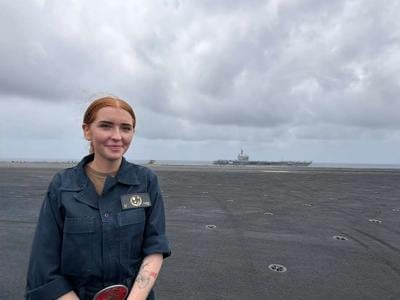
CLIFTON — A three-word text — "watch the news" — has become one of the only ways Mary Penrod learns what her daughter is living through nearly half a world away.
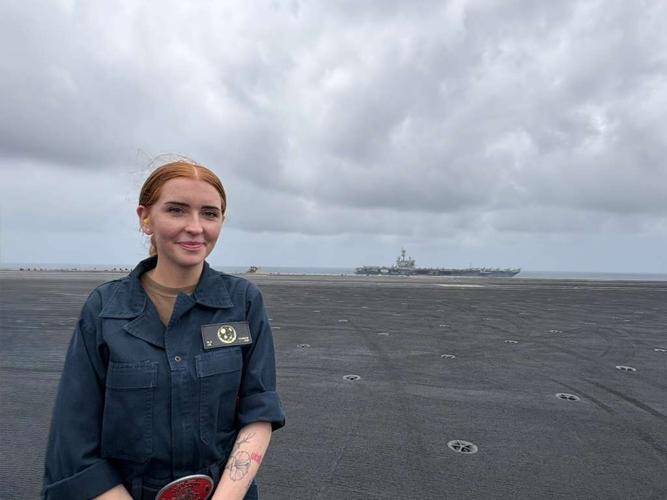
Katy Jane Penrod, who was raised in Clifton by her parents, Mary and Richard Penrod, has spent more than 230 days and counting aboard the USS Abraham Lincoln as the aircraft carrier operates near the Strait of Hormuz amid the ongoing conflict between the United States and Iran.
Mary is one of many East Idaho residents with a loved one currently serving overseas, part of the less than 1 percent of the U.S. population that serves in the military.
Katy joined the Navy in April 2025 at age 23, later than some of her peers who enlisted straight out of high school.
After finishing basic training, she was assigned to the USS Abraham Lincoln. She left San Diego just days before Thanksgiving in November 2025, on what was originally planned as a routine deployment to the Indo-Pacific region.
The ship made a single port call, a one-day stop in Guam, before being diverted toward the Middle East.
By early February, tensions with Iran had already turned active. A Marine F-35C flying off the Lincoln's deck shot down an Iranian drone near the carrier weeks before the war officially began.
When fighting broke out in late February, aircraft from the ship's air wing took part in the opening strikes, and the carrier strike group has since helped enforce a naval blockade against Iran.
Katy's deployment was originally supposed to end in June, when the ship was scheduled to return home.
Instead, the fighting has kept the Abraham Lincoln and its roughly 5,000-person crew at sea for well over 200 consecutive days, longer than any modern U.S. aircraft carrier has stayed continuously underway, surpassing a record set by the USS Dwight D. Eisenhower in 2020.
The Lincoln's two nuclear reactors allow it to stay at sea for months without refueling, a capability that's kept the ship and its crew sustaining high-tempo missions across the region with no end date in sight.
The Navy's limited number of carriers, split between two oceans and an active war zone, has left little room to rotate ships home.
On Jan. 27, before the fighting broke out, Katy sent her mother a text message.
"Keep the prayers coming, it's very scary out here right now, we're preparing for what we joined for," she wrote.
Mary said she typically hears from Katy every other day through WhatsApp, though the ship sometimes goes without Wi-Fi for days at a time for security reasons.
"Katy mostly wants updates from home and photos," Mary said, since she isn't permitted to discuss operations or politics.

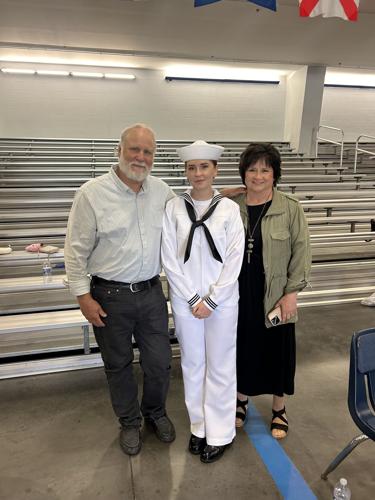
Katy Jane Penrod, center, poses with her parents, Mary and Richard Penrod, before her deployment.
Life aboard the carrier is largely monotonous — 14-hour workdays, the same routine and the same food, broken up only occasionally by morale days when the crew gets to hold a party or work on a craft.
Katy sleeps in the top bunk of a three-person berth below deck, where the constant noise of jets taking off and landing eventually becomes background noise. In one message to her mother, Katy described the toll of the routine.
"I feel like every day is blending into one long day, I miss you and the fam and my friends and my life and eating good food and the mountains and land and everything you can think of," she wrote.
Early in the deployment, the reality of the assignment hit home.
Katy called and asked her mother to take over access to her bank account, telling her the crew had been warned that some of them might not come home.
"We were just really scared," Mary said.
Since then, Mary said the family has drawn comfort from being told the carrier is among the most heavily guarded and protected vessels in the fleet, as safe a place as anyone could be in a war zone.
That reassurance was tested when Iranian state media repeatedly claimed the ship had been damaged or sunk, prompting worried texts from extended family and friends before Mary could confirm the reports were false.
On at least one occasion, the ship was targeted for real, when a wave of missiles was fired at the Abraham Lincoln and intercepted before ever reaching the ship.
Mary said Katy doesn't learn about developments involving her own ship until after the fact, something she believes helps keep the crew from living in a constant state of alarm.
Katy has admitted to moments of doubt, telling her mother more than once she wasn't sure she could keep going, though Mary said she believes that feeling is shared across the ship.
Mary has encouraged her daughter to lean on fellow sailors, reminding her they're all facing the same exhaustion and isolation.
The deployment has changed how the Penrod family relates to the war and to the military more broadly. The family now flies an American flag on their porch.
"Every time I see the flag, I think of Katy and her crewmates," Mary said.
Katy signed away five years of her life to the Navy, required to serve wherever and however she's told.
"It's like a job with meaning and purpose, but if with anything it's hard, it's not easy," Mary said. "It's just not easy."
For the Penrod family, and for every family with someone standing watch on a ship, in the sky or on the ground right now, the war playing out overseas is not a headline or a line on a map. It's a daughter, a son, a husband or a wife, living it one 14-hour day at a time, and it's a sacrifice Mary said she hopes people back home never take lightly.

(1) comment
Bring them home
Welcome to the discussion.
Log In