

POCATELLO — Nestled in a corner of Historic Downtown Pocatello sits a building constructed of dressed gray ashlar and aging red brick inlaid with massive round arches embossed in herringbone patterns.
The building, constructed in 1914 and known as the Union Pacific Depot, played an integral part in the development of Pocatello and its role in industrial manufacturing during World War II.
Adorned on the walls inside the building are vintage framed photographs of old steam engines, long-forgotten railroad structures and the industrial trappings of a bygone era.
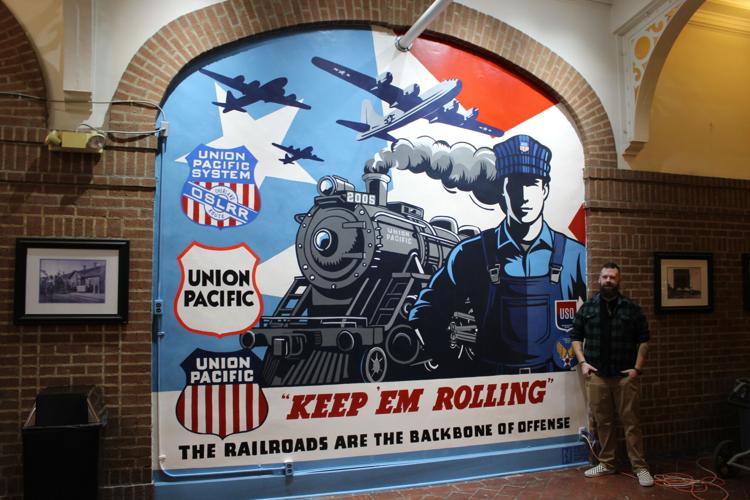
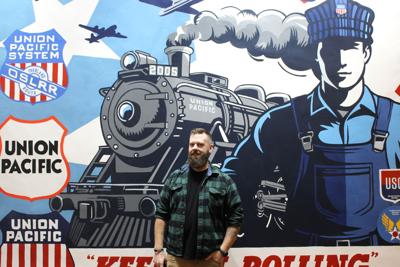
But among the vintage furnishings, a new mural has taken shape, anchoring the space with a visual story that connects the Gate City’s past, present and future.
Local artist Nick Hottmann was commissioned by Union Pacific after a simple word-of-mouth recommendation from Rory Erchul, owner of the Yellowstone Hotel. Erchul passed Hottmann’s number to Union Pacific’s Chris Johnson, who was looking for a muralist to bring new life to an interior wall.
The mural that followed is densely layered with local history. Hottmann dug into Pocatello’s World War II-era role as both an industrial site and a military hub. He visited the Veterans Memorial Building, consulted local sources, pulled information from social media and combed through historical references to understand how the community supported the war effort.
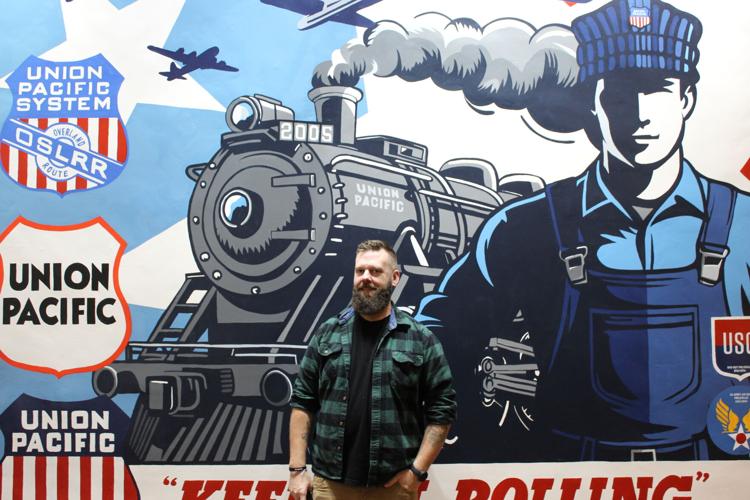
Those elements now are bound together in paint. The mural features a Union Pacific locomotive modeled on a display in Ross Park, a familiar landmark instantly recognizable to those familiar with the Gate City’s storied history.
Overhead, World War II-era B-17 bombers fly in formation, a nod to wartime aviation and the base that once operated nearby. Across the composition runs the slogan “Keep ‘Em Rolling,” a phrase pulled directly from Union Pacific’s 1940s war bonds propaganda, when the railroad promoted itself as part of the backbone of the war effort.
At the center stands a 1940s Union Pacific engineer clad in blue, rendered in period-accurate denim overalls, shirt and cap. Behind him, a stylized flag and star motif reflects the crisp, high-contrast look of midcentury war posters and industrial print work, with notes of Art Deco inspiration.
From the mural’s inception, Hottmann and Johnson agreed the art should feel like it belonged to the building’s original era. Hottmann opted to build a color palette based on Union Pacific’s own branding throughout the ages. The mural is composed of rich reds, pale blues, dark navy and asphalt grays while further showcasing various Union Pacific insignias and period-accurate airbase decals.
The result is a nostalgic 1940s World War II-era color scheme that keeps the piece vivid while staying historically grounded.
That attention to historical detail extended to retaining the walls’ pitted patina. Rather than smoothing the wall into a flawless surface, he left divots and irregularities visible, painting over conduit and power boxes so they became part of the composition instead of distracting eyesores.
Hottmann said the goal was to create something that looks like it could have been there for 30 years but will still feel appropriate decades into the future. The final result is a masterful blend that melds into the bones of the structure.
For Hottmann, murals like this are more than decoration. He sees them as drivers of economic activity and civic pride — that even a fresh coat of paint can shift how people experience a place like Pocatello.
Hottmann said employees of Union Pacific walking through the space already have stopped to share their own connections: relatives who worked at the military base, family members tied to the railroad and memories of specific trains.
Those personal ties often translate into behavior that benefits local businesses. Hottmann said murals and street art give people a reason to slow down, take photos and linger.
As more buildings add murals or restoration work, Hottmann said he is noticing a ripple effect that inspires neighboring owners to start sweeping sidewalks more regularly, cleaning windows or upgrading facades, contributing to a broader sense of care and investment in the local community.
“There’s a lot of people that are contributing to this,” Hottmann said. “It does feel revitalizing. Most businesses see an increase in sales and product and traffic because it’s something to stop and look at and then they will live there. They walk in and they shop. Murals do serve a purpose, more than just visual. They are good for the economy, but I feel like it makes you feel like you’re more invested.”
The Union Pacific project arrives at a moment when Historic Downtown Pocatello already is changing. Buildings are getting new coats of paint, and historic neon signs like the nearby Greyhound sign are flickering back to life. Hottmann said the goal of restoration is for people not to notice a dramatic change — to retain and maintain rather than remake.
Hottmann credits the leadership and direction of Historic Downtown Pocatello President and CEO Stephanie Palagi, business owners like Craig Yaiden and Jim Young, along with partners like Union Pacific, for helping drive a culture of preservation and revitalization.
Plans already are in place for the new mural to be unveiled during Historic Downtown’s First Friday Artwalk in February. The Union Pacific depot will be open to the public, allowing residents an opportunity to fully immerse themselves in artwork rife with historical meaning and significance.
Looking ahead, Hottmann already is at work on projects that stretch into 2026. Plans are in place for collaborative projects with Historic Downtown Pocatello, the Gate City Grays baseball club, the Museum of Clean and the My World Discovery Museum in an effort to bring “a breath of new life” to key hubs around town.
“I’m always looking for new clients,” Hottmann said. “I’m always looking for new opportunities to do stuff here in Pocatello and wherever else, residential to commercial, indoor to outdoor, whatever. 2026 is shaping up to be a pretty cool year for even just the projects that I know that are happening in Pocatello. You’ll see some cool changes coming pretty soon.”
In a railroad city long defined by forward movement, Hottmann’s new Union Pacific mural rests in reverent silence on the brick wall, pulling together trains, planes, war bonds and local stories. Yet in its stillness, it hints at momentum — a visual reminder that investment in history and art can help keep a community, in more ways than one, rolling.

(1) comment
I had a chance been walking inside the depot with my elder friend about 12 years ago. He had been born and raised in Pocatello, and at that time was in his late 50s. My friend had sat down on one of the original solid hard wood benches looking up the ceiling and started talking about his childhood memories associated with the Union Pacific depot. At the times of passenger service, he had recalled multiple times as a child been sitting at the same bench with his parents and siblings waiting for a train to arrive. He looked up and said that the ceiling use to have “a beautiful mural covering the entire dome”. And he had been really fascinated with the mural for hours. So now, looking at the picture of a brand new wall mural painted by the artist, I have a question I had failed to ask my elder friend 12 years ago. What was originally painted on the ceiling mural in the Union Pacific Depot? But unfortunately it’s too late because my friend is no longer with us. Please, I wonder if somebody else knows anything about the long gone ceiling mural. And if so, would the artist Nick Hottmann be able to some how re-imagine the old piece, and paint a small fragment of it on the top of his artwork, or maybe better on the bottom of the balcony please?
Welcome to the discussion.
Log In