

The 8-square-mile island of Iwo Jima is barely a blip on the world’s map.
Yet on this barren hot volcanic island, nearly 50,000 soldiers either lost their lives or were injured in the only Marine battle of World War II in which American casualties outnumbered Japanese.
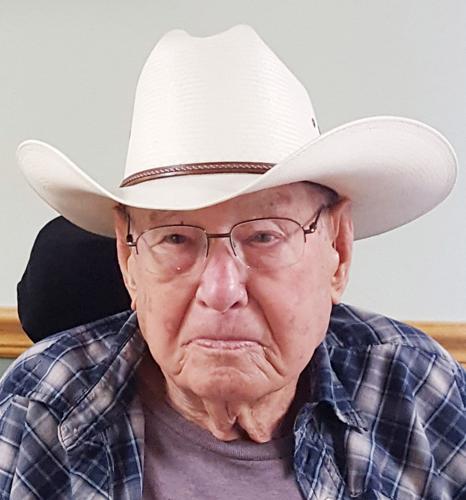
In February 1945, Technician 5th Class Ned Mickelsen, a 22-year-old farm boy from Blackfoot, was sailing in a US Naval Transport Vessel that had launched from New Caledonia, an island west of Australia. Standing nearly 6 foot, 3 inches tall, Mickelsen loved playing basketball and had learned to work hard on his parents’ farm driving a horse-drawn plow, topping beets, weeding acres of hay and breaking work horses.
Mickelsen had been drafted into the Army in 1942 soon after Pearl Harbor was bombed. He had sold all the farm equipment and animals he’d been acquiring for his own farm in order to serve his country.
He had no idea where he and the other Army soldiers of the 147th Infantry Regiment attached to the 4th Marine Division were being transported. In New Caledonia, Mickelsen’s infantry unit had spent the Christmas of 1944 listening to coconuts drop on their tents. For the past three weeks, Mickelsen’s unit had been practicing deploying from transports into landing craft while under fire.
They all suspected they were heading for combat.
“We couldn’t tell nobody where we were at and couldn’t write home. It was all a secret,” said Mickelsen, who’s now 95. “I never knew where I was going until I was on the boat and half-way there. Then they told us, ‘You guys are heading for Iwo Jima.’”
On the transport vessel, the troops were told that their mission was to kill as many Japanese as they could and take over the island.
B-29 bombers could carry enough fuel to reach Japan from recently secured Marine air fields in Saipan, Guam, and Tinian. But Japanese fighter planes taking off from the three air bases on Iwo Jima were bombing these U.S. Marine airfields and shooting down the B-29s, making the final advance into the heart of Japan very difficult.
For months, Iwo Jima had been bombarded by US warships in preparation for the ensuing invasion. It was believed that the battle to obtain Iwo Jima would only take about 12 days, that the island only housed 12,000 Japanese soldiers, and that many of the Japanese had been killed in the prep attacks.
Mickelsen’s infantry unit would soon find out that in every instance, the military had been wrong. Safe inside deep volcanic caves and bunkers, around 22,000 Japanese soldiers awaited the U.S. troops who landed on Feb. 19, 1945 — the beginning of a battle that lasted three times longer than expected.
Jumping off the landing craft, Mickelsen waded through chest-high water with his rifle held above his head, which made him and all the other troops walking targets for the Japanese housed safely in foxholes and bunkers. Navy pilots flying overhead during the battle stated that the troops appeared to be fighting the island itself because no Japanese could be seen.
According to Gen. Fred Haynes, who led the 5th Marine Division (the other Marine Division that attacked Iwo Jima), of the 3,400 soldiers who led the attack, only 600 remained standing when it ended.
Mickelsen scrambled onshore, found a foxhole and stayed there for two days.
“The island was a smoking mess,” Mickelsen said, “The Navy was hitting that island every minute and the noise was terrible. …I felt dizzy, confused and sick to my stomach. The beach was taking mortar and artillery fire the whole day. There was no safe place to be. …We crawled through bloated Japanese and American bodies getting off the beach. Wounded men on the beach were killed in the aid stations while waiting for evacuation. There were trucks, tanks, landing craft and other equipment all damaged along the shore. …I still cannot get the sights and smells of the beach out of my head.”
Mickelsen recalled hearing many soldiers calling for their wives or their mothers. Many of the dead had lost their dog tags and were buried in unknown graves. To this day, Mickelsen cannot eat rice because it reminds him of the maggots that proliferated due to decay.
He said that most of the fighting over the next few weeks involved minimal advances and waiting in shallow foxholes for the Japanese to come out at night. He remembers mostly eating Hershey’s candy bars and Spam.
“Every step of the way the Japanese were bringing down fire,” Mickelsen said. “Attacking one defended position would bring fire from two or three hidden places. It was just a nightmare. Men would get shot and you didn’t know where it was coming from.”
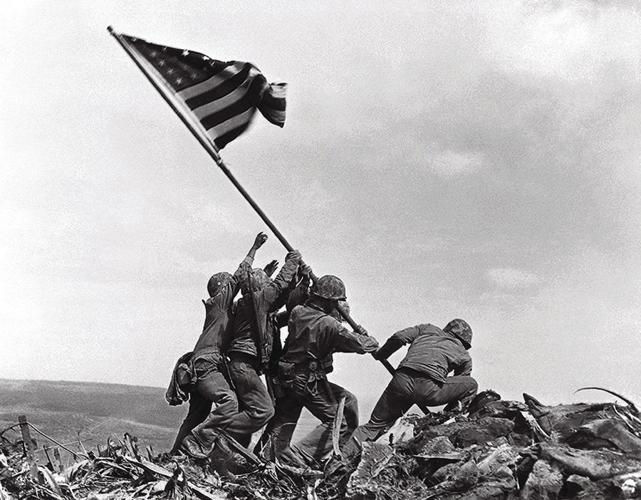
On Feb. 23, while hiding in a foxhole on Mount Suribachi, Mickelsen watched as five Marines and one Navy Corpsman bravely stood up and planted a large American flag on top of the mountain to bring hope to the American soldiers fighting all over the island. It was the act captured in an iconic photo by Joe Rosenthal that later became the model for the U.S. Marine Corps War Memorial near Arlington National Cemetery. Of the six men who planted the flag, only three would survive the battle.
“When we saw the flag raised,” Mickelsen recalled, “it meant we were winning the battle. We thought we had lost it at one time.”
Because of his larger size, Mickelsen was assigned to carry the heaviest automatic rifles and machine guns. For the rest of his life, he would suffer irreparable damage sustained to the ligaments in his shoulders from carrying and firing those guns.
About mid-March, the remaining Japanese fighters had no food or water and their ammunition was almost gone. They got desperate.
“They made a final banzai charge and were hollering as they charged our position at night,” Mickelsen said. “Our trip wires were going off all over with the parachute flares lighting up the sky. It was real scary and I was right in the middle of it. Many a time I thought I would not live to see the next day.”
Mickelsen continued, “The man next to me had his rifle shot out of his hands and a piece of shrapnel stuck into my finger. Another man jumped up and yelled, ‘To heck with this!’ and took off running. They shot him down. …By the morning most of the Japanese had been killed.”
Of the 22,000 Japanese solders on Iwo Jima, only 216 were taken prisoner. Mickelsen tells of how one time he was helping to bring in prisoners. He was standing on a big rock when a prisoner came up to him and pushed him off.
“I didn’t know if I should shoot him or stab him,” Mickelsen said.
The prisoner moved the rock, which was covering a bunker housing a few more Japanese soldiers.
Mickelsen recalls being shocked at how clever, well-hidden and protected the Japanese soldiers had been. One prisoner gave him a Japanese flashlight as a souvenir that he has to this day.
On March 26, 1945, the battle for Iwo Jima was officially declared over and U.S. B-29 Superfortresses were landing there.
“Those flyboys were happy to be on that island,” Mickelsen said. “We saved a lot of men by taking Iwo Jima.”
Mickelsen’s unit was transferred to Okinawa in April to train for the final invasion of Japan, but Iwo Jima would prove to be Mickelsen’s last battle. On Aug. 6 and 9, B-29 bombers dropped the world’s first atomic bombs on Hiroshima and Nagasaki—which then ended the war.
While in Okinawa, Mickelsen contracted malaria and was sent to the Philippines to recover. He was released, awarded the combat badge, and returned to the U.S. For the battle on Iwo Jima, 27 Medals of Honor were awarded—more than any other battle in U.S. history.
Mickelsen returned to Blackfoot, feeling restless.
“I couldn’t come back to a farming life,” he said.
Mickelsen worked in the meat packing industry, mostly in Twin Falls and Pocatello, for many decades and then retired from the Idaho National Engineering Laboratory after about 12 years working in the operations waste site.
Mickelsen raised two children, Mike and Linda, mostly on his own. Mike said that it has only been in the past 15-20 years that his father has started talking about his experience in World War II.
“I had no idea my dad had gone through hell,” Mike said. “It makes you proud that your dad went through all that for you and for the country.”
When asked if he had any idea of what he would face at Iwo Jima, Mickelsen said, “You know, I didn’t really care. I had a job to do. That’s what I went to do.”
Many decades after the war, Mickelsen gave presentations on WWII to junior high kids. He once asked how many had heard of Iwo Jima and only three raised their hands.
“I thought that was a shame,” Mickelsen said. “I also wish the kids had a little more respect for flag and country.”
About 50 years ago, Mickelsen visited the war memorials in Washington, D.C., for the first time.
“The Marine Corps Memorial is a beautiful monument,” he said. “It brought back a lot of memories of Iwo Jima and the young men I served with that never made it home. …I think back to those young boys and wonder what their lives would have been like.”
Mickelsen added, “Visiting the capital makes you appreciate our country and all that has been done by our servicemen to maintain our freedoms.”
Though he still suffers daily flashbacks from his experience in WWII, Mickelsen states, “I was very proud to have done my share to help. …I hope we never forget what our military men and women have done for all of us. They sacrifice for us and we must make sure that we take care of them.”
Ned Mickelsen also wanted to thank those who take such good care of him at the Idaho State Veterans home in Pocatello where he resides.

(0) comments
Welcome to the discussion.
Log In