

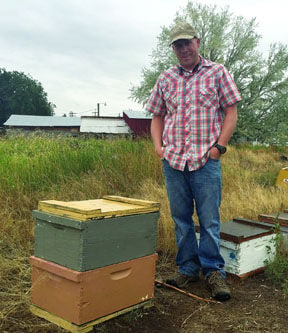
If you were to take a trip down Beehive Drive in Blackfoot, you would stumble upon one of southeast Idaho’s top honey retailers. David Dance is knee deep in the bee business these days. He purchased Gorder’s Honey, a long standing Southeast Idaho retail honey company back in February 2015.
Dance is a third generation bee enthusiast. He supplies honey to retailers in Idaho, Montana, Wyoming and Utah. If you shop at Albertson’s, Brouhlim’s or WinCo, you may find it gracing the aisles on the top shelf. Inside the Gorder’s Honey warehouse, it is evident that the rich and delicious grade ‘A’ honey is also shipped out in massive volumes to bakeries and meat companies. However, Dance does more than process honey for retailers. He is also a beekeeper who rents out his hives to farmers for pollination purposes.
In light of the recent crash on Interstate 15 (the second in a little more than six months), many folks have wondered where and why bees are being transported. Although there is no uptick in accidents involving bees, they do garner more attention because the ensuing swarms make news. A flatbed truck holds 408 hives. Each hive, depending upon its maturity, holds upward of 50,000 bees. Simple mathematics would put the number of bees that were released on I-15, and its surrounding neighborhoods, at approximately 20 million. That is why Pocatello saw a true cloud of bees in the air Sept. 10.
Although more subject to exposure, flatbed trucks have always been utilized. Dance explained that it is rare for a business to use enclosed trucks to ship their bees because of the added expense of temperature regulation and the limited number of hives that can fit inside.
At about this time of year, the northern states begin shipping their bees back to a holding yard where they can winter and be fed. This particular truck was headed back to California from North Dakota, where they had just finished up honey production. The bees are being shipped because local bee populations can’t begin to meet the pollination demands of the farms.
The majority of Gorder’s bees go to the San Joaquin Valley for almond season, which begins in February. Dance says this is “the largest coordinated pollination event in the world.” They basically need all of the bees in the United States for this effort. The Farm Press has reported that the honeybee population in the almond orchards may exceed 80 billion. It’s estimated that there are 2.5 trillion flowers in need of pollinating. Each acre needs a minimum of two hives, which equates to 1,620,000 hives.
After almond season, there’s then a need in Washington state for cherry and apple pollination. In the Dakotas, the bees are needed for summer sunflowers and alfalfa. There is also serious demand from blueberry and citrus growers. Locally, bees are used to pollinate crops such as alfalfa, canola, onion and peach. Just about everything we farm needs bees in order to produce.
Dance said, “We aren’t living in the same type of world as we did in the 1970’s. Today’s market demand for fresh produce is global.”
Many people forget that without bees, there simply will not be any fruit.
The money beekeepers make off a hive rental often exceeds their retail business. It’s the bread and butter of the operation. For instance, the California almond farmer will offer $140 to $190 per hive during a four to six week bloom season. This is a good thing for beekeepers since the production of honey per hive is down. They used to harvest 80 to 100 pounds, and now they are lucky to get 40. So why the decline?
Sadly, Gorder’s will typically lose between 30 and 50 percent of its bees each year, and it doesn’t look like things are going to change anytime in the near future.
“If this were any other industry, it would cease to exist,” Dance said.
The cost of coming up with a new queen and hive is mighty work. A new queen costs about $20, and without her there is no hive. That is why all the bees involved in the traffic accidents died. Without a queen and colony, they perish. When asked if the bees could simply start a new colony, Dance said it wasn’t likely. Each bee is connected to a specific queen solely by her scent, or pheromones. Creating a new hive is a complicated process.
It’s no secret that there’s been a decline in bee populations over the years. There are various maladies that can affect hive health. Bees need to be medicated two to three times a year to kill the dreaded Varroa mite. Additionally, the companies who are renting hives from the beekeepers are the same persons who are killing off the bees. Insecticides and herbicides are toxic. The bees unknowingly track it back to their hive and feed it to the larvae, in turn killing them all.
Dance seemed concerned about the bee decline.
He said another factor affecting the health of our bee population was the fact that “you don’t see ditch banks anymore.”
He explained that back in the day farmers would allow a 20 foot buffer between fields or crops. That’s gone now because of the need to maximize profit by utilization of space. They are using every square foot of land available. These former buffer zones used to be full of native plants and grasses (weeds), which was fodder for the bees. Now their food source is gone. Add to that the crop dusting, and you have a possible added answer to our bee issue.
When asked for advice he could give home gardeners on helping to keep our bee population healthy, Dance answered, “Try to spray and fertilize your yards early, in the morning, or at night while the bees are in their hive.”
Although not a perfect solution, it would indeed be of help.
For anyone interested in more information on the bee business, feel free to contact the American Beekeeping Federation. You can find them on the web at abfnet.org.

(0) comments
Welcome to the discussion.
Log In