

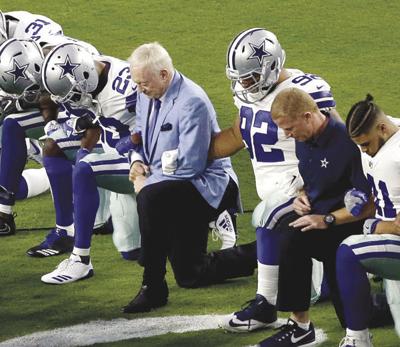
President Donald Trump on Friday called on NFL team owners to fire any players who refused to stand for the national anthem.
Trump encouraged the NFL owners to say, “Get that son of a bitch off the field right now. Out! He’s fired.”
Delivered at a rally in Huntsville, Alabama, Trump’s remarks spurred hundreds of NFL players, coaches and owners to kneel, sit or otherwise demonstrate peacefully during the national anthems performed in stadiums across the country on Sunday and Monday.
And on Tuesday, Trump doubled-down on his remarks by calling for a “rule that you can’t kneel during our National Anthem!”
The president’s statements — which include 14 tweets — and the controversy surrounding the movement started by former NFL quarterback Colin Kaepernick 13 months ago has several prominent African-American citizens with ties to Pocatello compelled to set the record straight on why these peaceful protests have nothing to do with the flag, the national anthem, patriotism or the lack thereof exhibited by participating protesters.
Many Southeast Idaho residents might remember the name Ed Sanders, who in 1952 became the first African-American Olympic Heavyweight Champion and the first American to win gold in the division since 1904. Ed Sanders was also a veteran who served in the Navy during the Korean war.
“My father stood with his hands at his side and did not cover his heart when he received his gold medal,” said Ed Sanders’ son, Russell Sanders who lives in Pocatello. “That was the most inspiring thing that has ever happened to him as a member of this nation.”
The U.S. is a nation that 226 years ago said its government will make no law abridging the right for its citizens to speak freely or to peacefully assemble.
For 74 years after the U.S. ratified the First Amendment, African Americans were sold, purchased and owned as property for slave labor.
And for almost 100 years after the U.S. ratified the Thirteenth Amendment abolishing slavery, African Americans drank from separate drinking fountains, went to separate schools and were attacked repeatedly by the men who swore an oath to protect and serve all American citizens.
“We have some issues with equality in this country and slavery had a big deal to do with it,” Russell Sanders said. “More than 150 years later, it’s like we are still being watched by slave patrols.”
Russell Sanders said that times were simple in 1952. Twelve years before segregation was outlawed, Russell Sanders said that his father lived in a time when American citizens loved their country but were not so nationalistic that they worshiped the American flag.
In high school, Russell Sanders said he was never asked or told to cover his heart during the recitation of the “The Star-Spangled Banner.”
And when Russell Sanders played basketball for Idaho State University during the ’70s, the American flag was not considered a novelty item used to sell flip-flops, bathing suits or bandanas.
“The flag means nothing in comparison to our Constitution,” Russell Sanders said. “Today, the flag is used in a capitalistic way to sell things.”
When asked what he thinks about Kaepernick’s decision to protest during the national anthem, Russell Sanders said, “I think he did the right thing. As an African American, I have four male children and one male grandchild. It’s always been a very, should I call it, big problem for me that people of color are being shot at the rate that they are being shot.”
Russell Sanders continued, “It was like someone let loose a memo that when a police officer is pulling over a black male they can do whatever they want.”
Ed Sanders wasn’t the last Olympic athlete to dissent popular traditions during the national anthem.
In the 1968 Olympics, African-American sprinters Tommie Smith and John Carlos famously raised their fists in a black power salute on the medal podium while “The Star-Spangled Banner” played, protesting American treatment of African-Americans.
And in the 1972 Munich Olympic games, two other African-American sprinters, Wayne Collett and Vince Matthews, stood around casually, and, some would say, disrespectfully during the song. Their different poses, however, did not result in a statue raised at the National Museum of African American History and Culture like the former duo. Instead, both were suspended from the U.S. team, an act Trump has called upon owners of NFL teams to do to punish protesting players.
The ritual of teams standing on the sidelines during the national anthem is not such a longstanding tradition. It began just eight years ago. Last year, NFL spokesman Brian McCarthy confirmed that the practice began in 2009, adding “players are encouraged, but not required, to stand for the anthem.”
The way Trump has positioned the protests made by NFL players calls for citizens to believe the actions of these players are a sign of disrespect to the men and women who serve in the military, and ultimately a sign of disrespect to all of America.
But in the eyes of Les Purce, Pocatello’s first and only African-American mayor elected in 1976 who now resides in Washington state, the protests are just the opposite, in that they are the epitome of the rights the forefathers afforded when founding America.
“Our country is supposed to be free,” Purce said. “Our democratic tradition is grounded on the idea that people can speak and have a voice. When people protest, it is by nature uncomfortable. But the fact that these people are expressing their own personal experience apart from their profession is well within the bounds of the rights afforded in the Constitution. And the mixed reaction is part of history as well.”
The messiest part of America’s democratic government, according to Purce, is that members of the military fight for the ability of people to protest and express their concerns about what is wrong in the country, sometimes doing so at a time — like during the national anthem — when American citizens should pay homage to those who have sacrificed their lives.
“While there is this controversy because people have a difference of opinion about the protests, in America whether you are an athlete, a professor, a veteran or in whatever profession there is no distinction between your ability to have a voice when you are a citizen first and an employee second,” Purce said. “You always have a voice.”
And while Ed Sanders didn’t sacrifice his life protecting the freedoms of American citizens, he died in the ring during a boxing match against Willie James, the New England Heavyweight Champion. Russell Sanders was 8-months-old at the time.
“If my father was alive today I think that he would have been a humanitarian about it,” Russell Sanders said when asked what his father would make of the controversy surrounding the protests today. “And you know what, I believe he would have taken a knee, too.

(0) comments
Welcome to the discussion.
Log In