


A couple of weeks ago, our Boy Scout troop went on a five-day camping trip. I was asked to come up to the main camp on Wednesday and help the scoutmaster teach rifle marksmanship and certify the boys for the Rifle Marksmanship merit badge.
As we were waiting for the second group of boys to arrive from another merit badge class, our camp medic and I were talking about how much the bullet of the .22 rimfire cartridge we were using in the marksmanship class dropped at various distances out to a couple hundred yards.
That discussion quickly turned to estimating how far away several areas we could see from camp were and how to make a decent estimate of range without a range finder.
We then started a conversation about long-range hunting and suitable rifles and cartridges for hunting at ranges out to 400 yards or more.
I don’t know about you, but I can never get much closer to deer and elk than about 300 to 400 yards when I’m hunting. I can only hear out of my right ear and have trouble telling the direction of sound. It isn’t that I didn’t receive excellent training in stalking from my father and my uncles, but I suspect I often make more noise than I am aware I’m making. At any rate, although I sometimes do see deer and elk within 100 yards, the general rule for me is about 300 to 400 yards or more.
Long-range hunting is becoming more popular by the minute. Sometimes I wonder if that is because most hunters are not as good at stalking or figuring out where game is hiding or bedded down as the previous generation, but more people seem to be interested in rifles and cartridges that can reach out and take game at several hundred yards.
Hunting in places like the Bob Marshall Wilderness in Montana, the Frank Church Wilderness in Idaho or in any of the more rugged mountain areas in the Little Lost River area generally means longer shots at game and a very small window of opportunity to make the shot.
Fortunately, the selection of guns and gear for those long-range hunters is growing by leaps and bounds and aided by shooters in long-range sniper competition and in the Target Rifle Division of F-class competition.
What has been learned through long-range competition isn’t just for the hunters who want to try 800-yard shots at game, but can be beneficial to hunters who are facing 300- or 400-yard shots that they aren’t quite comfortable trying to make.
A hunter who incorporates some of the lessons learned in long-range shooting matches can improve his abilities and confidence by improving the quality of his equipment and spending a lot of time on the shooting range.
A hunting rifle doesn’t need all the things that make competition rifles accurate at a thousand yards.
As a matter of fact, most people can’t carry heavy rifles with long scopes and long barrels more than a few minutes in the terrain in which we hunt.
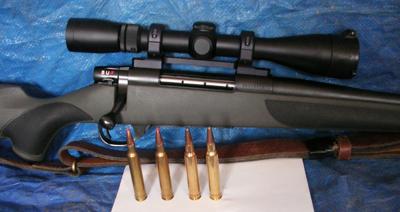
My personal preference is a rifle of a moderate weight of about 7 or 8 pounds, with an ergonomic stock, chambered for a flat shooting cartridge of sufficient power to cleanly take the animal I intend to hunt.
The barrel should be 24 to 26 inches long with a medium to medium-heavy contour. That usually means one of the 7mms or .300 Magnums. I also like a 4-12 power telescopic sight with an objective lens of 42 to 44 mm so I can keep the scope mounted low to ensure a good cheek weld.
The rifle should also be capable of shooting half-inch groups at 100 yards with a good hunting load. Most of the better rifles on the market come with a three-shot sub-minute of angle guarantee when used with specified ammunition. The bullet ought to be tough enough to withstand a short-range impact with an elk’s shoulder and yet not be so hard as to not expand at long-range where velocities are slower. Hornady’s ELD bullets, the Scirocco ll bullets and the Hornady Interlock Spire Point bullets have all worked well for me.
I personally am leery of polymer-tipped bullets because they tend to warp from the heat generated by the velocities of most Magnum calibers. However, The Hornady ELD was specifically designed to hold its shape at high velocities, and I haven’t noticed any problems with the Scirocco II, while the Hornady Interlock Spire Point doesn’t have a polymer tip.
Last, but not least, the long range-hunting rifle should have a reliable action and a crisp, light trigger pull.
If you are on a budget, you should be able to get a very acceptable long-range rifle and scope for less than $1,500. If money is no problem, make sure you get what you are paying for.
Smokey Merkley was raised in Idaho and has been hunting since he was 10 years old. He was a member of the faculty of Texas A&M University for 25 years. He can be contacted at mokeydo41245@hotmail.com.
Smokey Merkley was raised in Idaho and has been hunting since he was 10 years old. He was a member of the faculty of Texas A&M University for 25 years. There he taught orienteering, marksmanship, self-defense, fencing, scuba diving and boxing. He was among the first DPS-certified Texas Concealed Handgun Instructors. He can be contacted at mokeydo41245@hotmail.com.


(0) comments
Welcome to the discussion.
Log In