

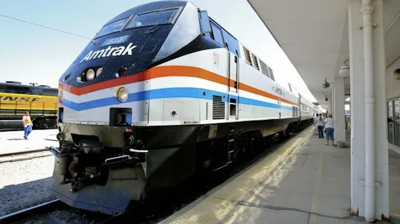

For almost 13 years now, people have been asking Pocatello Mayor Brian Blad when the city might see passenger train service again.
He’s heard his predecessor fielded the same question often. The question seems to be more than a decade old, and might even stretch back to the discontinuation of Amtrak’s Pioneer line, which served the area until 1997.
For the more than 25 years since, Pocatello and the rest of Southeast Idaho and parts of northern Utah have not had access to passenger rail.
That could change in the coming years, however. An amalgamation of Idaho and Utah communities are working with the federal government to consider bridging the 340 miles of high desert between Salt Lake City and Boise with a passenger train service.
The effort would be a collaboration between the City of Boise, Idaho Transportation Department, Utah Department of Transportation and a slew of other communities on the way including Pocatello.
Boise’s leadership has pushed hard for the return of passenger rail service to the region in recent years — it was a centerpiece of conversation at the Boise Metro Chamber’s 2023 Annual Leadership Conference earlier this year, according to BoiseDev — but appetite for passenger rail is strong in Southeast Idaho too.
“I have yet to speak to any mayors or city council people who are opposed to it,” Blad said in an interview last month.
Even if the effort is successful, Idaho is still years away from seeing full passenger trains pull into local stations. But Blad and many other Southeast Idaho community leaders are still working hard to realize that dream and all the economic opportunity that could come with it.
What is the process?
An Amtrak passenger line between Salt Lake City and Boise did exist up until 1997. Dubbed the Pioneer, the train snaked its way up from Salt Lake City, through Southeast Idaho to Boise, and on to Portland and Seattle. While that service has not existed for more than 25 years, the cities on the old route are hoping to take advantage of the Federal Rail Administration’s Corridor Identification and Development Program, said Bri Brush, the mayor of Boise’s transportation advisor. The program seeks to restore passenger rail service to parts of the country where it previously existed, but does no longer.
The first step for Boise and Salt Lake City and the communities in between was to submit an application to the Federal Rail Administration for a grant to study the possible route. They completed the application in March, Brush said. They’re hoping to hear back by September, she added. The Federal Rail Administration has a major report on passenger rail due to Congress in the fall.
If the grant were awarded, the Utah Department of Transportation would partner with Idaho on the project’s next steps, said John Gleeson, spokesman for the department.
“And then from there the first phases of the program would be exploration,” he said.
He said the grant would allow Idaho and Utah to study if the route would be feasible and if it would make sense as an option for transportation in the region.
While the Idaho Transportation Department would take the lead on the stretch of line from Salt Lake City to Boise, Gleeson said the Utah Department of Transportation is leading a similar effort to secure passenger rail service from Las Vegas to Salt Lake City.
He also cautioned, however, that this doesn’t necessarily guarantee these proposed passenger rail routes will move forward.
‘A lot of interest in our community’
Even if the logistics of restoring passenger rail service between Salt Lake City and Boise still need to be studied, Blad is convinced the line would be a windfall for Pocatello. He noted the large amount of traffic between Utah and Southeast Idaho related to business.
“Economically I believe it would help the city of Pocatello… because people can get here,” Blad said. “People can make a day trip here if they want to.”
Brush said her team has collected more than 100 stories from people who discussed how passenger rail would benefit them. Many of those stories came from outside of Boise, and several of them involved traveling to Salt Lake City for work, she said.
Blad also noted the passenger train would be a good option for area residents who don’t drive, but who still need to travel. Brush pointed out many people who live in Southeast Idaho still must travel to Salt Lake City to receive specialized medical care they can’t access in their area. The train could help with that too.
Speed on the route would largely be determined by how far apart the stops are, Brush said. Even if the passenger train itself wasn’t faster than driving, Blad still feels it would be an important option. Both Blad and Brush noted travelers can do things when traveling by train that they can’t do when driving, such as sleeping or attending work meetings online. Right now, to get from Salt Lake City to Boise, residents must either fly or drive; Brush said a third option would be valuable.
In the early stages of working with other communities on the grant application, Brush said the initial conversation most often was with each city’s chamber of commerce. Other community leaders and groups soon joined in though, she said, inspired by the idea of a revived passenger rail line.
“There is a lot of interest in our community,” Blad said.
Next Steps
Brush said the Federal Rail Administration received more than 70 similar applications for renewed passenger rail service from other areas across the country. The old Pioneer route already has a head start over some of those applications, however, because the tracks still exist along the corridor. That’s not true of every potential corridor across the country, Brush said.
There would still be plenty of work to be done, however. Even though the tracks currently exist, locomotives and passenger rail cars would need to be procured. Cities along the route that don’t have train stations would need to build them.
Still, Brush estimated progress on the old Pioneer corridor would be faster than on some of the other proposed passenger rail routes the federal administration received.
“Even five to 10 years I don’t think is too ambitious,” she said.

(3) comments
Does anybody have an old picture of the Amtrak train stopped in front of the Pocatello depot?
Back fourteen years ago in 2009, Amtrak had completed extensive feasibility study of reinstating Pioneer route and submitted it to the US Congress. Pocatello Mayor at that time was Roger Chase. The document appendix contains a letter signed by the US Senator from Idaho Mike Crapo dated September 30, 2009 who is still serving in the same position. Interesting reading indeed.
https://transitzac.files.wordpress.com/2014/01/amtrak_pioneerservicestudy.pdf
Fast forward to the present: The current US Government is unable to control ballooning National debt and is basically heading into an imminent bankruptcy. Alas! The priority now is to finance the war in Ukraine with support given to weapons manufacture's and supplier's profits. So sadly, I do not think we can afford both the Military Industrial Congressional complex and the Amtrak Pioneer train for “many people who live in Southeast Idaho [and] still must travel to Salt Lake City to receive specialized medical care they can’t access in their area”. Amen.
Back fourteen years ago in 2009, Amtrak had completed extensive feasibility study of reinstating Pioneer route and submitted it to the US Congress. Pocatello Mayor at this time was Roger Chase. The document appendix contains a letter signed by the US Senator from Idaho Mike Crapo dated September 30, 2009 who is still serving in this position. Interesting reading indeed.
https://transitzac.files.wordpress.com/2014/01/amtrak_pioneerservicestudy.pdf
Fast forward to the present:
The current US Government is unable to control ballooning National debt and is basically heading into a bankrupt. Alas! The priority now is to finance the war in Ukraine with support given to weapons manufacture's and supplier's profits. So sadly, I do not think we can afford both the Military Industrial Congressional complex and the Amtrak Pioneer train for “many people who live in Southeast Idaho [and] still must travel to Salt Lake City to receive specialized medical care they can’t access in their area”. Amen.
Welcome to the discussion.
Log In