

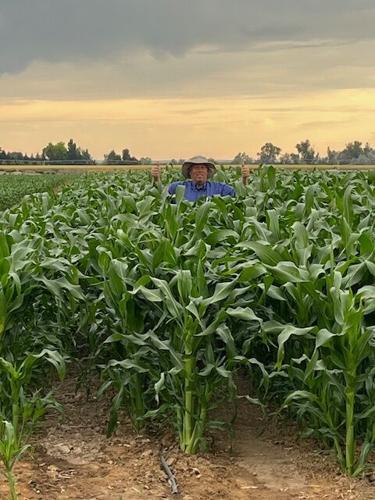

Richard Johnson, a farmer in the Blackfoot area, is the regional sales manager for Lemken, a German equipment manufacturing company.
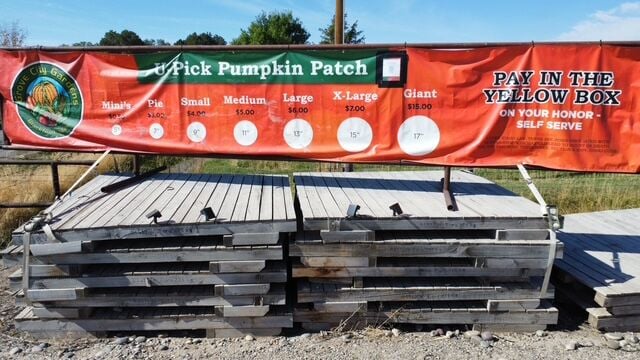
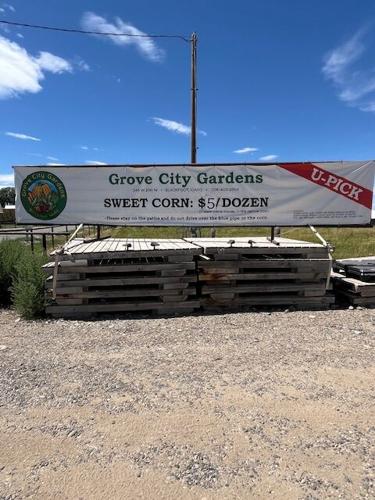
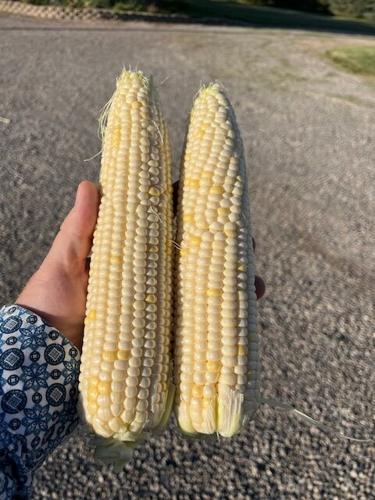
He and his family also have a U-pick farm, growing sweet corn, pumpkins and various produce crops.
“We started our farm, Grow City Gardens, in 2008 when our kids were young. We have seven children — six boys and a girl. The youngest just graduated from high school a year ago and is now in college. We decided to raise produce for farmers markets to provide experience for our children. Since they’ve all grown up now, it’s a challenge to keep doing the farm,” he said.
“We use drip irrigation, and our water use is more than 90% efficient. It’s 25 acres, but I can water everything in about three days; my electric cost is less, and fertilizer costs are less because I feed the crop through the drip tape. Instead of having a pump bill for seven days a week, it’s only three days,” Johnson said. “We have the cost of the drip tape because we put in new tape every year, then have to dispose of it, but it enables us to grow a higher quality, higher-yielding crop. We can water and fertilize the crop in the root zone, and have fewer weeds because we’re not watering the whole field. As farmers, we are good stewards of our resource; the soil is a living thing that we must take care of and manage. Water is necessary to grow anything in this high plains desert.”
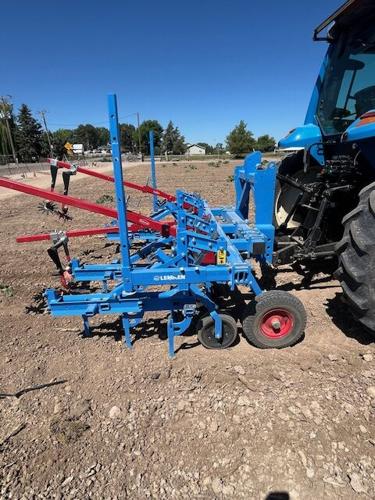
All the crops are on a bed system, growing in 2-meter-wide beds. Johnson uses Lemken equipment on the farm and sees its efficiency.
The U-pick is self-serve, on your honor.
Johnson said, “We let people come and get what they want. We also have a farm stand at our house that is self-serve on your honor. Our greatest challenge is finding a reliable and dependable labor pool of teenage kids, since the work is seasonal. Kids today have busy lives with sports and other activity. That’s all well and good; we did the same thing with sports with our kids, but found a balance to make it work, instead of being constantly engaged in sports activities.”
For many years, they sold produce through farmers markets between Rexburg, Pocatello and Jackson, Wyoming.
“Our kids learned all aspects of growing crops — planning crop rotations, ordering seed and harvesting,” Johnson said.
Selling produce also taught the kids people skills.
“In our little stand at farmers markets, we didn’t have chairs. I learned the value of this years ago when I worked for John Deere, and we went to trade shows. You don’t sit down in your booth; you stand there and engage with people. If you are standing up, you talk with people, introduce your product, give them a sample, answer their questions, etc. You’d see people sitting at their booths and people just walk by, but if you are standing up, the people walking around are more inclined to stop and talk,” said Johnson.
“The kids also learned how to make change. We’d have a scale, and someone would put potatoes on it and it might be $1.50 a pound, and they had 7.5 pounds. They’d give you a $20 bill, and you had to make change. Our second youngest son, Blake, was known as the banker at the Jackson Hole market. He was not even 10 years old and was making change. The locals knew him well and would be there shopping, and tourists would give him money and he would boom-boom-boom give them change, and they’d start counting it. A local would say, ‘Hey, Blake’s the Banker. He’s got you covered.’ It was fun to see the kids develop these life skills,” Johnson said.
“A few years later, after doing farmers markets, we bought the Wild Adventure Corn Maze from Shawn Stolworthy and ran that for a number of years. At the same time, we also bought the Mexican Crazy Corn business from a family at Driggs. We grew that business, then after we didn’t have enough kids to help with it, we sold it to the same people we sold the corn maze to. As you grow older and your family labor dwindles, it changes the dynamics of the farm,” he said.
“When we first started, we didn’t have much mechanical equipment. We’d plant and dig spuds by hand. Each year, we’d invest the money we made for improvements. We bought an old John Deere two-row spud planter, then during COVID, found a two-row old Allis-Chalmers potato harvester. Now we dig and put them right into a truck or trailer. We’ve also had a mechanical corn harvester that’s made life easier because we don’t have to pick corn by hand,” said Johnson.
“The older kids said, ‘Dad, we didn’t have it as easy as the younger ones. They have a tractor with GPS and a cab and don’t have to pick by hand.’ I told them that’s why you invest the money you make into those things. It taught our kids planning, budgeting and money management. None of the kids have any student loans to pay off from college because they supported themselves and worked their way through,” Johnson said.
Farming gave them a great background in life.
Johnson said, “We also got to work with people in the community. Years ago, a friend of mine was director of the Chamber of Commerce in Blackfoot and urged me to join. She told me it was a great way to network with other businesses and the community, so eventually I did. You can choose to be a spectator in life, or a participant. I chose to become more engaged with people in the community, and now I’m serving a second term on the board.”
He continued, “On the professional side, I’m area sales manager for Lemken and responsible for new product development — research and development — for the company. Nov. 10, with all the Lemken employees, we took 93 guests to Germany to attend the world’s largest ag trade fair, AGRITECHNICA at Hanover Fairgrounds. That ag show is held every two years. The group we took from the U.S. included people from Idaho, Montana, Utah, Texas, Iowa, Michigan, Ohio, Minnesota, Florida, Indiana and Colorado. We also toured the Lemken factory.”
Lemken has been a family-owned business since 1780 and is currently run by the seventh generation. They started by producing plows, had several patents and kept producing new innovative ag equipment.
Johnson said, “One of the customers who went with us on this trip was the first Lemken customer in the U.S. He bought some of their equipment in 2012.”
Johnson joined Lemken in 2016 and at that time his territory was Montana, Wyoming, Idaho, Utah, Colorado, Arizona and New Mexico — the entire Intermountain West from Canada to Mexico.
“A couple years ago, we split that territory, and now I just have Idaho, Montana and Wyoming, but also have responsibilities of product research and development for new machines in the U.S.,” Johnson said. “Lemken is an innovative company and owns many patents for different ways of doing things. For instance, we have high-speed disks. Rather than tandem or offset disks, they are straight in line but each disk blade has its own arm and a dual-angle design — a certain number of degrees to the direction of travel and certain number of degrees to the direction of the soil — and you are pulling these between 8 and 12 miles per hour. You end up with a flat, level finish without any lumps.”
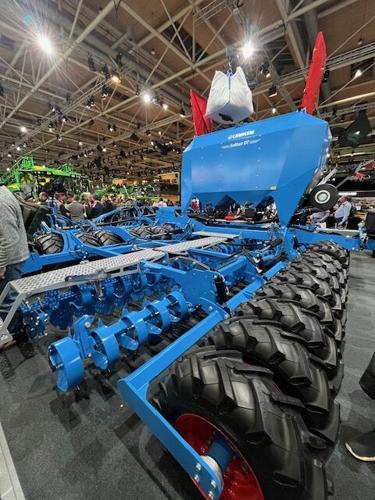
He continued, “We supply all kinds of planting and tillage equipment worldwide. We have a couple factories in Germany, a facility in India, in South Africa and the Netherlands. At the John Deere booth at AGRITECHNICA this year, they had one of our big seeders hooked up to one of their tractors, showing off the best of both. Some lucky grower will end up purchasing the actual show unit that was at the John Deere booth.”
Johnson feels the neat thing about Lemken is how it helps farmers.
He said, “My greatest joy in working with farmers is not the sale, but what that equipment does to help farmers be smarter, better, more sustainable, making fewer passes across the fields. The drills have a 5-inch spacing, so you have more rows but less seed in the row competing and can get higher yields. One of our customers in the Jerome area (Mix Miller Farms) recently set a new record. He entered three of his barley fields in the State of Idaho Barley Yield Contest. In 2023, he set the record for Idaho and the U.S. irrigated barley yield with 199 bushel. He broke that record with 200.97 bushel in 2024. This year, the first field he harvested went 227 bushel, his second field went 230 bushel and the third field went 238 bushel.”
Johnson added, “It’s an unofficial world record, because Guinness Book of World Records wants $16,000 to verify it. It’s fun to help customers set new records and new levels of farming proficiency using this equipment. Many of them tell me they couldn’t afford to farm without it. By eliminating some of the passes over the field and incorporating the residue better to create a healthier soil profile, these guys are able to do things they haven’t been able to do before. That’s my biggest joy, to see them succeed.”


(0) comments
Welcome to the discussion.
Log In