

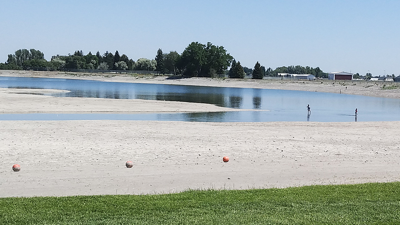
BLACKFOOT — A new agreement between the city of Blackfoot and the Snake River Valley Irrigation District will end Jensen Grove’s woes that left it a puddle this year.
The lake will return in the spring as normal, with the assurance of full recreation seasons into the future.
This landmark agreement was approved by the Blackfoot City Council on Nov. 4. It is anticipated the agreement will be approved by the Snake River Valley Irrigation District board, according to board chair Tracy Hillman, who attended the City Council meeting.
The agreement sets aside all previous agreements and disagreements to move forward for the benefit of both city residents and district farmers, who partly rely on meeting state aquifer recharge requirements through the Jensen Grove recharge basin and lake.
As water issues are, the agreement is multifaceted.
First, there is the completion of Snake River Valley Irrigation District’s annexation of the Jensen Grove lands, which authorizes the district to manage the recharge basin with its expertise and resources. As part of this arrangement, the city will sign over its two water rights on the condition that they will solely be used for Jensen Grove.
Additionally, Snake River Valley Irrigation District agrees to make available up to 2,500 acre-feet of its stored water to supplement the city water rights and keep Jensen Grove at a usable water level. If needed, it will locate other water rights to keep the lake full.
In serious water shortage years, however, the lake may again suffer low levels. In such an emergency state, it is understood that Snake River Valley Irrigation District’s priority will be meeting the district’s irrigation needs. In fact, each partner agrees that the goal of the agreement is to maximize the recharge use of Jensen Grove.
Accordingly, another facet of the agreement involves managing the recharge requirements and revenue. Since Snake River Valley Irrigation District will be managing the lake, it will be paid 25 percent of any recharge revenue for that administration. The remaining 75 percent will be held in a contingency fund solely for any Jensen Grove capital improvements, maintenance or repairs of the river side of the agreement — including levees, headgates, weirs and weed control in the ditches. The city agrees to be responsible for the surrounding land, beach areas, mowing and surface maintenance.
Each year, the balance of the recharge revenue will be carried over to the next year. However, after three years, if funds remain in the capital improvements reserve, the balance will be released to Snake River Valley Irrigation District and a new three-year revenue cycle will begin.
Yet another facet is how the agreement partners will communicate to avoid future misunderstandings. Twice a year, they agree to meet — once in the spring hosted by Snake River Valley Irrigation District and once in the fall hosted by the city — and discuss the budget, capital improvement projects or repairs, give an accounting of revenues and look at the water supply outlook. Outside of these meetings, day-to-day management issues will be discussed by Snake River Valley Irrigation District’s manager and the city’s Parks and Recreation director. Any contractual, financial or major issues will be discussed between Snake River Valley Irrigation District’s chairman of the board and the city’s mayor.
The agreement also requires mutual agreement about pursuing grants or outside funding before any applications are submitted. Likewise, no agreement partner can authorize expenses beyond the contingency fund, which the other partner must help pay for, without first obtaining written authorization. In these situations, they agree to meet and discuss how to cover the shortfall from both partners’ budgets.
Finally, any change in the diversion point for Jensen Grove water must be agreed upon by both agreement partners before any changes are made.
The last major facet — besides legal conditions concerning termination procedures, default terms, waivers, amendments and authority — is about the resolution of past grievances and fixing the physical structures that led to this year’s puddle.
First, the city has paid the disputed Snake River Valley Irrigation District invoice of $88,977 for the city’s portion of the recent upper diversion dam rebuild.
To fix the delivery system, Snake River Valley Irrigation District will alter its diversion dam by lowering the east ballast by about 2 feet at a cost of $164,999. On the city’s part, it will repair the lower diversion dam system, as previously authorized by the City Council, for $174,337.50. Both restoration projects will be done in February or March 2026 while the river is low.
These repairs and restructuring projects, plus the pledged water rights and storage water contribution, will once again bring the river flow to the city’s culvert and into the Jensen Grove lake.
With the river delivery system repaired, past misunderstandings resolved, future communication patterns established and a clear declaration of each partner’s responsibilities, the future of Jensen Grove lake and recharge basin promises to be full, abundant and sustainable.

(0) comments
Welcome to the discussion.
Log In