

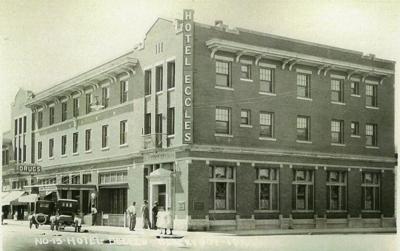

Historical photo of the Eccles Hotel.
In mid-April of 1916, the Eccles brothers, of Logan, Utah, announced that they had purchased a large block of ground on North Taylor Street to build a grand hotel that would cost around $100,000. Some local men would contribute to the construction cost, along with a Mr. Lohman, of Los Angeles. The local men quickly raised $25,000, which the Eccles brothers matched two to one. This was enough to get the project moving, and a start date was set for six weeks hence. One condition of the agreement, however, was that the block of Taylor Street to be in front of the hotel must be paved. At the time, Blackfoot had no paved streets at all.
Marriner and George Eccles, sons of millionaire David Eccles, were heirs to the Eccles fortune, estimated at $7 million, when David Eccles died in 1912. They, and all the 21 children, had been groomed from early childhood to work hard and to enter into wise business ventures. They were involved in building many fine hotels in Utah and Idaho, as well as banks, sugar factories, coal mines, lumberyards and an opera house. The brothers’ largest project was entering into a partnership with five other companies to build the Hoover Dam.
There were three homes occupying the land which the Eccles boys had purchased. The house and barn on the corner belonged to the Hopkins brothers, and was moved to a new location across town, the barn having to spend one night in the middle of Main Street. The other two homes, belonging to Mrs. Carson and Mr. Hinkle, were destroyed. A crew of 20 men arrived June 8 to clear up debris and prepare the ground for the start of construction. The first load of lumber arrived on the 9th. By the weekend, much of the basement had been dug. Marriner Eccles visited Blackfoot with Mr. Robert Anderson and Mr. F.A. Dahle to view the beginning steps on the hotel. Mr. Dahle was the construction supervisor.
The design for the Eccles Hotel called for 7 seven retail storefronts along the front sidewalk plus a lobby area and a restaurant. The second floor would be completely devoted to hotel rooms, and the third floor, which covered only half the building’s length, would be rented rooms also, making a total of 60 rooms. The lobby would be grand and elaborate, with fine wood paneling and detailing. The flooring would be white penny tiles. Past a large check-in counter, the main stairway would rise elegantly to the second floor. All the woodwork and staircase would be stained a dark, rich brown. To the right was a formal dining room, beautifully appointed. The basement contained the kitchen, utilities and storage.
The City Council pushed through the needed permit. It read “Eccles Investment Company, hotel and business rooms, of inflammable material, in the Lewis addition, corner of Pacific and Taylor streets, to cost $125,000” and “Eccles Investment company, garage, near hotel on Pacific Street.” This garage was later occupied by Bill’s Auto company.
August brought a labor dispute. Carpenters demanded a raise in wages from 50 cents/hour to 62 cents/per hour, plus an eight-hour workday and time and ½ on additional hours. Workers at the hotel were initially discharged from their jobs, with contractors citing a delay in the arrival of lumber and bricks, with work scheduled to restart in two weeks. At the end of that time, carpenters returned to work, unwilling to discuss the wage settlement.
At this time, the newspaper sponsored a contest to name the hotel. Over several weeks, ideas came in and the name “Pawnee” was chosen. Next week, the full story of this contest will be printed.
A bond for street paving had easily passed for $22,250. The bond would cover more than just the block on Taylor Street. Most of downtown would be paved. However, it was soon realized that upgrading water pipes, storm drains, and sewer lines must be done before paving could start. By the end of September, paving was completed. The City Council settled the bill with J.C. McGuire with a $2,000 holdback, payable in 90 days if no repairs were needed.
Blackfoot City Bank contracted to lease the hotel’s corner retail space, with plans to open there in March of 1917. Considerable money was spent on marble and impressive woodwork décor in the bank. The Eccles company invested in this bank, put two of their own men on the board of directors, and eventually rolled this bank, with all their other banks, into the First Security Bank system. The large safe still remains in a corner of that building.
The goal of finishing the building, before the cold weather set in, was not realized and the grand opening was postponed until spring. In March, Harry Hall came into Blackfoot as hotel manager. He had opened a hotel for the Eccles Company in American Falls and had made a success of it. Mr. Hall was already acquainted with many Blackfoot people and was well-liked.
The large glass panes for the fronts of the retail stores did not arrive until April 4, but by the 6th, all had been put into place, which added greatly to the appearance of the building. Work continued on the storefronts, but Dustin’s Pharmacy; B & K Stores, Co.; Miss Jackson’s Art & Millinery; the Blackfoot Jewelry Co.; and Beachy Shoes had already committed to move in as soon as possible.
In addition to the rooms listed above, the hotel contained a barbershop, billiard room, writing room and a ladies’ lounge. Room rates were set at a reasonable price of $1.50 per night for a room with a private bath and $1for a room without the bath.
The grand opening was set for April 21, 1917. Mr. Hall told the Blackfoot Optimist newspaper that the building would be open from “cellar to garret” upon inspection of the citizenry. The furniture and fixtures were all in place, with the exception of the dining room, which would open around the May 1. Marriner Eccles was scheduled to come from Logan to attend the Grand Opening.
The newspaper pronounced the new Pawnee Hotel “the finest hotel in this section of the Inter-Mountain West, and Blackfoot may well be proud of the new building” and “Blackfoot will boast of one of the most modern and complete hotels in the west.”
Now to the names. The street name was changed from “Taylor” to “Broadway” at some point after these events. The hotel’s official name was “The Pawnee,” but the “Eccles” name remained, prominently displayed, on the front of the building until it was replaced by the “Milmor” in 1958. In early April of 1958, the Eccles Company sold the hotel to Dr. A.E. Miller of 585 S. Shilling and Dr. Charles Morris of 390 Rich Street in what was called the biggest real estate transaction in the history of Blackfoot. The name “Milmor” was taken from the last names of the two men.

(0) comments
Welcome to the discussion.
Log In