


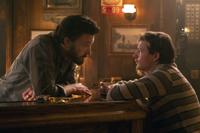




George Clooney adapts the memoir “The Tender Bar” by author J.R. Moehringer — a comfortable, middle-of-the-road coming-of-age story about a boy who lifts himself from a broken home and meager means to graduating from Yale and getting his nose wet at the New York Times. This type of story is evergreen in the world of just-above-made-for-tv dramas geared toward boomer nostalgia. But Clooney keys into a few characterizations and performances in the hopes of dusting off the well-worn structure of the storytelling.
After his father leaves the picture, young J.R. (Daniel Ranieri) and his mother (Lily Rabe) move into the household of his grandfather (Christopher Lloyd), also occupied by the worldly and streetwise uncle Charlie (Ben Affleck). Charlie spends most of his time running a family New York bar called the Dickens, where he tries to guide the precautious child toward reading and writing and away from sports and other blue-collar interests. Later, teenage J.R. (Tye Sheridan) accepts a scholarship to Yale where he meets a rich girl named Sydney (Briana Middleton) who strings him along. During this transitional period, our protagonist decides if he should become a lawyer or prove himself as a professional writer.
The movie is set on a familiar track, and it’s hard not to let scenes glide past you as you point out the obvious genre trappings: ’70s music cues, first loves, dreams dashed, destiny discovered. It’s almost as if director Clooney took on the project because he knew those tropes would do half of the work. Where he focuses his energy is on dialogue set-pieces in which J.R. — younger and older — shares heart-to-heart lessons in life and philosophies on bruised masculinity with Affleck’s potty-mouthed, chain-smoking, exasperated uncle Charlie.
Tye Sheridan takes on the assignment of portraying a somewhat passive and bland Americana archetype with brooding intensity and bottled rage that fuels the character’s professional and romantic ambitions. Sheridan’s work here is remarkable because far too many aspects of J.R.’s personality are reactive to the people in his life, at least as adapted here by screenwriter William Monahan (“The Departed,” “Body of Lies”). But through sheer force of internal characterization, Sheridan burnishes what little independence may exist below the surface of the page.
Christopher Lloyd is practically marionetted through his performance like the corpse in “Weekend at Bernie’s,” and that’s a damn shame. The effervescent Middleton barely saves her one-note, college fling, one-that-got-away arc. Max Martini as J.R’s deadbeat dad commands every scene he’s in, but, again, with little to no help from the script. Affleck was given the most room to create and shape his character, to the point that it’s almost strange how little the others are given in this lopsided ensemble.
“The Tender Bar” doesn’t reinvent the wheel, nor is it even interested in the type of genre mobility that would require wheels, but occasional scene-work between actors elevates moments of genuine relatability. Sheridan shows here that he is capable of complicated adult roles and Affleck proves that he still has the charisma that we fell for 25 years ago. It’s only a shame that the rest of the movie wasn’t allowed the same specificity to blossom into something less pedestrian.
Grade: C+
Cassidy Robinson is a former Idaho State University student with a master’s degree in film studies from Orange County’s Chapman University. He is currently working as a media journalist in Los Angeles, California.


(0) comments
Welcome to the discussion.
Log In