

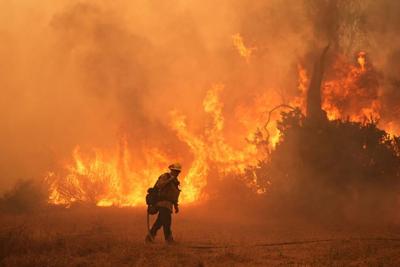
Idaho saw a dry winter with little snowpack this year, and continued dry and drought conditions are raising concerns about how bad wildfire season will be this year.
Gov. Brad Little is set to proclaim May as Wildfire Awareness Month on Friday, May 1. In a pair of memos released Thursday, USDA outlined an aggressive wildfire strategy.
“As you all know, wildfires pose an escalating threat to communities across all 50 states,” USDA Secretary Brooke L. Rollins said in a statement. “No longer confined to the West, wildfires cause massive tolls to lives, health, property, and economic prosperity to Americans across the country. This is an all-hands-on-deck, year-round situation that requires precision, efficiency and effective response to tackle.”
The core strategy for 2026 includes faster and more aggressive fire response; expanding prevention efforts; strengthening interagency coordination; improving firefighter readiness and safety; and implementing a technology such as risk mapping to anticipate and respond to fires.
USDA said the Forest Service will work with the Environmental Protection Agency to eliminate regulatory barriers on the use of fire retardant, which includes revising the exceptional events rule.
Closed fire season in Idaho runs from May 10 through Oct. 20, according to the Idaho Department of Lands. During this time, burning is regulated on state and private lands through burn permits where specific types of burning may or may not be allowed. The U.S. Bureau of Land Management also issues an annual prevention order ahead of the season, though the agency hasn’t yet published this year’s rules.
IDAHO REMAINS VERY DRYRecent rains haven’t put a dent the state’s prolonged dry and drought conditions.
The U.S. Drought Monitor’s most recent data, released Thursday, show about 25% of Idaho remains abnormally dry while the rest is experiencing drought to some degree.
Ada and Canyon counties in particular are entirely abnormally dry, USDM’s lowest rating, and have been for months. About half of Gem County is abnormally dry, while the other half is largely experiencing severe drought. A small portion in the middle of the county is a notch lower at moderate drought.
Extreme drought, which is the highest rating, is being experienced in Owyhee and Twin Falls counties.
There are now six counties experiencing extreme drought: Blaine, Cassia, Oneida, Owyhee, Power and Twin Falls.

(0) comments
Welcome to the discussion.
Log In