

Thirty feet from the end of the world.
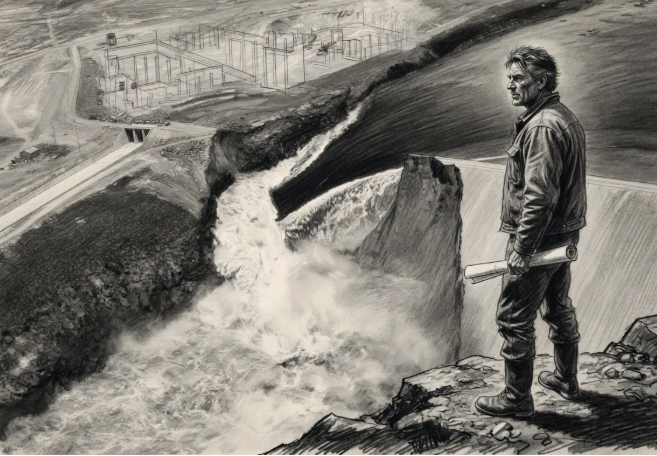
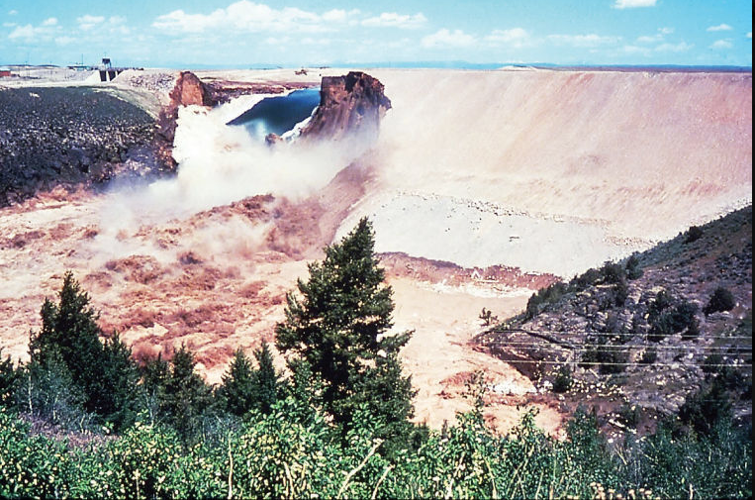
That’s how Richard Robison described Teton Dam General Excavation Foreman Jay Calderwood’s experience as he witnessed the Teton Dam burst on June 5, 1976.
“Jay Calderwood was one of the last men on the Teton Dam before the earth opened beneath him,” Robison writes. “He had helped build it from the very first day. He would watch it die in seconds.”
Robison details the story in his ongoing Facebook series “The Teton Substack.”
In the series, Robison writes how Calderwood got a phone call just after 10 a.m. that Saturday and immediately sensed something was wrong.
“Nobody on the Teton Dam project worked Saturdays unless something special came up,” Robison said. “In the four years of pouring sweat into that canyon — four years of hauling fill and pushing rock and watching an earthen wall rise 300 feet above the Teton River — not much had come up that couldn’t wait until Monday.”
Calderwood raced from his Victor home to the site and found Excavation Superintendent John Bellegante there.
“He stood on the crest watching two D-9 Caterpillar tractors work the upstream face,” Robison said.
D-9s are 115 feet wide and five feet tall at the blade, containing 75,000 pounds of steel and diesel, he said.
“(They’re) the kind of machine that makes the ground tremble when it moves, that can shove a house-sized boulder like a child pushing a block across the floor,” he wrote.
Just 30 feet from where Bellegante was standing, “the reservoir had begun to devour itself,” Robison said.
“A whirlpool had formed — 30 feet across, funnel-shaped, spinning with a violence that could not be heard over the roar of the dozers but could be seen in the way the water twisted and dropped into a vortex six feet deep,” he said.
Water made its way through the dam, breaking through “fine-grained material” believed to be penetration proof. Instead, the water quickly gushed down the dam.
“The technical term is ‘piping,’” Robison wrote. “The human term is ‘the beginning of the end.’”
Calderwood and fellow D-9 operator Owen Daley dropped “riprap” — or three-foot-wide rocks — into the whirlpool.
“Now it was being shoved, load by grinding load, into the spinning throat of the vortex in a desperate attempt to choke whatever passage had opened below,” Robison wrote.
The two men spent 20 minutes on the D-9s, he said.
“(They watched) boulders the size of refrigerators disappear into the whirlpool as if they were pebbles tossed into a storm drain,” Robison wrote. “Twenty minutes of knowing, with each pass of the dozer blade, that the ground beneath you might be the next thing to vanish.”
Just moments earlier, two fellow workers leaped from their bulldozers just seconds before the dam swallowed their equipment whole, he said.
At that point, Bellegante felt the dam collapsing, Robison said.
“(It was) a sickening drop, as if the dam had exhaled,” he wrote. “The kind of movement that cannot be explained by anything other than catastrophic internal failure.”
Bellegante waved his arm, urging Calderwood and Daley to get off the dam and to put their D-9s in reverse, he said.
“First gear, because the slope was steep — 30 feet of grade between them and the crest — and a D-9 in reverse on a slope is not a fast thing,” Robison said.
The D-9s lurched, coming to a slow crawl. Shortly afterward, the ground in front of the men collapsed.
“The crest of the dam simply ceased to exist,” Robison said. “They’re watching dam collapse as they’re backing their D-9s all the way down to the south end of the dam.”
The collapse created a massive gap that quickly grew. Just 30 feet from the gap, Calderwood witnessed it grow to 100 feet wide, he said.
“The dam (was) peeling apart like a wound opening in slow motion except it wasn’t slow at all,” Robison said. “It was impossibly fast.”
The diesel engines made enough noise to block out any other sounds, he wrote.
“It was only when they finally shut the machines down and climbed off and stood on what remained of the dam, that the noise arrived,” Robison said. “The roar was the river.”
The reservoir quickly emptied itself through the dam’s gap and quickly grew to 80 feet deep in the canyon, he said.
“Cottonwood trees that had lined the Teton River for a century — trees with trunks three feet thick — were mowed down by the flood like hay before a scythe,” Robison said.
The floodwater quickly overwhelmed the powerhouse, he said.
“The air tasted like dust and river silt,” Robison wrote. “The ground beneath their feet trembled with the force of the discharge.”
The floodwaters crashed through the canyon carrying debris with it. They careened into Wilford, Sugar City and Rexburg. The floodwaters killed 11 people while causing billions of dollars in damage to homes, farms and livestock.
A year later, Calderwood was interviewed and asked what caused the disaster.
“I’ve wondered about that many times,” he said. “I don’t know. I worked with it day after day, sweat and blood and tears and sleepless nights. You know you’ve done a good job, and you try and think back, ‘What may have caused it?’ I can’t answer that. I really don’t know. As far as I know, everything was done the best it could be done. That is something that I don’t believe they will ever know.”
Robison reported that officials later stated “piping through inadequately sealed volcanic rock in the dam’s foundation” caused the tragedy.
The water found pathways through light rock and volcanic rock of the canyon walls and later through sediment of what was previously thought to be impossible to penetrate, proved “tragically permeable under the pressures of a full reservoir,” he said.
Robison wrote that the dam’s failure wasn’t man-made but instead was caused by “geology deceived design. It was a critical design flaw.”
“The hands that placed the fill and compacted the earth and tested every load — those hands did honest work,” he said. “Jay Calderwood knew this. A report cannot reconcile a man with the knowledge that he did his job right.”
Calderwood said construction was done properly.
“I can vouch that the material (had) been put in there correctly,” he said.
For more information on Robison’s Teton Letters, visit tetonletters.substack.com.

(0) comments
Welcome to the discussion.
Log In