

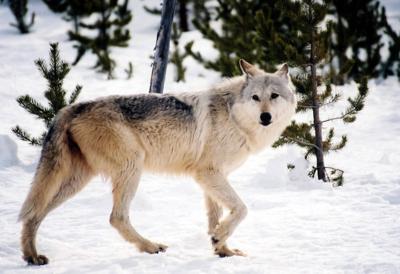
In a vote on Thursday afternoon, the U.S. House of Representatives passed a bill that will delist the gray wolf from the endangered species list throughout the country.
H.R. 845, brought by Colorado Rep. Lauren Boebert and cosponsored by Montana Rep. Troy Downing, titled the “Pet and Livestock Protection Act,” directs the Secretary of the Interior to reissue a rule delisting the species.
“Montanans should be able to secure their herds, crops, and personal safety without fear of undue legal repercussions,” Downing said in a statement on Thursday. “As written, the ESA makes the gray wolf out to be a liability to avoid, not a resource to be protected. It is critical that we trust the science and look towards a more precise conservation approach when dealing with unique populations. I was proud to support this measure today and look forward to seeing it signed into law.”
Montana Rep. Ryan Zinke, a former Interior Secretary during President Donald Trump’s first term, voted in favor of delisting the species. In a statement posted on X, Zinke wrote that “The ESA was created to protect endangered animals, not to be weaponized for a radical agenda by activist judges. The last four administrations have all agreed that the gray wolf has recovered. Let’s follow the science and Montana’s lead and delist.”
Conservation groups immediately decried the move, saying removing federal protections amounted to creating an open season on the species.
“Rep. Boebert’s bill is a deadly invitation to trophy hunt wolves to extinction,” Stephanie Kurose, deputy director of government affairs at the Center for Biological Diversity, said in a statement. “Stripping these amazing animals of protection while they’re still fighting to survive isn’t conservation, it’s cruelty. Wolves belong in the wild, not mounted on someone’s wall.”
Other groups, including the Humane World Action Fund, said that the decision to delist an endangered species should not be made by Congress.
“The Endangered Species Act has worked for decades because decisions are made by scientists, not politicians,” Sara Amundson, president of Humane World Action Fund, said in a statement. “Congress shouldn’t override expert agencies and the courts just to fast-track wolf hunts, and it certainly shouldn’t ignore how deeply Americans care about wolves. The Senate should stop this meritless bill dead in its tracks and keep in place the vital protections that are making wolf recovery possible.”
When gray wolves were initially delisted in Montana and the other western states in 2011, it was done through a similar provision.
Montana’s then-Sen. Jon Tester, a Democrat, placed a rider on a federal budget bill to remove ESA protections from wolves in the Rocky mountains. It also contained a provision that the courts could not intervene.
Wolf whiplash
Gray wolves were almost entirely eliminated from the lower-48 states by the 1970s, leading to their listing under the Endangered Species Act.
In 2009, the species was delisted, an action that led to immediate litigation and paused the change in status. In 2011 Congressional action officially turned management of the species in Montana, Idaho, Wyoming and the eastern thirds of Oregon and Washington over to the respective states.
Currently, gray wolves are listed as a threatened species in Minnesota and endangered in the remaining 44 states.
According to a 2022 report by the U.S. Fish and Wildlife Service, which formed the basis for its later determination, there were approximately 2,797 wolves in the western U.S. — including roughly 1,000 wolves in both Montana and Idaho, fewer than 400 in Wyoming, and around 200 in Oregon and Washington. The federal agency estimated an additional 20 wolves are in California and Utah and two in Colorado.
In 2023, Colorado began relocating wolves to the state, with four established packs reported as of this summer.
Under the Trump administration in 2020, the Fish and Wildlife Service had decided to delist gray wolves in the states outside of the northern Rockies where they had been protected by the Endangered Species Act. But a federal judge in California reversed that decision in February 2022, which led the service to publish a rule in November to comply with the order.
Conservation groups filed a lawsuit last summer against the U.S. Fish and Wildlife Service in an attempt to force the agency to reapply ESA protections to the species across the western portion of the country.
A federal judge in Missoula ruled in favor of the groups in August and found the federal government had erred in a determination that further protections were unwarranted.
Judge Donald Molloy said the federal government “made numerous unfounded assumptions regarding the future condition of the gray wolf despite recognizing either limitation on those conditions or bias in the population estimates utilized,” Molloy wrote. “Because these deficiencies are serious and pervasive, they weigh in favor of vacating the portion of the 2024 Finding that determined that the gray wolf in the Western United States does not meet the definition of an endangered or threatened species.”
Montana officials called the ruling a move by an “activist” judge favoring environmental extremists.
Subsequently, the federal government decided not to prepare a national gray wolf recovery plan, which led to more legal action by conservation organizations, led by the Center for Biological Diversity.
In the state, Montana’s own wolf hunting regulations are tied up in dueling lawsuits.
This year, Montana Fish, Wildlife and Parks and the Fish and Wildlife Commission — the agency’s rule-making body — increased the quota of wolves to be killed during the 2025-26 hunting season.
A group of conservation organizations sued, saying the quota is too high and risks decimating the wolf population, while a group of outfitters and legislators also sued, saying the quota was too low and would not reduce the wolf population enough.
A hearing on the case was held in November, and a ruling is still pending.
According to a state Fish, Wildlife and Park’s dashboard, hunters and trappers have killed 82 wolves so far this season out of a statewide quota of 452. One hunting area, just outside of Yellowstone National Park, has closed after hunters and trappers reached its three-wolf quota.
The hunting and trapping season lasts until March 15.
The House bill will now advance to the U.S. Senate, where it will need 60 votes to pass.

(0) comments
Welcome to the discussion.
Log In