

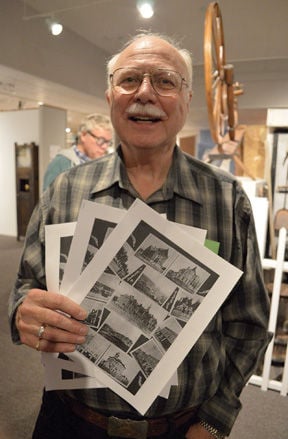
POCATELLO — The school board had lost its mind.
That was the consensus of Pocatello residents when, in 1892, the board announced plans to build West Side School to house all grades.
“People around town, and, even the newspaper, called it ‘folly. There will never be enough children to fill the building’,” recalled former Pocatello High School teacher and high school historian Arlen Walker.
Walker told the story of West Side School — later called Pocatello High School — during a recent Bannock County Museum presentation.
Despite disapproval, the school board persisted in building the school that eventually cost $60,000, substantially more than its original $20,000 cost.
“A bunch of school board members and businessmen got together and paid off the bill so they could start school,” Walker said.
Soon, naysayers had egg on their collective faces as the school quickly filled with students. So great was the growth that the school district moved grade school students into hastily built elementary schools. The growth also caused the school district to add the high school’s south wing.
The school soon become the city’s treasure and a tourist attraction.
“When you go to Paris, you go see the Eiffel Tower. If you go to Washington, D.C., you go see the Washington Monument. If you go to Pocatello, you go visit West Side School,” he said.
Presidents John F. Kennedy, Theodore Roosevelt and William Howard Taft also visited the school.
Then Gov. Brady picked Taft up at the train depot and took him to the high school.
“The newspaper said there were thousands there. Taft spoke for 30 minutes,” Walker said.
Throughout the 1910s, officials expanded the high school. Yet, in the midst of all that expansion, flames erupted at the school on Dec. 16, 1914.
One student reported watching the blazing high school.
“(She) talks about being overcome by the smoke and standing there hearing the mournful sound of the bells that crashed and fell to the basement,” Walker said.
Thanks to the quick thinking of residents, they saved most of the school, its records and furniture.
During the remaining school year, officials farmed students out to various locations like the Academy of Idaho (now Idaho State University) and various churches.
Thanks to a $60,000 insurance settlement and an additional $70,000 in bond money, the school district not only rebuilt the damaged section but added several more classrooms.
Fast forward to the 1940s, and the country entered World War II. Students ran their own bank to help finance the fight.
“After the war, they were commended by President Harry S. Truman for their outstanding efforts,” Walker said.
In, 1960, post war baby boomers made for the high school’s largest student body population. That year, the school’s band marched in the Rose Bowl Parade.
“When it came into view, the announcer said ‘Wow, what a band,’” Walker said.
Thirteen years later, controversy hit the school when Native Americans asked that the Indian Chief mascot be changed.
“There wasn’t local support for that,” he said.
Instead school officials agreed not to use the Chief in any comical representations.
One memorable event also occurred in the 1970s when cheerleaders kidnapped the Highland High School’s boys’ basketball team.
The girls made arrangements with the boy’s mothers and asked that the boys be blindfolded prior to taking them to breakfast at a local church. When the boys missed their early morning practice, furious coaches wondered what happened to their team. The Idaho State Journal reported the incident as did famed broadcaster Paul Harvey.
In December 2014, the Idaho State Journal also reported a camera picking up a ghostly image in a school hallway. The story went viral.
Very aware of ghostly reports at the school, Walker recalled one icy cold locker associated with some former students who had threatened suicide.
Students also reported a lingering fragrance in hallways.
“Sometimes people said they could smell perfume while going down to the girl’s bathroom in the west wing, but I never smelled it,” he said.
When Walker worked on yearbooks with students late at night, they often heard strange noises.
“There’s always been ghost stories and always a lot of noise at night. An old building like that is going to creak,” he said. “Nobody died on the campus.”
Walker worked at the high school as an English, journalism and photography teacher starting in 1971. He left in 1998 for employment with Kimberly Clark and later at the ISU College of Technology.
He became interested in Pocatello High School’s history after learning of fellow teacher Keith Forest, who kept a record of the school. The two eventually joined forces on Forest’s project.
“A history of the school hobby sort of grew,” he said. “We kept it up.”
Museum officials plan to hold more such seminars during the fall months, and encouraged residents to offer topic suggestions. For more information, call 233-0434.

(0) comments
Welcome to the discussion.
Log In