

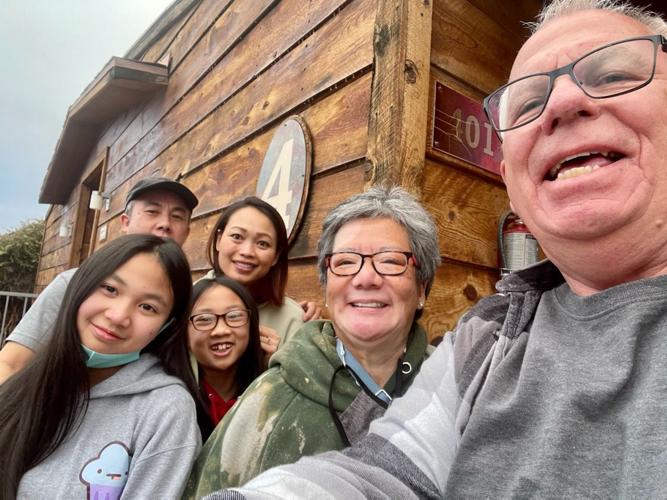



As part of the process of preparing for a spring break vacation trip to Moab, Utah, this week, 67-year-old Pocatello resident Suzanne Johnson and six other local Asian Americans found themselves questioning whether or not they could make the trip safely.
Their concerns weren’t related to any incoming inclement weather or overdue vehicle upkeep, but rather were rooted in the possibility the group could potentially become the next target of violence or harassment against Asian Americans in the U.S.
Their concerns aren’t unfounded.
“Why do we even have to have these conversations?” asked Johnson, who was born and raised in Pocatello after her parents emigrated from Toisan, China, about five decades ago. “We shouldn’t have to worry about being safe anywhere in the United States of America.”
Over the past year amid the coronavirus pandemic, the number of anti-Asian incidents in which Asian Americans have been shunned, harassed, scapegoated, blamed, attacked and even killed has skyrocketed. Stop AAPI Hate, a coalition that tracks incidents of violence and harassment against Asian Americans and Pacific Islanders in the U.S., reported nearly 3,800 instances of discrimination against Asians in the past year. And while the overall hate crime rate in the U.S. fell by 7 percent in 2020, anti-Asian crimes surged by nearly 150 percent, according to the Center for the Study of Hate and Extremism. Many experts suggest the actual number could be much higher.
While Johnson hasn’t experienced any anti-Asian sentiment amid the pandemic, she’s no stranger to discrimination.
“I was born and raised in Pocatello and it’s been an exceptional experience,” she said. “I remember kids calling me Hong Kong Suzanne or saying (racial slurs) when I was young, but it didn’t bother me because I was born in America and didn’t have any other experiences to relate to. My dad once saw somebody say something anti-Asian in one of my yearbooks, though, and while it didn’t bother me, he said it was not acceptable because of the fact he and my mother weren’t allowed to eat at a particular restaurant in Pocatello back in the ‘50s and ‘60s.”

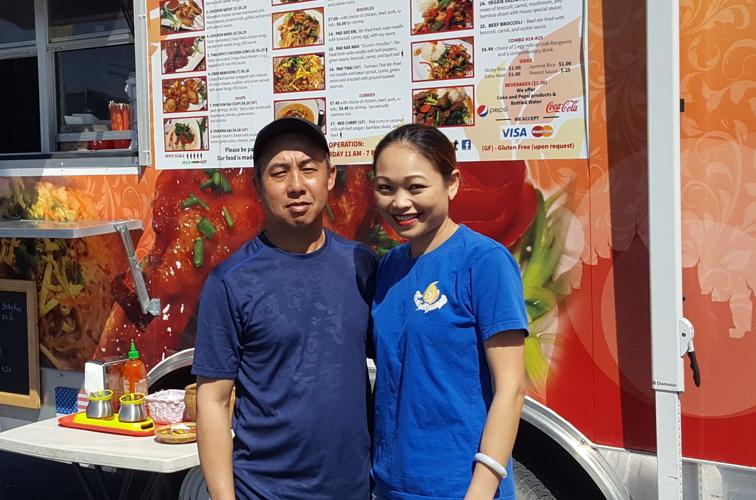
In this 2018 photo, Vahn Phranasith and his wife Mam stand in front of their Thai Zap food truck in Pocatello.
Of the nine people in Johnson’s spring break travel party, seven are Asian. Vahn Phranasith and his wife, Mam, the owners of Pocatello’s Thai Zap restaurant and food truck, and their three children as well as a cousin accompanied Johnson and her husband on this week’s trip to Moab.
Johnson said she was relieved her husband, Rod, could accompany them on the trip, particularly because he’s white and would inherently make the group feel safer.
A major spotlight was turned on the rise in anti-Asian incidents on March 16 when eight people, including six Asian women, were killed in a series of mass shootings at three Georgia massage businesses. One eyewitness told Chosun Ilbo, a top South Korean newspaper, that the suspected shooter, 21-year-old Robert Aaron Long, who’s white, shouted “I’m going to kill all Asians” during one of the shootings, KXAN, a Texas NBC affiliate, reported on March 17.
In the wake of the Georgia mass shootings, President Joe Biden and Vice President Kamala Harris forcefully condemned anti-Asian violence, providing Americans with a stark shift from the racist rhetoric of previous President Donald Trump, who on numerous occasions characterized the coronavirus with phrases such as the “Kung Flu” or “China Virus.”
“Our silence is complicity. We cannot be complicit. We have to speak out. We have to act,” Biden said, speaking last week from Emory University in Atlanta.
The message Biden and other U.S. leaders have shared in recent weeks is ever-important, said Maria Wong, a professor of experimental psychology and the Psychology Department chair at Idaho State University. Wong, who said she has previously experienced racial microaggressions and more subtle forms of racism she perceived as unfair treatment, says America needs even more people, particularly politicians and other influential figures, to publicly denounce racism and discrimination.
“I think what the current president is doing at the national level is very important,” Wong said. “He has denounced the violence and is speaking up for minority groups and I think that’s something other leaders could do. We really need to have leaders who are ready to work with different stakeholders and leaders of sub-groups in order to get everybody working together. This idea of pitting one group against each other or calling the coronavirus the ‘Kung Flu’ or the ‘China Virus’ only reinforces negative stereotypes and hate at a subconscious level.”
Wong continued, “You have to recognize that a particular portion of the U.S. seems to be doing that. There are talk show hosts, politicians and journalists who are perpetuating the hate message and that narrative needs to change. Nationally, it has to start with not just the political leaders, but also within the education sector and even in different civic or religious groups.”
Notwithstanding the fatal shootings in Georgia, examples of anti-Asian incidents have been documented all over the country throughout the past year, from San Francisco to New York to Maine. Xiao Zhen Xie, the 75-year-old Chinese American woman who fought off an attacker in San Francisco, has decided to donate all of her GoFundMe money, almost $1 million, back to the Asian American community to combat racism.
Of the nearly 3,800 instances of discrimination against Asian Americans in the past year, women were the victims in a much higher share of the incidents, at 68 percent. The data, which includes incidents that occurred between March 19, 2020, and Feb. 28 of this year, shows that approximately 500 incidents took place nationwide in 2021 alone.
Verbal harassment and shunning were the most common types of discrimination, accounting for just over 68 percent and 20 percent of the reports, respectively. The third most common type of anti-Asian sentiment, physical assault, made up 11 percent of the total incidents. More than a third of the incidents occurred at businesses, the primary site of discrimination, while a quarter took place on public streets.
The Society for Personality and Social Psychology issued a statement against anti-Asian racism on March 19, describing the prejudice, discrimination and violence in the U.S. as deeply disturbing.
”This rising violence against (Asian American) communities is part of a persistent, ugly, and recurring pattern in our domestic and international history,” the society’s statement said. “Understanding the violence in context also requires an intersectional lens, because violence against (Asian American) communities has been predominantly perpetrated against Asian women; the massage workers in Atlanta were working class, making them particularly vulnerable to this act of racist terrorism.”

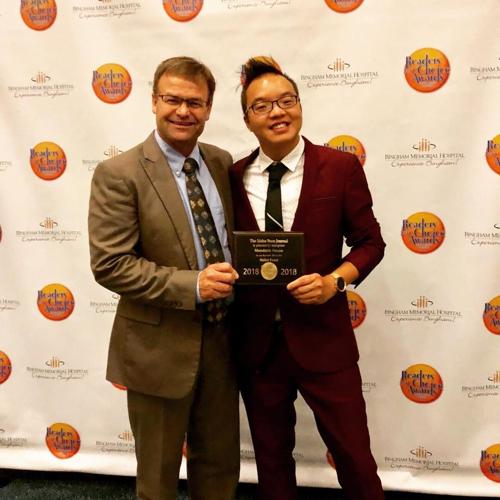
Kevin Cao, right, stands next to Pocatello Mayor Brian Blad at the 2018 Idaho State Journal Readers Choice Awards event.
As part of this article, the Idaho State Journal interviewed several other Asian Americans living in Southeast Idaho, including Kevin Cao, a manager at Pocatello’s Mandarin House restaurant who is Chinese; Thipsavanh Sibounma, who’s Laotian and Chinese and is a member of a volunteer group of ordinary citizens who have formed long-term relationships with the people of Iwamizawa, Japan, and other foreign cities through the Pocatello Sister Cities Committee; and Mam and Vahn Phranasith, who are Thai and Laotian, respectively.
Vahn Phranasith said he had bad experiences in high school when he came to the U.S. as a refugee from Laos. He didn’t speak much English then and said he hated going to school. Mam said she has always felt loved and supported in Pocatello.
“We always wonder if kids who come from other countries who don’t speak English will feel as accepted as we do,” Mam said.
Both Cao and Sibounma said they have not directly experienced any racist or discriminatory treatment in Southeast Idaho, but they admitted that doesn’t mean it doesn’t happen.
Sibounma, who immigrated to the U.S. from Laos, said she can relate to Vhan Phranasith’s childhood experiences, but she feels children asking about the shape of her eyes or commenting on the smell of her food was more out of curiosity than it was intended to be discriminatory.

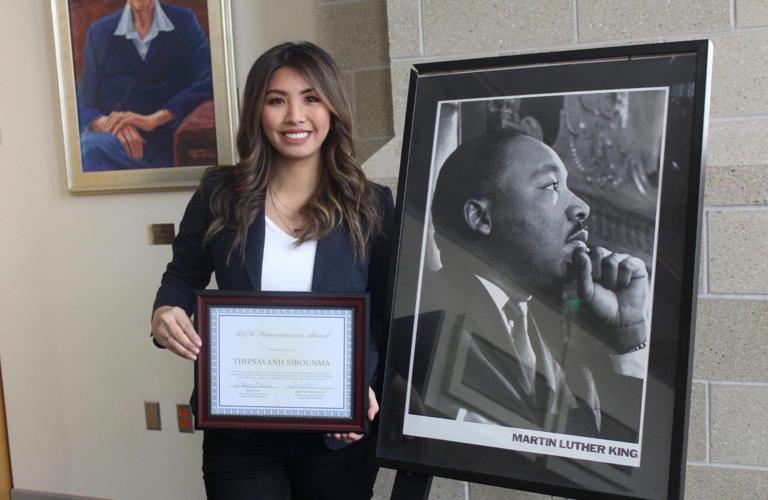
Thipsavanh Sibounma receives the 2020 Martin Luther King Jr. Humanitarian of the Year Award from Idaho State University during its 2020 Martin Luther King Jr. program.
Just two decades ago, one of Pocatello’s most well-known mountain peaks included a racial Chinese slur in its name and some websites detailing local hiking and trail routes still use the derogatory term today.
According to Johnson, the anti-Asian incidents that have occurred over the past year in the U.S. are not a new phenomenon but have escalated in number and severity after the coronavirus became a global pandemic following the initial outbreak in Wuhan, China. And while this vitriolic behavior won’t change overnight, Johnson believes every American has the ability to effectuate change and contribute to forward progress, but such progress requires a calculated, dedicated and conscientious effort.
“Each of us have to look personally into our own belief system to see if there are issues with racism of any kind,” Johnson said. “And if there is, there needs to be a desire to change our thinking. This starts within our families because my kids are typically going to act like I believe. What I believe is everybody is important, they have a right to be alive and the right to be whoever they are regardless of their beliefs, what they eat, what clothes they wear or the color of their skin.”
She continued, “We all have a right to be here on this Earth, and in America especially.”


(0) comments
Welcome to the discussion.
Log In