

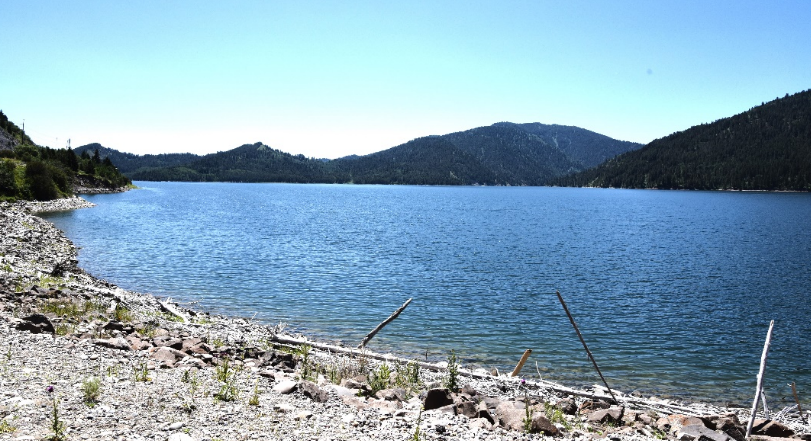

With drought conditions increasingly threatening the West, being able to increase water resources by an average of 10% is a significant achievement. In Idaho, a collaboration of many interested parties are bringing in this water harvest through cloud seeding operations across 20 counties. By encouraging greater snowfalls at higher elevations, the augmented snowpacks have helped to fill the reservoirs, replenish the aquifer, and fulfill the irrigation and power-generating needs of Idaho.
Originally, cloud seeding began 35 years ago as the Upper Snake River Valley Cloud Seeding Project and served five counties. The Upper Snake program was coordinated by High Country RC&D in partnership with Idaho Power, and they still have the most extensive network of ground generators and produce the most snow from cloud seeding.
With the growth of cloud seeding across the state, the Upper Snake River cloud seeding program combined with other programs and became a statewide Collaborative Cloud Seeding Project. This collaboration is led by the Idaho State Water Resources Board, Idaho Power and many water uses such as municipalities, irrigation districts and canal companies in the Boise, Wood and Upper Snake River basins. High Country RC&D remains as an important contributing partner in the Upper Snake region.
Each entity has its own reasons for increasing the water harvest. IDWR, which contributes 56% of the budget, is focused on making sure the interests of all water users are considered, including the needs of agriculture, industries, municipalities, domestic wells, the aquifer, fisheries and the recreation industry. Idaho Power is primarily concerned with making sure it has enough water with its secondary water rights to keep generating power. It contributes 33% of the budget and provides scientists, meteorologists and a fleet of specially outfitted storm planes. The many agricultural water users, who collectively provide 11% of the budget, are relying on this extra water to help them meet the demands of the new water agreement of 2025. They are not interested in having their irrigation pumps red-tagged.
How much of a water harvest does cloud seeding produce? The data from recent years, as the program has become more refined, indicates an average of 1,100,000-acre feet of water can be produced each year statewide, according to the Idaho Water Users Association. That equates to filling a football field with water 1,100,000 feet deep, which stretches upward 208 miles. The Earth’s atmosphere only goes up 62 miles.
The Collaborative’s cost to fund the cloud seeding statewide is $3.8 million, largely for aircraft operation forecasting and equipment. Plus having more available water makes the program worth continuing. In the industry, they only talk of how much water is valued by what you pay per acre-foot, which is currently $4. This calculates out to the additional water harvested being valued at $4.4 million. Though this means there is only a modest profit made, the real gain is in having the reservoirs full and the rivers and canals flowing sufficiently for crops, people and power generation.
There are several crucial conditions needed for cloud seeding to work. The temperature must be cold, but not too cold. Also, the clouds need to be moisture-rich clouds — surprisingly, not all clouds are. When these conditions coexist, snow is likely to fall, but only as much as there are also particles in the clouds that the cold liquid moisture binds to, gets heavy and falls to the ground. If there aren’t enough particles to form snow, the moisture remains in the cloud and moves on with the storm.
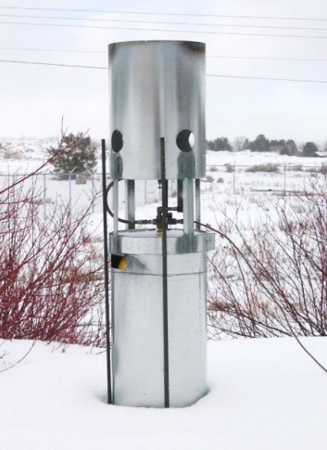
When the conditions are right, in order to convert the unused moisture in the clouds to snowpack storage on earth, ground generators project silver iodide particles into the clouds. Additionally, Idaho Power’s storm planes fly through the clouds and release silver iodide particles directly into the clouds.
Notice all this happens within clouds. The white contrails seen across clear skies are the exhaust from passing jets and are not connected to cloud seeding.
It takes about 5-15 miles for the bind and drop process to reach the ground. These generators are strategically placed, and the planes’ paths are charted so the extra snow will fall where it can pile deep until spring. It is also important to position the snow storage banks so they melt into reservoirs, lakes, and rivers that will later supply water to the farmers and cities.
Does harvesting snow in Idaho mean there will be less for other states? No, clouds are a fluid open system that replenish themselves naturally. When moisture is released, more moves in to replace it until other factors disperse the clouds. Snow or rain-producing storms can keep on producing moisture as they advance, according to Jonathan Jennings of the Utah Division of Water Resources.
Does the falling silver iodide create toxic silver concentrations immediately or over time? On the surface, it sounds logical if you aren’t a chemist. The answer is in the chemical properties of different forms of silver.
Jennings explains that not all silver forms are the same. The free elemental silver form can be toxic, especially in water. However, the silver iodide form is a compound of free silver and iodine that has an extremely strong bond due to their differences in electron charges. In fact, this bond has been rated as three times stronger than the basic scientific definition of a strong bond. The result? The toxic free silver is made harmless by a bond that does not break in normal or even in naturally occurring taxing conditions.
Further, for research scientists have made the bonds break in lab conditions and discovered that the most silver a solution can absorb is 0.984 micrograms per liter — less than 1 microgram. Safe drinking water standards allow for 100 micrograms per liter. Impacts on aquatic life begin at 4-6 micrograms per liter, and plants are affected somewhere between 10-10,000 micrograms per liter. A level of less than one microgram per liter is not going to harm humans, plants or aquatic wildlife.
After 35 years of cloud seeding in Southeast Idaho, there are no indicators of a toxic buildup, which probably hasn’t happened because of the powerful binding power of iodine. However, should any free silver break out, it would readily form a new compound with other negative ions, which would again bind it and render it nontoxic.
To summarize, the cloud seeding silver is bound in an unbreakable iodide molecule that couldn’t harm humans, fish or crops even if it could be released. In fact, some areas in southern Utah, Nevada and California have naturally occurring free silver levels of about 4-6 micrograms per liter with no ill effects. In September 2025, Yale Scientific concluded that the moisture produced through cloud seeding is safe.
With the uncertainty of winter weather and the growing need for reliable water for agriculture, new industries and Idaho’s growing population, cloud seeding brings a welcome assist rather than a toxic danger — if it is understood and seen clearly through scientific lenses.


(0) comments
Welcome to the discussion.
Log In