


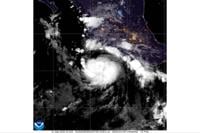
The National Hurricane Center says Tropical Storm Polo will rapidly intensify in the Pacific Ocean and become a major hurricane later this week. Polo formed late Sunday. By Monday morning, it was centered about 255 miles south-southeast of Manzanillo, Mexico. Forecasters predict it will be a major hurricane by Wednesday and could bring up to a foot of rain to parts of coastal Mexico. Tropical Storm Odalys is farther west in the Pacific and is not a threat to land. However, forecasters say Odalys will become a hurricane by midweek. Tropical Storm Fay is in the Atlantic Ocean and is weakening.

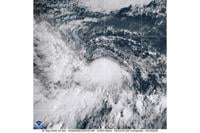
Tropical Storm Fay has formed in the northern Atlantic Ocean and continues to strengthen far from land. The National Hurricane Center in Miami says Fay had top sustained winds of about 65 mph late Sunday and was swirling about 400 miles southwest of the Azores. There are no coastal watches or warnings in effect, and Fay is expected to dissipate later in the week. Meanwhile, Tropical Storm Odalys has formed southwest of Mexico's western coast and is forecast to strengthen into a hurricane in the next day or so. Odalys was located Sunday about 1,345 miles west-southwest of the southern tip of Baja California.

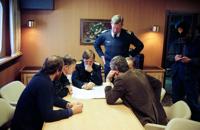
Russian icebreaker skipper Sergei Fedorovich Reshetov, rests his hand on his chin as he studies charts of a section of Arctic Ocean where two California gray whales are trapped in the ice. Others from left are, Soviet advisor, NOAA Rear Adm. Segmund Petersen, Reshetov, USCG Capt. Jim McClelland, Ron Morris, NOAA and Alesander Patzevich, during a meeting, Oct. 26, 1988, aboard the Russian ice breaker Admiral Makarov near Barrow, Alaska. (AP Photo/Jack Smith)

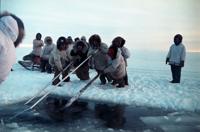
Native whalers using pike poles, push a large chunk of ice under the Arctic Ocean ice as they open another hole, Oct. 22, 1988, near Barrow, Alaska. Two California gray whales have been seen in a small breathing hole. The third whale is missing and presumed dead. Rescuers are attempting to lure the whales to open water and safety. (AP Photo/Jack Smith)

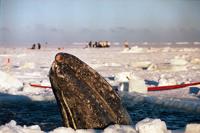
A California gray whale with its nose battered and bloody, surfaces in a small breathing hole as native whalers in the background cut more holes in the Arctic Ocean ice near Barrow, Alaska, Oct. 22, 1988, in an attempt to get the three whales to open water. The three have been trapped in the ice for two weeks. (AP Photo/Jack Smith)

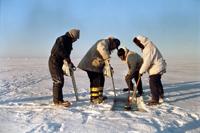
Native whalers using chainsaws and shovels open a hole in the Arctic Ocean ice near Barrow, Alaska, Oct. 18, 1988, in an effort to save three trapped California gray whales. The whales are battered and bleeding while being confined to a small breathing hole. Efforts are underway to help the whales get to the open sea. (AP Photo/Jack Smith)


A large Army helicopter carrying a five-ton weight heads for an area near three trapped California gray whales near Barrow, Alaska, Oct. 22, 1988. The Army is using the helicopter and the weight in an effort to knock holes in the Arctic Ocean ice in an attempt to free the whales. (AP Photo/Jack Smith)

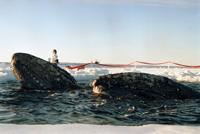
Two California gray whales surface in a small breathing hole in the Arctic Ocean ice near Barrow, Alaska, Oct. 20, 1988. Three whales have been trapped in the ice for two weeks. Rescue efforts so far have failed. (AP Photo/Jack Smith)

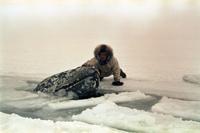
Native whaler Delbert Rexford pets one of the two California gray whales that are trapped in the Arctic Ocean ice near Barrow, Alaska, Oct. 24, 1988. Efforts to free the two whales imprisoned in the ice have not been successful. They have been trapped for more than two weeks. (AP Photo/Jack Smith)

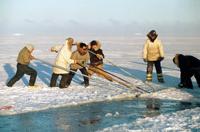
Native whalers using chain saws and pike poles open a hole in the Arctic Ocean ice near Barrow, Alaska, Oct. 22, 1988, in an attempt to lure three trapped California gray whales to open water. The three whales, trapped for about two weeks, are in a small breathing hole. Rescuers are attempting to cut holes leading to open water in an attempt to save the whales. (AP Photo/Jack Smith)
