


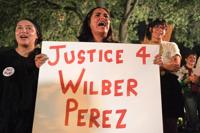
The attorney for a Venezuelan man shot by a federal immigration officer in Texas says he's back in an ICE detention center after being taken to a hospital for a second time. Wilber Rafael Garces Perez was being held Tuesday at a federal center in South Texas. His attorney says Perez was making a DoorDash delivery Sunday in Austin when immigration officers in an unmarked vehicle sideswiped his car and forced it to stop. Perez was shot and taken to a hospital. The U.S. Department of Homeland Security, which oversees ICE, did not immediately respond to requests for comment Tuesday.
The shooting of a Venezuelan man by a federal immigration officer in Texas has set off renewed protests about the Trump administration's immigration crackdown. An attorney for Wilber Rafael Garces Perez says he was delivering food for DoorDash on Sunday when a traffic stop by U.S. Immigration and Customs Enforcement officers ended with Perez being shot in the back. Perez says he was treated at a hospital but doctors didn't remove a bullet near his spine before releasing him into ICE’s custody. He spent the night at a Texas detention center before being taken back to a hospital Monday. The U.S. Department of Homeland Security has said little about the shooting.


Costa Rican man complained of lack of care for diabetes before his death in ICE custody, family says
A 36-year-old Costa Rican man whose family says he complained of not receiving proper care for his diabetes is the third detainee in less than six months to die at a U.S. Immigration and Customs Enforcement facility in Louisiana. Carlos Josue Marchena Marchena was found unresponsive at Winn Correction Center in Louisiana and later pronounced dead at a hospital, according to ICE. The man's sister, girlfriend and a detainee in a nearby cell said Marchena told them he was receiving irregular insulin doses, insufficient food and water and poor medical care in the days before his death. ICE said he received proper medical care.


The attorney for a Venezuelan man shot by a federal immigration officer in Texas says he is back in the hospital after being held at a detention center with a bullet still lodged in his back. Immigration Attorney Kate Lincoln-Goldfinch said Monday Wilber Rafael Garces Perez is in the hospital. She said earlier that he was making a DoorDash delivery in Austin on Sunday when immigration officers in an unmarked vehicle sideswiped his car and forced it to stop. She says Perez was shot and taken to a hospital, but transferred to an immigration detention center without the bullet being removed. The U.S. Department of Homeland Security has released little information about the shooting.

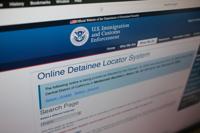
The U.S. Immigration and Customs Enforcement website used to locate someone in immigration detention is displayed, Monday, Sept. 21, 2026, in New York. (AP Photo/Rachel Leathe)


U.S. Immigration and Customs Enforcement has stopped publicly revealing where it is holding most detainees who are subject to final deportation orders, in a move that has made it harder for lawyers and relatives to find them. ICE this week quietly removed the names of those detainees — who make up more 1/3 of the agency’s recent bookings — from its online detainee locator system. The practice applies to detainees who are subject to final orders of removal from an immigration court. Nearly 16,000 people who were arrested and booked into ICE detention in July were subject to final removal orders, according to ICE data obtained by the Deportation Data Project based at U.C. Berkeley and UCLA.


Newly obtained data on the unprecedented surge of border crossings over the past decade is shedding light on who entered the U.S. and where they went. Each month, the government reports how many people are released in the U.S. The Associated Press wanted to know where they went. Agents record street addresses for everyone released — a self-reported destination for each immigrant. In June 2025, AP filed a Freedom of Information Act request with U.S. Customs and Border Protection, seeking individual anonymized information on every person released at the Mexican border by ZIP code, nationality and other characteristics. After months of back-and-forth communication, CBP gave AP records.
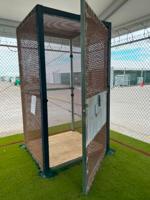
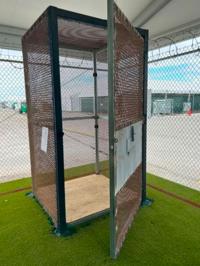
Detainees at a now-closed immigrant detention center in the Florida Everglades — known as “Alligator Alcatraz” — were held for up to two hours in small metal enclosures used as “calming areas.” That's according to a new report by the Department of Homeland Security's Inspector General, who called it a practice that “does not meet standards for humane treatment.” The report was prepared following an unannounced visit to the South Florida Detention Facility on Jan. 21. It marks the first time a government agency has confirmed the existence of such conditions. Advocates, lawyers, families and human rights organizations such as Amnesty International had previously reported and harshly criticized the treatment of detainees.
This image released by the Department of Homeland Security Office of Inspector General shows a small metal enclosure used to to house detainees at the "Alligator Alcatraz" immigration detention center in the Florida Everglades in Collier County, Fla., Jan. 21, 2026. (DHS OIG via AP)

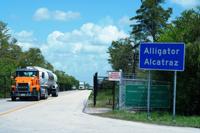
FILE - Trucks come and go from the "Alligator Alcatraz" immigration detention center in the Florida Everglades, Aug. 28, 2025, in Collier County, Fla. (AP Photo/Rebecca Blackwell, File)
