
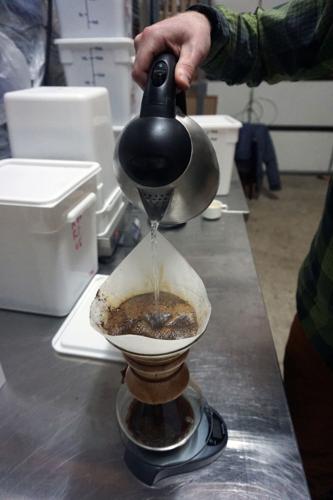
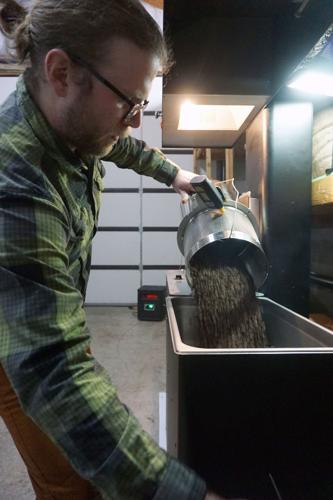
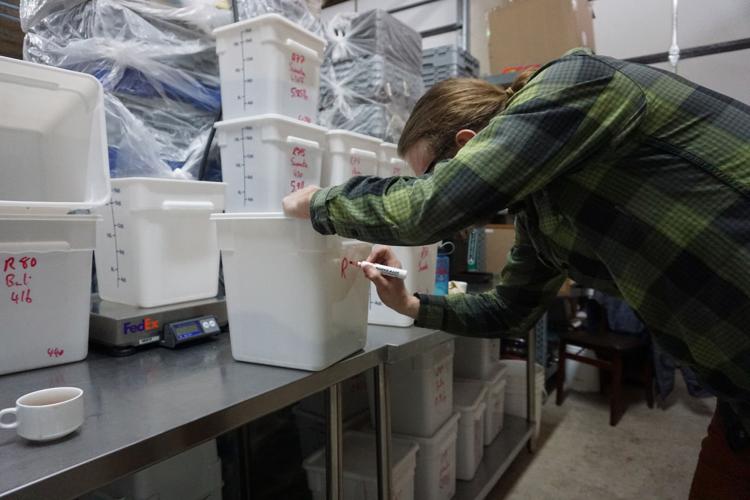
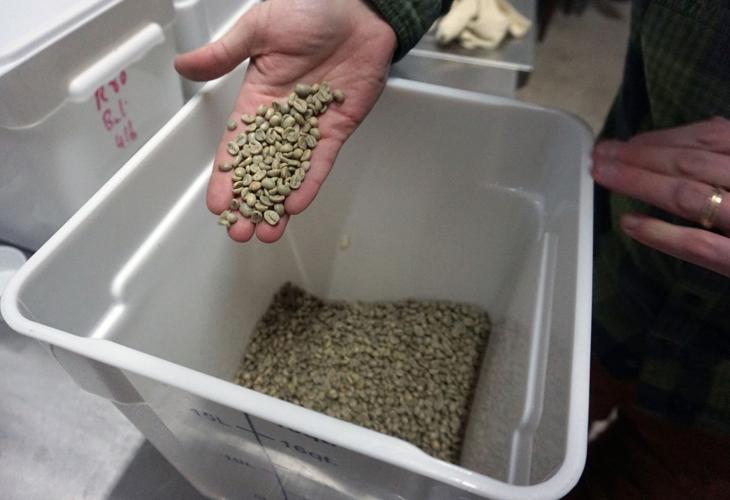
Roasting coffee requires precision and consistency; minor variations in temperature and time mean the difference between a perfect bean and a burned batch. That’s why Alex Suckling, owner and sole employee of the new coffee roasting company Alpine Air, is very careful when he roasts—he is most productive in the morning when he’s well-rested and attentive, rather than after a day of skiing or later in the evening when he’d rather be having a beer with friends than working on his one-man brand.
Since opening his doors at the beginning of December, the 29-year-old from New Zealand has sold around 200 pounds of coffee. Suckling got his first experience in the coffee world back in Christchurch, working as a barista and then as warehouse staff at a roasting company. He put that passion on hold to chase winter for several years by living in British Columbia and Crested Butte and skipping summer to ski in the southern hemisphere.
He met Erica Hansen, the brilliant woman who would become his wife, in Colorado, then followed her to Logan, Utah, so she could pursue her master’s degree in wildlife biology. They were both enamored with the Tetons and moved to the valley four years ago, as soon as an opportunity presented itself.
Suckling has spent his entire stint in the valley working within the same block on Lupine Lane in Victor; he was a sales representative for Kate’s Real Food then became the head of sales for Sego Ski Co. This year the boutique ski company scaled back its operation, leaving Suckling without a job.
“The silver lining of that was that it forced me to think about what I wanted to do in my life. I didn’t want to commute the pass, I love the valley, I wanted to make a contribution to the community, and it has always been a goal of mine to become my own boss. So I said, ‘let’s go big’.”
He attended roasting and sensory skills courses at Boot Coffees Campus in San Rafael, California, took out a small business loan to buy a roaster from a company in Post Falls, Idaho, and set up shop in Bill Boney’s commercial kitchen at the Wildwood Room, also on Lupine Lane. Within nine weeks of being laid off, Suckling started selling coffee.
There was already one coffee roaster in Teton Valley, Teton Coffee Company based in Tetonia, but Suckling felt that there was plenty of room for a second. He has been pouring coffee at the Jackson Hole Winter People’s Market, has already secured shelf space at the Victor Valley Market, Barrels & Bins, the Finn and Feather Inn, and Yeti’s Post, and is working on an account with Huntsman Springs. Grand Teton Brewing created a beer for Hand Fire Pizza using Alpine Air coffee. Employees at the Jackson Hole Regional Land Trust, Hansen’s place of work, are now brewing Alpine Air every morning, and Suckling hopes to secure more office accounts. He also sells online at alpineaircoffee.com and is offering a subscription service with free delivery in the valley.
Of the four flavors Suckling sells, the Frank Sumatra has proven to be the people’s choice, but his favorite is the Peak Bagger, which combines the natural fruitiness of Ethiopian beans with the chocolatey richness of Brazilian and Indian beans. For now, when he’s testing new blends he relies on the tasting notes provided by Royal Coffee, but he will soon have a small test roaster with which to experiment with flavors.
He has the help of design and marketing guru Katie Cooney and is drawing on other business relationships he has fostered in his time in the valley, often on the chairlift or at the trailhead.
“I’m pulling a lot from my experiences with Kate’s and Sego,” he said. “Without that, I wouldn’t have had the know-how or gumption to do this. I’m willing to put in the hard yards to get my coffee in front of people.”
Having worked for those two small companies with big goals, he understands the importance of perseverance.
“You never reach the top, you always have to keep climbing and keep aspiring,” he said. “No one will do it for you.”
Suckling plans to offer coffee tasting courses, or cuppings, to introduce new flavors and help people understand that there is a correct way to brew coffee.
“I feel pretty strongly that people should buy fresh, buy little, and buy often,” he said. “Within two weeks of roasting is when coffee will be its absolute best. That’s why it’s very important for me to include a ‘roasted on’ date on each bag.”
Along with carefully roasted and blended coffee, Suckling also prioritizes environmental consciousness. He found a company that manufactures fully biodegradable bags that don’t require a commercial composting facility to break down.
He sources his beans from Royal Coffee, and although Alpine Air isn’t certified fair trade or organic, Suckling buys only organic beans and around a third of his supply is fair trade. He acknowledged that many hands touch coffee as it travels from bush to buyer.
“I want to make sure I’m making good coffee and working with a company that has good business practices and supply chain transparency.”
Arabica is the predominant bean species used in coffee, Suckling is working to introduce local palates to the more earthy notes of Robusta, which is a hardier plant that grows at lower elevations, yields more fruit, and is less susceptible to climate change, which threatens global coffee production.
“Coffee is going to change dramatically in the next 20 to 50 years. Coffee our grandparents and parents drank and loved won’t be available to our children,” he said. “That’s why I want Alpine Air to be as sustainable as possible.”



(0) comments
Welcome to the discussion.
Log In