

On Sept. 25, 1937, the Idaho School of Beauty Culture opened on the campus of The Southern Branch of the University of Idaho—or what is now known as Idaho State University.
Celebrating its 80th anniversary this year, ISU’s cosmetology school has been around nearly as long as the New York Macy’s Thanksgiving Day parade.
According to a written history put together by the ISU Cosmetology Department, the first graduating class had eight students and one instructor—Bertha Franks—the original founder of the program.
A newspaper article from Sept. 8, 1937, stated that the program included courses in the following: permanent waving, scalp treatment, facial massage, skin-care, finger and water waving, marcelling and iron curing, shampooing, manicuring, hair cutting, sterilizing instruments and care of equipment.
Robert “Bob” Kimber, a former director of the program, believes that ISU’s beauty school was the first officially-licensed beauty school connected with a university in the U.S., but this could not be confirmed.
Rick Fuger, coordinator for ISU’s Cosmetology from 2014 to this past fall, did confirm that ISU’s program was the first state University Cosmetology School established in Idaho. And it’s still the only school in Idaho that is housed within a higher institute of learning.
Gara Armstrong, the current assistant instructor of the program, said that being housed under a public university has a lot of advantages.
“We do not have to worry about our bottom line like private schools do,” Armstrong said, “We are a self-sustaining program. Our instructors are paid by the university so that we can use the funds that we bring in for expanding the program to offer the best and most current education possible.”
Having attended ISU’s beauty program in the 1940’s, Bob Kimber has been involved with it nearly from its inception. But Bob Kimber himself adds significant history to the program by being its first male graduate, first male instructor, and first male coordinator.
While attending beauty school, Kimber remembers knocking an ISU auto-mechanic student “flat on his butt” who had been harassing him about being a male beauty school student.
“They didn’t know I had been a boxer in the Navy,” Kimber said.
Kimber was born in Pocatello and graduated from “Poky High” in 1943. He joined the Navy and served as a motor-machinist mate on a submarine chaser during World War II. His ship patrolled for enemy submarines and once found a sub just nine miles out of Pearl Harbor.
“Most people that I talked to just hated being in the service, but I loved it,” Kimber proclaimed. “I thought it was a blast and I got to see a lot of the world. In fact, I thought about staying in the Navy, but my father didn’t want me to.”
One of Kimber’s favorite things to do during his service was box. When Kimber first entered the military, he joined the Navy boxing program. But he was shipped overseas before he could get in the ring. Instead, he and his friends participated in a lot of bar brawls.
Kimber explained, “There were five of us who would go into a bar and one of the guys would go up to somebody and point to me and say, ‘See this little guy here and that big guy over there? This little guy is going to take that big guy on and he’s going to knock him out cold within five minutes.’ And then they’d place bets on the big guy or me. ... I never lost a fight.”
When WW II ended, Kimber came home to Pocatello and worked for Standard Oil Company. In 1949, when Kimber quit Standard Oil to go to beauty school, his father was really upset with him. Kimber said he had learned the beauty business from his mother and he knew its potential.
“My mother had a beauty salon in the front of our house on 235 North 10th Avenue,” Kimber said. “Back then, $60 a day was big money and my mom used to often be over $60. That’s what made me decide to go into the beauty business.”
After graduating from Idaho State College, Kimber moved to San Francisco for advanced training under some of the world’s best hair dressers at the time: Peter Hantz and John & Suzanne Chadwick. He returned to Pocatello, where he set up his first official salon in the back room of a shop on 9th and Lewis.
Kimber eventually owned and managed 9 salons under the name of “Robert’s House of Beauty,” 3 beauty schools, and 2 supply stores located in cities all over Southeast and Northern Utah. These included Pocatello, Burley, Twin Falls, Ogden, Logan, Soda Springs, and Preston.
Kimber also became a renowned platform artist, demonstrating hair styling techniques for companies such as Clairol and Duel Art at beauty conferences in cities like Seattle, San Francisco, and Las Angeles.
He won over 27 first-place hair styling awards and was offered several jobs to work for top manufacturing companies, but chose to remain in Pocatello.
“I love the people in Pocatello,” declared Kimber. “They are good, hard-working people. There’s always a few bad apples, but on the whole, Pocatello is a great place to bring up a family and to live ... Clairol offered me $100,000/year to do platform work and shows, but I didn’t want to raise my kids in a big city. I knew I could do just as good, or better, by staying right here in Pocatello doing my thing.”
After more than 20 successful years, Kimber decided to sell his businesses. He returned to ISU’s Cosmetology program and became the first male instructor there in 1973.
According to ISU Cosmetology Department history, in 1980 there was a dispute between the program coordinator at the time and an instructor that led to naming Bob Kimber as the program coordinator. He served until 1989.
Rick Fuger was also a graduate of ISU’s cosmetology school while the program was under the direction of Bob Kimber.
The greatest lesson that Fuger remembers learning from Kimber is that “a man could succeed in the cosmetology field and be passionate for the business.”
Even in the 1980s, Fuger experienced some of the same harassment that Kimber had in the 1940s for being a male cosmetology student.
“We, like when Bob went to school, had to wear nurses uniforms,” Fuger explained, “so they could pick us out on campus pretty easily.”
“Male students are more accepted now,” Fuger said. “And students don’t deal with the harassment like we did. They wear smocks over their normal clothes now so they don’t stand out as much.”
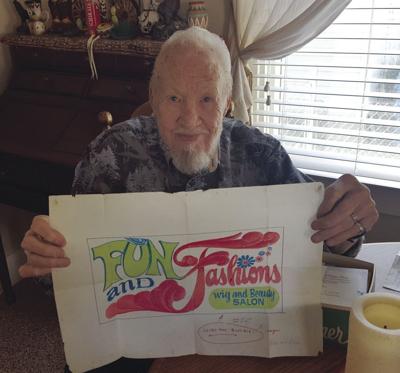
Now, at age 92, Kimber still lives independently, has outlived two wives and a girlfriend, and says he plans on living in Pocatello until he’s 100.
Kimber continues to be involved with the ISU Cosmetology program, where he generously provides scholarships for students in need.

(0) comments
Welcome to the discussion.
Log In