
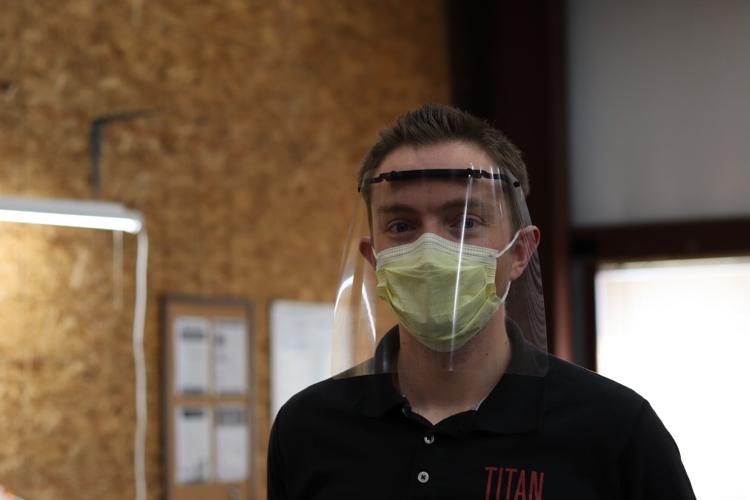
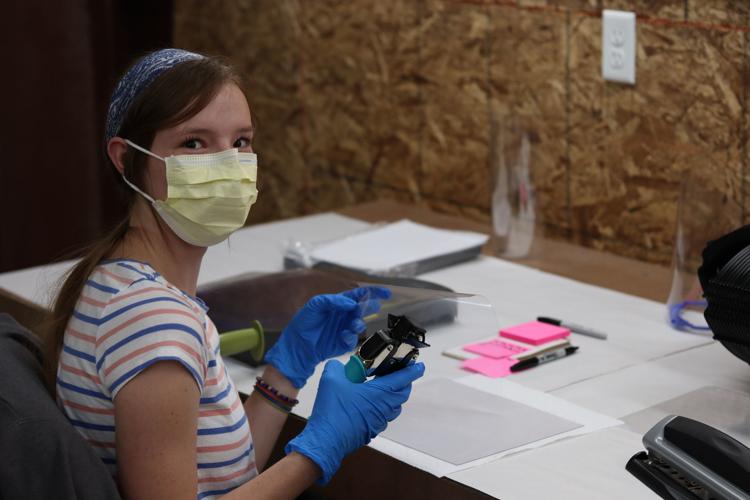
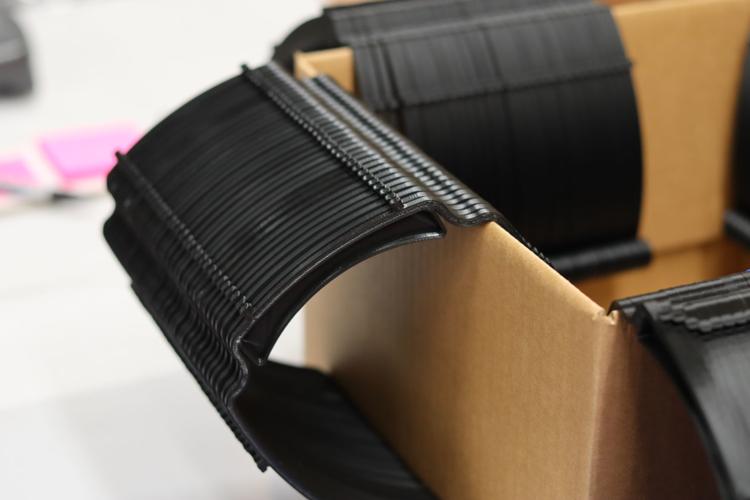
CHUBBUCK — A local business that specializes in making batteries has added a new component to its operations: making face shields for health care workers who are on the front lines of battling COVID-19.
Trent Clawson, the president and chief engineer of Chubbuck’s Titan Power, said that when the novel coronavirus hit the U.S., he and his employees felt they needed to do something.
“Titan is really obsessed with making good products that help people,” he said. “This might sound strange, but it hurt our hearts to sit around at a table discussing battery management systems when our community is suffering from this horrible thing. We felt like we had to spend some of our time, if anything for our own peace of mind, to be like, ‘How can we help?’”
Clawson said he and his employees ran through several different ideas on what they could make to help before they settled on making face shields.
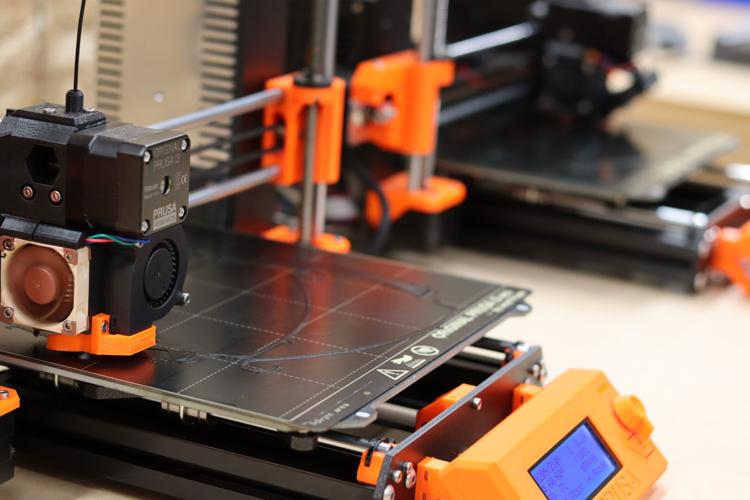
“I saw a video on YouTube about 3D printing face shields, and that was perfect because it’s not expensive or (time consuming), and it’s something that we can do with the equipment that we have,” he said. “We have 3D printers, and we have people who can make things really quick.”
Clawson has a friend who works in the medical field locally. Titan Power made that friend a prototype of a face shield, and the friend showed it to local medical personnel, who liked the product.
In addition to making face shields, there have been some other big changes at the business, which is located at 5795 Industry Way, Suite A4, in Chubbuck, as a result of the spread of the coronavirus.
“As it became more and more apparent this was going to be a serious thing, when the stay-at-home order was issued, as a team, we sat down and tried to think about how could we keep business going and keep people’s jobs in place and still be safe because our people are definitely our job priority,” Clawson said.
Ultimately, Titan Power moved about 90 percent of its production into its employees’ houses, which has drastically changed how the business works.
Instead of a basic production line where one employee does his or her part and slides the product to the next person in the line, individual employees now take a bunch of batteries home and do their part of the production on each piece. Then they drop a box with the parts off at Titan Power, where Clawson brings it in, wipes it down, puts the date on it, and then it sits for a week to make sure it’s properly disinfected before the next employee takes it.
“It’s been really hard, it’s been really challenging, but to be honest, we do hard stuff all the time,” Clawson said. “This is not anything new. You just have to remain flexible. It’s not the smartest, the strongest, the fastest, the richest that survives; it’s the teams that are the most flexible.”
As with many entrepreneurial endeavors, Titan Power was built because there was a gap in the market that a tinkerer wanted to fill. For Clawson, that gap was a battery for drones. He built drones as a hobby, and the kind of battery he wanted for them didn’t exist at the time. Thus, Clawson started building batteries in his basement in Bentonville, Arkansas, in 2015. The hobby quickly turned into a business, which has grown exponentially since its beginning five years ago and now employs 14 people.
“It’s kind of a classic American story that it kind of grew from there,” Clawson said. “This hobby took over my whole basement, some of my garage, and then it got to the point where it was like, ‘I’m crazy not to just do this.’ I’ve always been an entrepreneur at heart, … and once you have the opportunity, you’ve got to grab it.”
In 2017, Clawson left his full-time job at Walmart’s headquarters to pursue his passion, and in May 2019, he and his family uprooted and moved to Chubbuck. He has ties to the area — he attended Brigham Young University-Idaho in Rexburg, and his wife is from the Pocatello area.
Titan Power makes batteries for all kinds of things — from drones and airplanes to airsoft guns and golf carts and more.
“We originally started building batteries for flying things, so drones and fixed-winged aircraft — like your normal airplane,” Clawson said. “We started building batteries for commercial customers. We have NASA as one of our customers. A lot of defense contracting companies buy batteries from us as well. We also have an airsoft division, sort of like paintball but a little different. We are just on the verge of our final stages of our research and development for a golf cart battery replacement. So instead of 60-, 70-pound lead acid batteries, you get to put one 40-pound lithium ion battery in there. Instead of it lasting three years, it will last 10.”
Even before the coronavirus hit the U.S., global developments prompted Titan Power to make some big changes. Last year, the Trump administration imposed tariffs on China, where Titan Power did all their production. Because of that, the company decided to start doing their production within the U.S. starting in June of last year.
“When the tariffs came our way, we sat back and were like, ‘Well, we really don’t want to pass on this massive price increase to our customers,’ and so we started looking at other options,” Clawson said. “Someone suggested, ‘What if we made it in the U.S.?’ ... In the middle of June, we dropped all of our production in Shenzhen (China) entirely and went from four people to 14 people in the course of two or three months. ... When the dust settled, we had a product that was way, way better than we were having before because we have our design and manufacturing team at the same table, literally, and we actually made it for less than what we were doing before.”
The move to manufacturing within the U.S. ended up being a lucky move because, Clawson said, when the coronavirus hit China, everything was shut down.
“I’m just so grateful that we’ve been able to produce here because had we still been relying on Shenzhen, I think that would have been it. I don’t think we could have survived six months of no products,” he said.
For Clawson, keeping people safe during the COVID-19 outbreak is personal. His father-in-law is a doctor who is currently serving a medical mission for his church, and his 4-year-old son just overcame a three-year battle with leukemia, a disease that would have left him especially vulnerable to getting the infection.
“We are very passionate about loving our medical community. We’ve been in children’s hospitals for years,” he said. “As a battery designer, there’s not a whole lot I can do to support them, so when I get the chance to do anything, I’m going to take that without hesitation. It’s good timing in a way because our little guy is all immune sufficient. He’s all good to go now, and this was like the same week it started arriving in Pocatello. We’re just so grateful it all worked out.”
Clawson says his business has been hurt by the outbreak, but he thinks everything will turn out all right in the end.
“The airsoft (side of the) business is hurting because people aren’t able to play games,” he said. “They’re not supposed to be together because of social distancing. There’s not these big events like there are typically. ... So sales are for sure affected, but I think we’re going to be OK. The other half of our business is more related to government contracts or big companies, and because so many of them are building for the military or first responders, they’re still operating as essential. We’re able to still work for those companies. That side of the business hasn’t really been affected.”
When things return to normal, Clawson said his employees will return to the office, but they will do so with the knowledge of how to do things more efficiently.
“Certainly we’ll need positions back in the office, because logistically it’s too challenging to do it spread out all over the city, but I think things will be better,” he said. “Through all of this, because we’re trying to maintain the same production speed, we’ve had to be more efficient with what we’re doing, and those things that we’ve learned will be integrated back into our system.”
In the meantime, Clawson is looking for health care workers who are in need of face shields. Currently, Titan Power is making 50 shields a day, but it could be making up to 150 if the demand arises.
Because he’s not sure who to get in touch with locally, Clawson is currently shipping many of the face shields out of state to the country’s harder hit areas, which is fine with him, but he says if it’s possible, he’d prefer to help out locally.
“I want to help no matter where it is, but my first priority is the local community, so I’m trying to work with the local hospitals and first responders,” he said.
Clawson encourages anyone with access to a 3D printer to start making the shields. It’s an easy process — print the headband part of the shield, round the edges off the pre-cut plastic sheets and then punch holes in the sheets so they can be attached to the headband — and each shield costs less than $1 to make. He said the shields are important because they project other necessary items such as surgical masks, making it so those don’t have to be changed out as often.
“I don’t see these face shields being used for decades to come, but during this time, it allows those other things that are hard to get or are in short supply, it allows them to last longer,” he said. “That’s the real goal.”
Clawson said anyone with questions about how to start making face shields can reach out to him at trent@gettitanpower.com. He can also be reached there if you are a health care worker looking to get your hands on a shield.
“We really just want to help,” he said. “We’re 100 percent not doing this to build our brand. There’s other ways to build a company. We’re doing this because we just really want to help. We’re just one little company, just or three people doing this, but if a lot of people come together then we’re going to do a lot more good.”
For more information on Titan Power, visit gettitanpower.com.

(0) comments
Welcome to the discussion.
Log In