
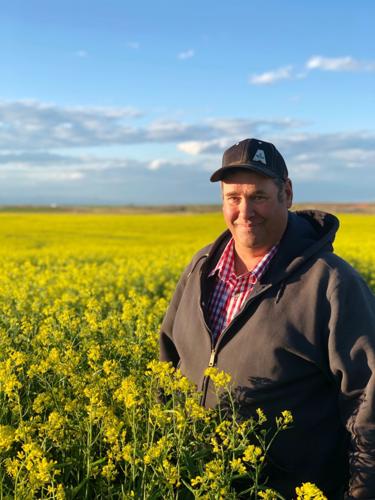
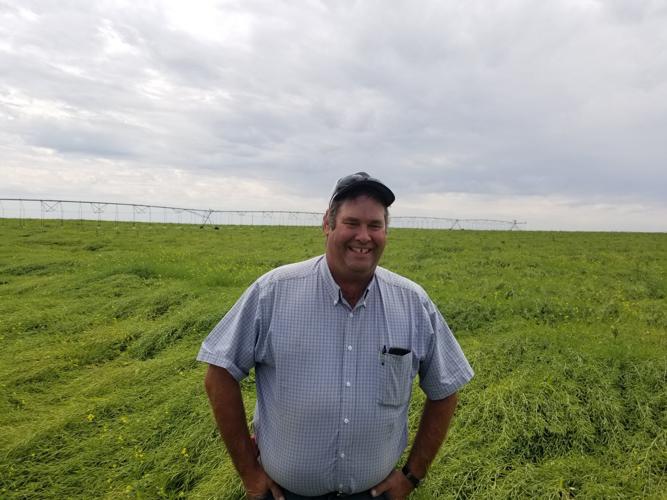
HAMER — Justin Place will soon become the first U.S. farmer to commercially harvest a type of mustard developed using a promising new approach to breeding varieties of the crop.
He’s planted 70 acres of a new “F1 hybrid” variety of mustard, called AAC Brown 18, which was bred in Canada and should deliver growers whopping yield gains, even if they plant at a fraction of the usual seeding rate.
“It is quite a bit more money for the initial seeding cost, but if the yield is there, it should more than pay for the initial seeding expense,” Place said of his unique field of brown mustard.
Not long ago, experts thought it would be improbable to breed a mustard hybrid. The term refers to the first generation of seed resulting from a cross, also called F1. Mustard — like corn, and alfalfa — is open-pollinated, meaning fertilization requires pollen from another plant to be delivered by bees or other pollinators.
Jim Davis, a research specialist involved in University of Idaho’s canola and mustard breeding program, explained the most conventional way of breeding mustard involves producing a small amount of F1 seed from two parents and then refining the genetics through subsequent generations of inbreeding and making careful selections. The process eventually yields homogeneous seed that growers can replant.
In the case of hybrid crops, two inbred parents are selected, and one is emasculated, leaving only female flower parts intact. F1 seed is saved only from the female plants, reducing the potential for variability in that generation. Crossed seed produces higher yields through a concept known as heterosis, or “hybrid vigor.”
Growers can’t save and replant hybrid seed, as genetic variability would return in the next generation.
“Canola is moving toward hybrid varieties; mustard is lagging behind because it’s a smaller-acreage crop,” Davis said, adding his program currently breeds mustard varieties only through the conventional approach.
In breeding corn, emasculating a plant for hybrid production simply requires removing the tassel. Mustard is far more difficult. The flower is too tiny to easily emasculate, so the breeder of the new hybrid variety, Bifang Cheng with Agriculture Canada in Saskatoon, sought mustard seed for a parent with male-sterility mutations.
The new hybrid was registered for sale in the fall of 2018. Growers must pay a royalty to raise it. Though Place is the sole commercial grower in the U.S. raising AAC Brown 18, Utah State University has planted a small amount of it in trial plots. A handful of growers in Canada are also raising it this season.
“The variety is promising to the industry as it is yielding significantly higher — 15 to 20 percent — than other varieties in the marketplace,” said Rick Mitzel, an official involved in the Saskatoon breeding program.
Place started raising a conventional variety of mustard last season for Bill Meadows, with American Falls-based Mountain States Oilseeds, seeking to add a new crop to his rotation. Despite his lack of experience, Place was among the region’s top-yielding mustard growers.
Aside from when he harvests potatoes, Place avoids tilling or disturbing his soil. Mustard helps him better control weeds in a no-till system, as he can use herbicides for treating grasses that would harm barley and wheat.
The crop’s deep tap root improves water infiltration, and the heavy chaff keeps his sandy soil from blowing in the spring.
Meadows approached Place in the early spring about planting the hybrid mustard, which was developed as a dry-land variety, as an experiment to determine how it would perform under irrigation.
For comparison, Place planted part of his pivot in conventional mustard and the remainder in the hybrid variety.
“It grew faster. It started blooming four to five days ahead of the conventional mustard,” Place said.
Place has taken random samples from conventional plants growing adjacent to the hybrids. Conventional samples averaged about 110 seed pods per plant, compared with about 450 pods per hybrid plant.
Place said the seeding rate for his conventional mustard is about 14 pounds per acre. He admits he was a bit nervous when he followed the recommended planting rate for his hybrid brown mustard of 6 pounds per acre — seeding directly into barley stubble from the prior year.
“When it came up, I thought we were in for a wreck. The hybrid was pretty spotty — not near enough plants,” Place said. “Once it got established, the hybrid really took off. It got bushier, and a lot taller.”
Place is 6 feet tall, and hybrid mustard plants have grown above his head in parts of his field.
Meadows plans to gradually shift all of his brown mustard production to the hybrid variety. He likes that the breeding technology achieves a significant yield boost without involving genetic modification, which can limit potential markets due to challenges with public perception.
“If we can plant at half rate and get 20 to 30 percent more yield, that’s a pretty good cash crop for the grower,” Meadows said. “I feel really good that we were able to get some of that seed in the U.S.”
In addition brown mustard, Meadows also contracts for oriental and yellow mustard in Eastern Idaho. He said his growers are steadily increasing their mustard yields as they refine their production techniques.

(0) comments
Welcome to the discussion.
Log In