
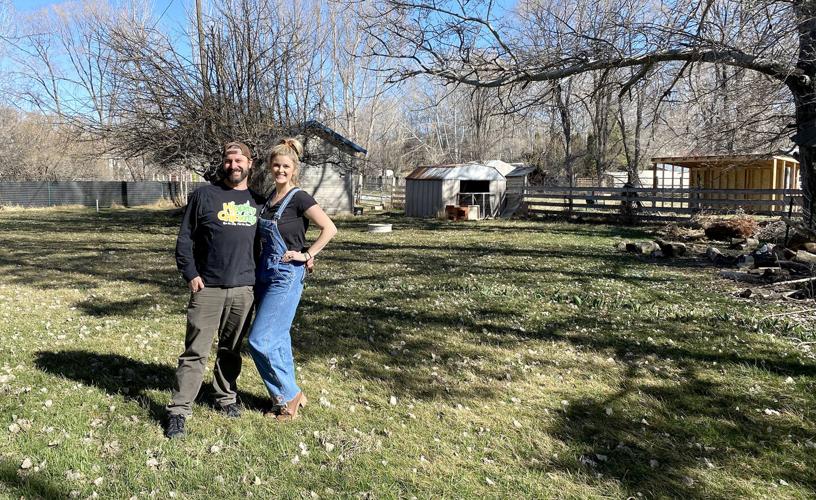
Farm life ain’t just for country folk anymore, thanks to the work of one Bannock County couple.
Erin O’Shaughnessy and Travis Stone launched their business, Hippity Chickity, in November with the goal of redefining what makes a farm a farm and giving everyone — no matter their living situation — a way to connect with nature.
“It doesn't matter how old you are, nature is awesome,” O’Shaughnessy said. “We love watching people get tickled and excited about nature, and we think that if more people get that feeling or get hooked on nature, they're going to incorporate more and more of that in their homes. And that's really what we're all about is we want people to have those experiences.”
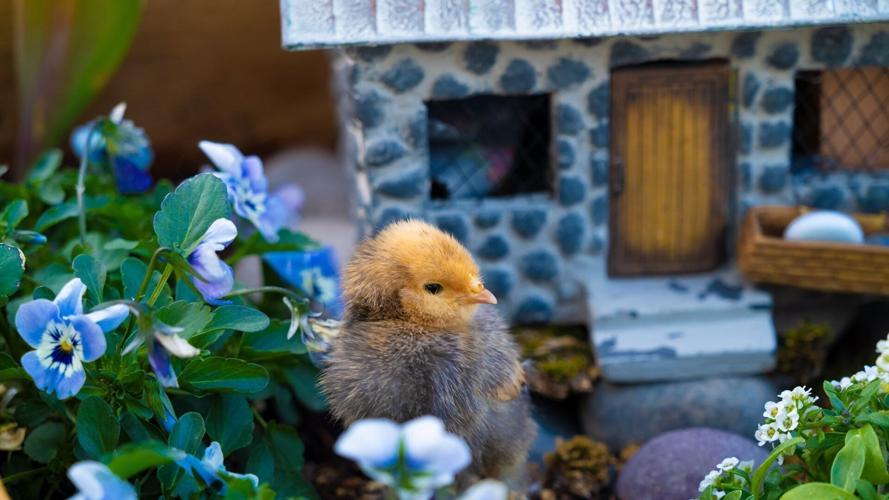
The husband-and-wife team offers a few different ways to do that, including kits for people to raise their own chicks or ducklings.
The business offers free delivery within 20 miles of Pocatello, and customers can get their own birds or the business will provide them for an additional fee. The kits include everything needed to raise the baby birds: a handcrafted enclosure, heat lamp and bedding, food and probiotics, and support through email and phone.
“We check in on our families that are doing the programs, and the kids are really excited,” O’Shaughnessy said. “It's cool, because some of them have never, ever handled an animal before, and by the time that we pick them up, they're like chicken wranglers. They’re like, ‘No, no, that's not how you hold them. You gotta tuck their wings in and do this.’ Not only that, but they also learn about compassion for other animals and species and thinking about, ‘How do we take care of animals?’ And ‘we really like these types of animals, so we want to make sure we have environments for other animals.’ And that kind of segues into, ‘Yeah, we need to take care of our nature so we can take care of native species.’”
Chick kit rentals are for five weeks, and duckling rentals are for three weeks. At the end of the rental period, customers can either keep the birds or give them to Hippity Chickity, and they will either live on O’Shaughnessy and Stone’s property in Fort Hall, or the couple will adopt them out.
“We have 20 boxes out right now,” Stone said. “And most of them, they didn't start wanting the chickens, but they got so attached to them that they're actually keeping the chickens.”
It was important to the couple to make raising chicks an easy experience that people could do even if they live in a small space or don't have a lot of time.
“We noticed with a lot of people that because they're in the city or they lack space, they missed out on these opportunities, and we weren’t OK with that, so we wanted to make it no hassle,” O’Shaughnessy said. “We get it, you can't keep these chickens permanently, but why don't you watch them grow with your kids, and then we'll take them back if you don't have a place for them?”
The chick enclosures are handcrafted by Stone and O’Shaughnessy, and they’re designed with toddlers and pets in mind. It has a removable lid so the birds can be put away and kept safe from paws and little hands.
The couple has two toddlers, and O’Shaughnessy says, “They love it. It's great for them because they can bang on it. We've had them sit on it. And that's what it should be for. You want an interactive brooder that also keeps them safe and keeps you safe. And we want it to be a fun and happy experience, not ‘oh my gosh, I can't wait to get rid of these chickens.’”
The birds that do get returned will soon have a snazzy living space. O’Shaughnessy and Stone are currently building a new coop that will hold up to 75 chickens. In the summer, it will be surrounded by sunflowers, and the couple has plans to hang lights and add speakers and generally make it a fun place to hang out with the chickens.
“The goal would be to make this a super, super glam chicken experience,” O’Shaughnessy said.
A PASSION FOR POLLINATORS
In addition to chickens, the couple is also passionate about pollinators.
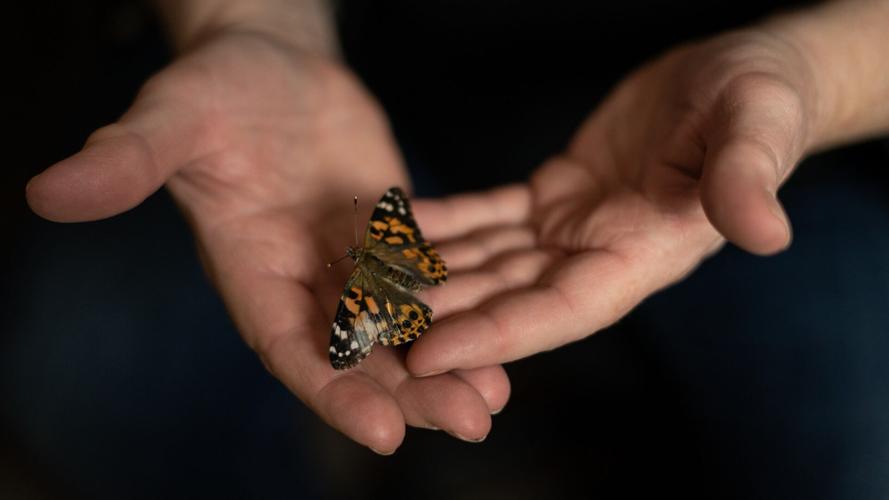
They offer butterfly boxes for Painted Lady butterflies, which lets people witness the life of a butterfly, from caterpillar to winged delight.
Stone said it’s easy to raise butterflies.
“They start super small, and they become big furry caterpillars, and they're just fun to look at,” he said. “And then they chrysalis up on the very top and they actually move when they're in their chrysalis. … They actually mimic a snake, and it keeps predators away so that they're safe. It actually looks like they have eyeballs on the chrysalis. When they emerge and their wings are wet and soaked out and they kind of take a little bit of time to dry, … and pretty soon they're flying around. You can open up the door. They know where their fruit is, so they'll always come back to it.”
O’Shaughnessy said that especially in the winter, she loves letting the butterflies stretch their wings in the home office (which is lovingly named the “Hen Den.”)
“I keep this room really hot, because they’re kind of solar powered, so if it's warmer, they’re gonna fly,” she said. “And then I get them drunk off fermented fruit and we have a good time in here while I'm working. They're great. And we have them all winter long because it is so dreary.”
One of the reasons why the couple started making and selling the butterfly houses is to help people understand the importance of pollinators.
“So many people love butterflies, but a lot of people in the city don't see them very often, and I don't think they understand that when we have all of these plants die off, we lose our butterflies,” O’Shaughnessy said. “We can see our monarchs disappear, we can see Painted Lady butterflies disappear, because we are around that environment, but our friends in the city can't see that contrast. … We really think if people are hatching out butterflies in the city, and they're like, ‘Oh, my gosh, this is so cool. I can't believe they're flying around our room,’ then it kind of hits more, like, ‘Oh my gosh, what if these disappear? What if I can't do this again?’”
Stone added, “This is Idaho. Monarch butterflies were everywhere here, and now you rarely, rarely ever see them. You used to have half a million butterflies that came to this area alone, and now … they're gone — essentially gone. It's rare to actually see them. It's a sad thing for me to see. I've been doing conservation, environmental restoration for 17 years, and it's so hard to kind of see the species decline. So it's an uplifting feeling to be able to give people those experiences and maybe show people that there's a reason to care.”
‘YOU DON’T HAVE TO HAVE ACRES’
Hippity Chickity offers a variety of other handmade products to get people closer to nature no matter the size of their home.
One such item is a grow box, perfect for small spaces such as a dorm room.
“We don’t want people limited by, how much space do you have in your yard? Or do you even have a yard?” Stone said. “So we have grow boxes, and then you'll be able to start plants if you have gardens outside. If not, you can grow your own herb garden right in your household.”
Soon, they will start offering custom-made planter boxes.
“Travis builds them to whatever your environment is,” O’Shaughnessy said. “So instead of having a standard size, we get people that call us and then he comes out to your property or apartment. … We can actually build planters on top of your garbage cans. … So we're really utilizing whatever limited space you have. You don't have to have acres. You can live in the city and be in an apartment and we can still figure something out.”
The couple also makes fairy gardens, both in the traditional variety and one with dinosaurs. The boxes also double as a planter box.
“It's toddler height, so they have their workbench, plus they have their little gardening supplies," Stone said. "So it becomes a place where they can learn about growing vegetables or fruits or whatever it is that they're interested in but also get to play.”
The fairy boxes play into an idea the couple supports that kids should be right up in nature from an early age.
“We’re super big believers that kids should be connecting with nature as soon as they're born,” O’Shaughnessy said. “Our daughter, she's been having butterflies land on her from the time that she was 4 months old. One of our other kids, she was playing with chickens before she could crawl. So we very much believe in that connection, and then they grow up more in tune to nature, and they're gentler, and we don't have to teach them how to handle animals.”
Many of the couple’s products feature one-of-a-kind epoxy floors meant to encapsulate some part of nature.
“Everything that we make incorporates those really beautiful aspects of nature we think that a lot of people miss out on,” O’Shaughnessy said.
‘NATURE’S CRAZY BEAUTIFUL’
O’Shaughnessy and Stone each grew up surrounded by nature and connected to it in profound ways. They hope that through their business they can give people of all stripes a way to experience the same and also rethink what makes a farm a farm.
“I really want to redefine farm life or what a farm is and incorporate ‘it can be fun, it can be fashionable, it can be beautiful,’” O’Shaughnessy said.
O’Shaughnessy grew up on a 200-acre tree farm in Washington, and she fondly remembers the experience of being near bobcats, mountain lions, elk and other wildlife.
“When people think of a farm, they think of this farm where there's tons of cows, and it's stinky, and if you're a farmer, then you kind of look a certain way,” O’Shaughnessy said. “... When I think of farms, I know there's butterfly farms and bee farms and tree farms and animal farms. And so we're really trying to get people to expand their minds of what a farm looks like to get people to realize that farming, urban farming, micro farming in the city can be beautiful. We want people to understand you can hatch out chicks and raise chicks and it doesn't have to be gross.”
Stone, a Shoshone-Bannock Tribal member, has over a decade and a half of experience in land management. He’s passionate about protecting land and preserving wildlife.
“I was lucky. I grew up in agricultural communities, and I've been able to visit farms all across the West,” Stone said. “... We do have some great farmers out there doing some really, really neat work, but sometimes it does get overshadowed (by industrial farming) and sometimes people don't know how their food gets to their table, and that's always an important part. And that's why I think gardens and raising chickens or even seeing butterflies and what pollinators do for the earth, being able to have that experience kind of gives you a better idea of what your food means and how fun it is to grow.”
Both O’Shaughnessy and Stone have been able to travel the world, and witnessing the ways in which different farms operate has had an impact on the way they approach their own business.
For O’Shaughnessy, the biggest influence was seeing dairy farms in New Zealand.
“Their environments are so much cleaner, and then just kind of how they operate farms is very different,” she said. “Here, it feels very industrial, and (in New Zealand) it's very much minimally processed, and the cows are literally just right there eating. There's no hormones, anything. It's some of the cleanest food and beef you can get."
For Stone, it was visiting Costa Rica that shaped his mindset the most.
“We actually got to go visit a sugar cane farm, and it was just a single guy and he'd been doing it his whole life,” he said. “He made his own sugar for his coffee. … He has this nice little table set up and you can sit down and drink coffee and the coffee's right from his neighbor farm and his sugar he was growing himself. He was doing the whole process by himself. So it was really like this, ‘Hey, this farm is beautiful. This is a fun experience. We can come here and visit him and taste what this product tastes like.’ He showed us the whole process of how he goes through it, and it was just a blast.”
The couple believes that inserting a bit of the farm into your home can be life changing, and they want everyone to have that experience.
“We want people to move away from the stinky industrial farm image they have in their head and realize there are vineyards, and that's a type of farm, and there's hatcheries and there's fisheries and realize that nature's crazy beautiful and awesome and you have to find ways to incorporate it into your home,” O’Shaughnessy said. “I really don't think your home is complete until you experience a piece of the farm.”
For more information, visit hippitychickity.com.

(0) comments
Welcome to the discussion.
Log In