
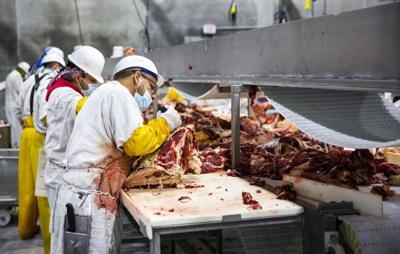
BURLEY — Allan Ward has seen his company Ida-Beef LLC’s name in the news more often than he would have liked since he opened the slaughterhouse southwest of Burley in 2018.
Slaughterhouses are required to have a U.S. Department of Agriculture inspector present in order to operate.
When an inspector observes an action that violates regulations, including humane slaughtering violations, a report is filed and the company has to come up with corrective measures to satisfy the USDA before they are allowed to continue processing.
Ida-Beef received violations regarding two cows in January 2019, one in May 2019 and one in December 2021 that went down in corrals and had to be euthanized.
To meet federal regulations, the cow must walk on its own into the plant, with restricted prodding from employees, Ward said.
When the cows are ambulatory they are led to a stall where a captive bolt device is used to render the animal unconscious before slaughtering, which is a federal regulation.
The employees who use the captive bolt devices are trained and certified to use them, he said.
When a cow goes down in a corral and is unable to get up, “the humane thing to do is to kill her as fast as possible to reduce suffering,” Ward said.
The corrals, Wards said, can be wet or icy, and there are no restraints to keep the cow from moving, which increases the difficulty of euthanasia.
When processing cows, Ida-Beef has two inspectors and a veterinarian present to ensure the processes are done humanely and the meat is safe for consumers, Ward said.
After each violation, Ida-Beef improved its practices, Ward said, including implementing pressure testing equipment, which is used each morning to ensure the captive bolt devices are working properly.
After one incident, Ward said, the responsible employee was suspended and reassigned to other duties.
The USDA regulations are not overly stringent, Ward said.
Mainly, he said, they keep the plant on track with the plan the company put in place for humane slaughter and producing a safe food product.
A USDA Food Safety Inspection Service spokesperson told the Times-News after the company’s recent violation, that each incident at a plant is investigated on an individual basis rather than being cumulative.
The stiffest penalty that can be issued, he said, would be a withdrawal of the grant of inspection. Without an inspector present, a company cannot slaughter.
“Will this be the last violation we ever get,” Ward said in regard to the December violation, “Probably not.”
But, he said, the company is always improving.
Because the plant processes old animals, he said, it will always be more vulnerable to violations than a larger plant that is highly mechanized and processes younger, healthier animals.
The majority of the cows that come to Ward’s plant are dairy cows that aren’t productive anymore, the remainder are old range cows.
“Many are on their last leg,” Ward said.
Prior to opening the plant, the old dairy cows in the area were transported by truck to California, Utah or Washington.
A percentage of them, he said, would die on the trucks.
“They are at the end of their lives, and they just do not travel well on the trucks,” Ward said.
Not only does having a plant closer to the Magic Valley dairies keep the animals from suffering while traveling long distances on the trucks, it also increased profits for the dairymen, he said.
Ida-Beef, along with other Idaho and national slaughterhouses, are also watched closely by the group People for the Ethical Treatment of Animals.
“I understand that PETA’s role in this is to look after the animals,” Ward said. “I think that’s a good thing. There needs to be someone to stick up for our pets and animals.”
But, Ward said, some people want to eat meat and when PETA asks everyone to consider going vegan, that request is unrealistic.
When Ida-Beef started in 2018, it had 12 employees. Now the company employs about 110 people.
Recently the business invested in new refrigeration equipment and a larger processing room that will allow it to ramp up production from 190 to 240 cows a day to 325 daily.
About 85 percent of the meat that comes from the plant is made into hamburger, and almost all of the parts of the cows are utilized and packaged together in totes, even the aortas, which are made into noodles for some eastern cultures, Ward said.
Some of the bones are sent to dog food plants and some bones like those along the spinal column in older animals are discarded, he said.
An X-ray machine on the production floor checks the totes for bones and a digital readout records the percentage of fat.
“A dairy cow is really lean and doesn’t have much fat on her,” Ward said. “They are fed to milk.”
Most of the meat is sent to a plant that grinds it for hamburgers or taco meat and sold to many fast-food chains.
The demand for the product, he said, can be seen every day by the lines forming at the fast-food drive-thru windows.

(0) comments
Welcome to the discussion.
Log In