

"MY TRIP TO OUTER SPACE BY SAM SPACE"
MARCH 13, 1960
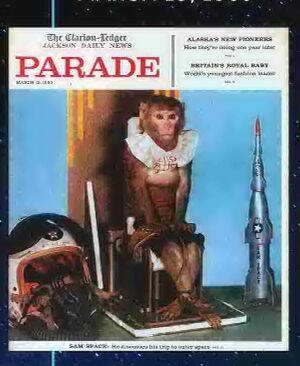
Meet Sam Space. He's a rhesus monkey who was blasted into space 63 years ago next month. On December 4, 1959, Sam flew from Wallops Island, Virginia, about 53 miles high in Little Joe II, part of the Mercury program. In a tonguein-cheek interview conducted by Parade's Washington correspondent, Jack Anderson (of muckraking fame), Sam told Parade all about his trip.
"My journey into space lasted little longer than it takes to scoot up a tall tree. But it was preceded by months of training, dieting and medical diagnosis," Sam reported. During the flight, Sam was wired up and his brain waves, muscular reaction, heart activity and respiration were measured. He also wore goggles to measure dizziness, and was strapped into a chair lined with plastic foam to absorb the shock. His space capsule measured only 36 inches long and weighed just 100 pounds (including Sam's seven pounds).
"There were moments when I expected to ascend right on to monkey heaven," Sam said of the launch. "I thought the blast-off pressure was going to squash me flatter than would an elephant's foot. High in space, my arms seemed to be floating away from me. Then my spaceship splashed into the Atlantic Ocean with a jolt that almost scrambled my insides. But I came through it without a misplaced vertebra, and doctors report I am fighting fit."
Sam went on to "say" that he was happily retired now and would be well taken care of the rest of his life. A few months after Sam, a monkey named "Miss Sam" flew eight miles high in a test of emergency procedures. In all, 32 non-human primates were launched into space.
"WOMEN IN SPACE"
APRIL 30, 1961
Jacqueline Cochran, the first woman to break the sound barrier, established more flying speed, distance and altitude records than any other man or woman of her time. For her work as head of the WASP (Women Airforce Service Pilots) in World War II, she won the Distinguished Service Medal. She was passionate about women in space. "I would like to predict that women will go into space by December 17, 1963—which is 60 years to the day after the Wright brothers first flew—but probably within six or seven years would be more realistic." (She was about 20 years off ; Sally Ride was the first woman astronaut in space in 1983).
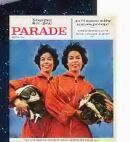
In Parade, Cochran made the case that females could be jet pilots or astronauts. Jan and Marion Dietrich, the twins on the magazine's cover, were part of a volunteer program testing that notion at the Lovelace Foundation for Medical Education and Research. The California sisters were qualified pilots who held a Federal Aviation Agency instrument rating and passed the same kind of endurance and tilt table stress tests that male astronauts do. While women were not being considered for astronaut or jet pilot jobs at the time (the magazine reported that the government deemed it too expensive to train women whose flying careers are likely to be interrupted by marriage and children), Cochran hoped this volunteer program was a "launching pad" for that to change.
"WHAT'S NEXT FOR JOHN GLENN?"
JULY 11, 1976
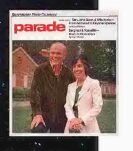
John Glenn, the first American to orbit the Earth, was still in the limelight even when his astronaut days were well behind him. Would the United States Senator from Ohio run for president? He wasn't saying no in this Parade story, as he prepared to be the keynote speaker for the Democratic Convention. Glenn planned an inspirational speech that would concentrate on the upcoming Bicentennial celebration and focus on the benefits of looking forward.

(0) comments
Welcome to the discussion.
Log In