

For the past several years, scientists have been hard at work in the remote northern Utah desert west of Tremonton, designing and testing key components of the rocket that blasted off toward the moon on Nov. 16.
With a long history as one of the main contractors working with NASA on the U.S. space program, it was only fitting that several members of the team at Northrop Grumman Corp.’s Promontory facilities in Box Elder County were among the crowd of thousands who gathered on the east coast of Florida in the early morning hours to witness the liftoff of Artemis I, the first lunar mission in 50 years.
Among a contingent of about 100 people from Northrop Grumman who had a front-row seat to the launch was Matt Mecham, manager of Space Launch System integration at Promontory.
Mecham started working at the Promontory campus 16 years ago when it was owned and operated by ATK. His job has allowed him to witness other launches in person, but none as big as Artemis I.
“For me it was a mixture of emotions,” Mecham said. “To see Artemis I actually take off and fly, it was relief, elation and just awe. It’s really humbling.”
Under the ownership of several different companies over the years, the Promontory campus located near Golden Spike National Historical Park has been the center of activity for the booster motors that have sent American space vehicles into orbit and beyond for decades under the Apollo and Space Shuttle programs, and now with the first mission of the Space Launch System era.
Now under the umbrella of Northrop Grumman, the facility is well positioned to continue playing an integral role in U.S. space travel until at least 2031.
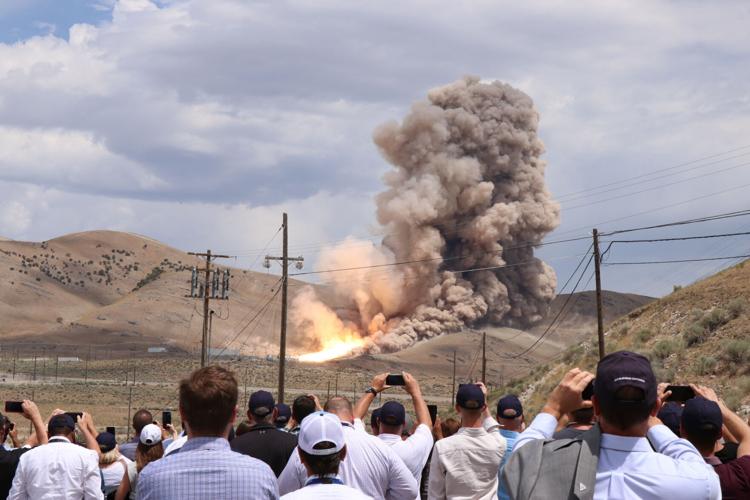
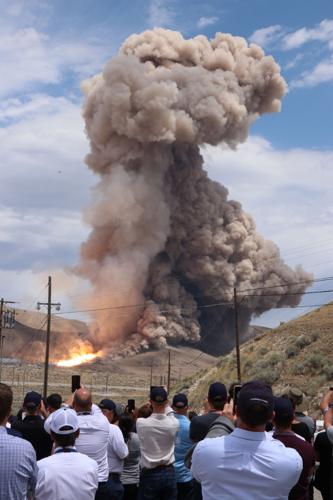
The Promontory facility is best known for the rocket motor test firings it conducts, sometimes inviting the public to witness the impressive show of power.
What the public doesn’t see are the countless hours of behind-the-scenes work at Promontory, where engineers are perpetually engaged in the research, development and design work that make space exploration possible.
The culmination of that effort comes on days like Nov. 16, when the unmanned Artemis I mission took off from Kennedy Space Center on a three-week mission to orbit the moon, a crucial step in NASA’s plans to send humans to walk on the lunar surface once again.
Northrop Grumman and other companies involved have been making preparations on site at Kennedy for more than two years. The process goes back even further than that at Promontory, where employees have been making modifications to equipment derived from the shuttle program, including booster segments that have been reclaimed and refurbished from previous shuttle missions.
Engineers have been busy modifying older designs and implementing new ones for the skirts, nozzles and other components of the booster to make everything fit to NASA’s exact specifications.
Promontory has also been the base for development and testing of the launch abort system, a motor that will separate the crew capsule from the rest of the launch vehicle in case of an emergency during future launches with astronauts on board. Since Artemis I is unmanned, it included an inert version of the abort motor so its mass and weight would be represented for data-gathering purposes.
It’s a highly complex process to bring all the different components together into one cohesive unit, making the successful launch especially gratifying to those who have poured so much effort into it.
Watching the rocket sit on the launch pad allowed Mecham to “really get a sense of the enormity of the vehicle as a whole,” he said. “It’s fun to be a part of.”
While some spectators weren’t thrilled with the 1 a.m. EST launch time, Mecham said seeing the launch against the backdrop of a dark sky on a crystal-clear night was unforgettable.
“The boosters burned for a little over two minutes, and with the naked eye you could see the separation, the boosters tumbling away (from the crew capsule) from 100 miles away or more,” he said. “It was phenomenal.”
As one of the world’s largest defense and aerospace contractors, Northrop Grumman has been involved with the space program since the 1960s. The company added the Promontory facility to its portfolio with the acquisition of Orbital ATK in 2018.
“Northrop Grumman has been pioneering in space for over 50 years and our contributions to NASA’s Artemis missions continue our incredible legacy of innovation,” said Wendy Williams, Northrop Grumman’s vice president of propulsion systems, in a press release celebrating the company’s involvement in the Artemis I launch.
Now under contract with NASA to provide ongoing support for future Artemis missions through 2031, the company’s ongoing work with the program bodes well for its workforce at Promontory and elsewhere in Utah.
Kendra Kastelan, Utah spokesperson for Northrop Grumman, said the company currently has some 350 employees working on the Space Launch System statewide and close to 500 nationwide — part of approximately 30,000 jobs in the government and private sectors that support the program.
“We like to say it’s a national effort,” Kastelan said.
The company is always planning years in advance and has already completed the booster segments for Artemis II and III, the missions that will first return humans to lunar orbit, and then to leave actual footprints on the moon for the first time in more than half a century.
Mecham said he and others who have been so deeply involved in the program felt a bittersweet moment following the Nov. 16 launch, as it represents the end of a chapter in their work. But the book is still being written, and they are looking forward to even bigger moments ahead.
“We at Promontory are continually working on the next flight because it takes a lot of time to get ready,” he said.

(0) comments
Welcome to the discussion.
Log In