

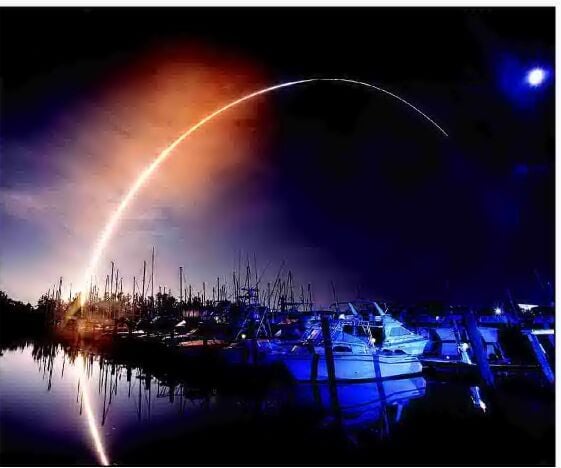
CAPE CANAVERAL, Fla. (AP) — A space capsule hurtled toward the moon Wednesday for the first time in 50 years, following a thunderous launch of NASA's mightiest rocket in a dress rehearsal for astronaut flights.
No one was on board this debut flight, just three test dummies. The capsule is headed for a wide orbit around the moon and then a return to Earth with a Pacific splashdown in about three weeks.
After years of delays and billions in cost overruns, the Space Launch System rocket roared skyward, rising from Kennedy Space Center on 8.8 million pounds (4 million kilograms) of thrust and hitting 100 mph (160 kph) within seconds. The Orion capsule was perched on top and, less than two hours into the flight, busted out of Earth's orbit toward the moon.
"It was pretty overwhelming," said NASA Administrator Bill Nelson. "We're going out to explore the heavens, and this is the next step."
The moonshot follows nearly three months of vexing fuel leaks that kept the rocket bouncing between its hangar and the pad. Forced back indoors by Hurricane Ian at the end of September, the rocket stood its ground outside as Nicole swept through last week with gusts of more than 80 mph (130 kph). Although the wind caused some damage, managers gave the green light for the launch.
An estimated 15,000 people jammed the launch site, with thousands more lining the beaches and roads outside the gates, to witness NASA's long-awaited sequel to Project Apollo, when 12 astronauts walked on the moon from 1969 and 1972. Crowds also gathered outside NASA centers in Houston and Huntsville, Alabama, to watch the spectacle on giant screens.
The rocket rode a huge trail of flames toward space, with a half-moon glowing brightly and buildings shaking.
The liftoff marked the start of NASA's Artemis lunar exploration program, named after Apollo's mythological twin sister. The space agency is aiming to send four astronauts around the moon on the next flight, in 2024, and land humans there as early as 2025.
"For the Artemis generation, this is for you," launch director Charlie Blackwell-Thompson called out, referring to all those born after Apollo. She later told her team: "You have earned your place in history."
The 322-foot (98-meter) SLS is the most powerful rocket built by NASA, with more thrust than either the space shuttle or the mighty Saturn V that carried men to the moon. A series of hydrogen fuel leaks plagued the summertime launch attempts as well as countdown tests. A fresh leak erupted at a new spot during Tuesday night's fueling, but an emergency team tightened the faulty valve on the pad. Then a U.S. Space Force radar station went down, resulting in another scramble, this time to replace an ethernet switch. "The rocket, it's alive. It's
creaking. It's making venting noises. It's pretty scary," said Trent Annis, one of the three men who entered the blast danger zone to fix the leak. "My heart was pumping. My nerves were going."
Orion should reach the moon by Monday, more than 230,000 miles (370,000 kilometers) from Earth. After coming within 80 miles (130 kilometers) of the moon, the capsule will enter a farflung orbit stretching about 40,000 miles (64,000 kilometers) beyond.
"It w"as pretty overwhelming. We're going out to explore the heavens, and this is the next step."
—Bill Nelson,NASA Administrator

(0) comments
Welcome to the discussion.
Log In