

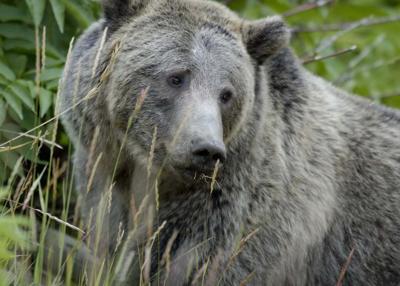
The female grizzly bear that attacked and killed a hiker at Yellowstone National Park last week has been euthanized.
The National Park Service said on Thursday that results from a DNA analysis confirmed bear hair samples found next to the body of Lance Crosby, 63, were a match for an adult female grizzly bear captured near the attack site.
Crosby’s body was found partially consumed last Friday in an off-trail area approximately a half mile from the Elephant Back Loop Trail near Lake Village. Investigators immediately placed bear traps in the surrounding area and captured the adult female grizzly and two of her cubs soon afterward.
Yellowstone spokesperson Amy Bartlett said euthanizing the female grizzly was a matter of public safety.
“We don’t want a bear running around the park looking at humans as a food source,” she said.
The results of the DNA analysis only confirmed what investigators had suspected all along. The grizzly and its cubs had been seen in the area when park officials arrived at the attack site, bear tracks were found around the body and puncture wounds inflicted on the victim were consistent with the bite size of the adult female sow.
Originally from Billings, Montana, Crosby was a long-term seasonal employee for Medcor, which operates three urgent care clinics in the park. An experienced hiker, he was reported missing on the morning of Aug. 7 when he did not report for work.
The Elephant Back Loop Trail and the Natural Bridge Trail were closed to the public after the attack. Both areas re-opened today.
The grizzly’s death has come as a blow to some wildlife advocates who were campaigning to save the mama bear. Bartlett said offices across the park had been inundated with calls throughout the week from concerned citizens from around the country pleading for the bear’s life.
A man named Richard Spratley launched an online petition urging clemency for the bear. As of Thursday night, the petition had received over 130,000 signatures.
The petition described the euthanized bear as a 20-year-old sow named Blaze, a popular grizzly who did not have a history of aggression. It also asked park officials to transplant the bear to a remote location far away from civilization.
“Despite hiking in the park for many years, this hiker carried no bear spray, wore no bear bells, and had roamed far off the trail,” the petition said. “He most likely surprised Blaze and her cubs in their natural environment. She did what grizzly sows are famous for doing: defending her cubs from a perceived threat. This was a grizzly being a grizzly in grizzly territory.”
Though the petition said the bear was acting defensively, Bartlett said investigators will probably never know the exact reason why the attack occurred.
“The bear didn’t act in a defensive way,” she said. “Normally a bear would look to neutralize the threat to themselves and their cubs and then retreat. But this bear decided to consume a significant portion of the body.”
Park officials also noted that the body was also cached, meaning the grizzly attempted to hide the carcass from other predators. When officials found Crosby’s body, his remains were covered with dirt and pine needles.
Though the mama bear in last week’s attack has been euthanized, the cubs’ lives have been spared.
The National Park Service said yesterday the cubs will be transferred to a facility accredited by the Association of Zoos and Aquariums. The name of the facility is expected to be released today.
“The cubs couldn’t have survived on their own without their mother, so we’re glad we were able to find a facility for them,” Bartlett said.
Human fatalities from bear attacks are relatively rare in the United States. Instances when the bear consumes the victim are even more uncommon. That is what makes last week’s case in Yellowstone so unusual, particularly since this is a time of year when bears’ regular food sources, such as berries, are plentiful.
But Bartlett said it is a common practice across the United States to euthanize bears that have fed on human victims, not just to protect the public, but to protect other bears as well.
Before last week’s incident, the last two confirmed instances of bears in Yellowstone killing humans occurred within a two-month timeframe in 2011.
On July 6, 2011, Brian Matayoshi, 57, was clawed and bitten by a grizzly while hiking with his wife on the Wapiti Lake Trail. The investigation found that Matayoshi was attacked because a female grizzly perceived him as a threat to her cubs. But unlike in the Crosby case, the bear retreated after the attack and did not feed on the body.
A month and a half later on Aug. 24, hiker John Wallace, 59, was killed in a predatory bear attack on the Mary Mountain Trail near Old Faithful. Investigators could not verify that the same bear that killed Matayoshi also killed Wallace. But Bartlett said officials did prove that sow fed on Wallace’s dead body.
As a public safety measure, officials trapped and euthanized the grizzly soon afterward.
The grizzly bears in Yellowstone National Park were first listed as endangered by the U.S. Fish and Wildlife Service in 1975, when the park’s population dropped to below 150.
In the 40 years since the listing, the grizzlies have made a strong comeback, with between 750 and 800 grizzlies now living in the Greater Yellowstone Ecosystem.
Though it is illegal for animals protected under the Endangered Species Act to be killed, exceptions are made if an animal poses a serious threat to humans.


(0) comments
Welcome to the discussion.
Log In