

I’ve been ordering the owl species in this series based on my experience with how common these species have been in my life. Your experience undoubtedly has been different! It would be a pretty dull world if we all walked the same path.
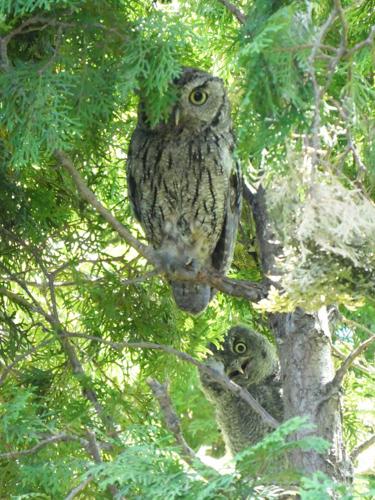
Next up for me is the western screech-owl. I’ve written at some length about this species before (April 29, 2020, and Feb. 10, 2021) so I won’t say too much more here. Because they nested in our nest box in two recent breeding seasons, I’ve spent hundreds of hours watching them through the video camera in the box. But when it comes to just blundering into this species out in the country, I have not seen them all that often. The Birds of Idaho Field Checklist classifies them as common everywhere in Idaho, except in the Panhandle. As with all nocturnal owls, the difference between their biological commonness and how commonly you see them is pretty different.
The screech-owls I’ve seen outside my own yard have been in the foothills and along the Boise River. In each case, there was a known nest, and you could reliably find the male perched nearby during daylight hours. But you have to know where to look. Even when our own owls were fledged and I knew where they were spending the day, it would sometimes take me several minutes to locate them. So, trying to find screech-owls in the woods just by scanning around is an enterprise with a low success rate.
Western screech-owls begin courting in January and February, depending on your latitude. The males start giving their distinctive calls then, and the females respond. The birds that have been in our yard have called a lot and have been pretty loud. They have awakened me at night through a closed window and pulled drapes. OK. Maybe the window was slightly cracked … just in case.
If you want to find your neighborhood screech-owls, you could drive around after dark in those months and listen for birds calling. Of course, your neighbors will think you’re a weirdo or a criminal. All the Ring doorbells will send alerts willy-nilly. Just be sure that all your open containers are mugs of hot chocolate and tins of cookies. And if you locate some owls, it will obviously be worth it.
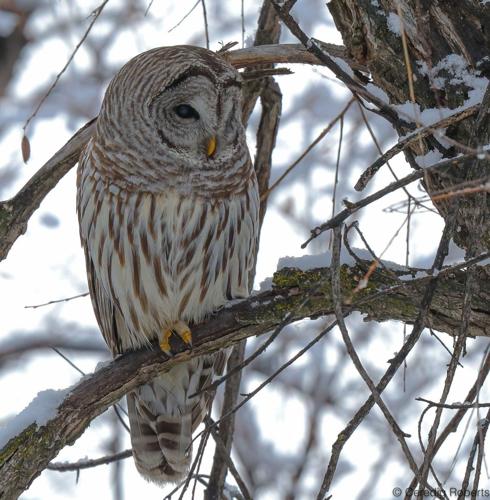
My next owl is the barred owl. But as I wrote earlier, this is based on my experience growing up in Wisconsin, not on my experience in Idaho. I well remember my first nocturnal field trip for my undergraduate ornithology class in January 1971 to the Wisconsin River Bottoms near Sauk City. It was below zero, and the snow was cracking beneath our boots. Even as a reasonably experienced outdoors kid, I thought maybe that outing was a little nuts.
Our professor told us to stop and be quiet. He then gave a short series of owl-like calls. Almost immediately, we heard the most bizarre series of cries, squawks, howls, and hoots that I had ever heard — by far. Our professor had not said what we were after (he just said, you’ll see), and I’m sure I was not alone in thinking, what the heck?!?! It sounded like two witches that were very unhappy about something. I half expected to see bolts of lightning or fire hurled our way.
Arthur Cleveland Bent (1938) describes barred owl vocalizations this way. “The antiphonal hootings of a pair of these owls, heard at any time during the day or night, will hold the hearer spellbound; when heard close at hand at night, they are fairly startling, as if a pair of demons were fighting.” True!
William Brewster (1925) writes, “Both sexes take part in them and sometimes as many as three or four birds will be gabbling and laughing at once or in unbroken succession, making the woods ring with their almost deafening clamor, perhaps for minutes at a time.” He adds that he heard a “ … prolonged and cat-like scream … . Although coming from a distance of nearly half a mile, this outcry was so loud, so piercing and expressive of ferocity as to be very thrilling.”
Barred owl sightings around Boise over the last ten years from December through May are almost always of a single bird. So, these are probably one or more individuals dispersing through the area. We are not likely to hear these exceptional vocals until we get one or more breeding pairs. And we might just get them.
This species has been expanding its range into the western U.S. for some years now. Changes in the ranges of native species are natural phenomena that we normally just track and seek to understand. But this expansion has gotten the barred owl into trouble because it started invading spotted owl habitats. Barred owls are larger and more aggressive and displace the spotted owl. That too, would be alright except that the northern spotted owl subspecies is federally listed as a threatened species in Washington, Oregon, and California. The removal of barred owls to help spotted owls has sparked enormous controversy. We won’t settle that here.
The next species is protected in eBird in that the exact locations of birds are not shown in their species maps. That’s because great gray owls are very tame, and bird photographers frequently approach them too closely and stay around too long. The owls may seem to be cool about it, but we are concerned about stressing them in winter when they might already be stressed due to lack of food.
I recall a bird in the Boise area a few winters ago when photographers were not content to get a photo with a 500mm lens from 30 feet away but insisted on getting closer and closer. DON’T DO IT! Imagine the bird flushing and getting killed by a car if that’s what it takes for you to back off.
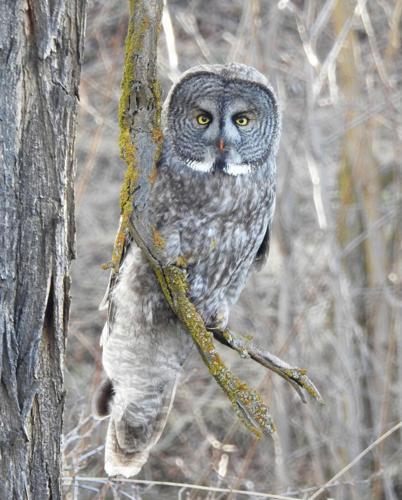
Great grays are larger than great horned owls by size, but not by mass. That extra size is in its feathers, which are needed to insulate it during the bitter winters of its Boreal Forest habitats. This species also occurs across the forests of Siberia.
My first great gray was near my hometown in southern Wisconsin many decades ago. I’ve since seen several in western Wyoming, western Montana, eastern Idaho, the Blue Mountains, the Boise area, and near Shoshone. Most of these sighting were just dumb luck. The one near Shoshone sticks out because it was out in the sagebrush just south of the Picabo Hills. The bird perched in large sage, on fenceposts, and on the ground. My friend and I took some photos and left it alone (the Kodachrome 24 slides are here somewhere).
I still wonder if that bird spent time in the sage or if it was just crossing to the forests south of Twin Falls. There were a lot of greater sage-grouse wintering in the area south of the Picabo Hills in the early 80s. But according to Birds of the World, both grouse and jackrabbits are too large for great gray owls to handle. If this bird did hang around, it was probably finding more familiar small mammal prey items. They are capable of diving at least 18” into snow, even crusted snow, to catch mice, voles, lemmings, and shrews.
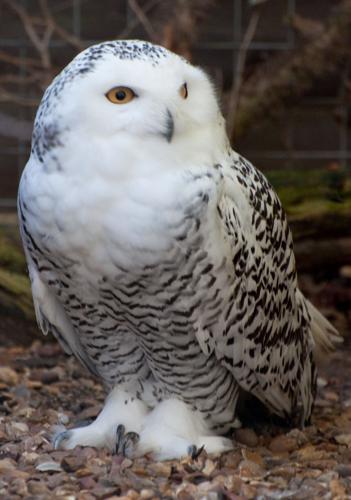
I’m now getting to owls that I haven’t see very often anywhere. I’ll never forget my first snowy owl. I was driving from Grand Forks, North Dakota, back to our home in Dickinson after the annual conference of The North Dakota Chapter of The Wildlife Society. It was February, snowing hard, and I was happy to be in a 4WD for a trip that now seems kind of insane. Plus, I was taking the scenic route to avoid 6 hours on the oh-so-boring interstate highway. By the way, they’re all boring.
As I was cruising along some lonely highway, I suddenly spotted a snowy owl sitting in the top of a small sapling in the fence line. I had not expected to see anything, despite being on the scenic route, because of the storm. I pulled over about 50 yards away. The owl was swaying vigorously as the storm buffeted the little tree. I’ll never forget the piercing gaze of its black eyes, watching me as I was watching it. I didn’t want to bother the bird more than I had, so just pulled out and around to resume my trip. The bird did not watch me leave, apparently being concerned with more important things.
I wrote some details about snowy owl occurrence in our area in last week’s column, so let me finish today with another story. The year after the barred owl encounter above, I was serving as an undergraduate TA for that same ornithology class. There was an area about 30 minutes from the University of Wisconsin where snowy owls had been spotted in past winters. We took a Saturday field trip to check it out. After scanning the landscape at various locations around Goose Pond, we were about to give up and go home.
Suddenly, I spotted a large white form with black eyes sitting at the base of a fence post about 100 yards away. I was so excited I could hardly stand it! We got all the spotting scopes and binoculars in on the right spot. About 25 students and the professor were watching for the owl to move so we could get a better look. Just then, a big white cat stood up and walked away.
Sometimes you get the bear. Sometimes the bear gets you.



(0) comments
Welcome to the discussion.
Log In