

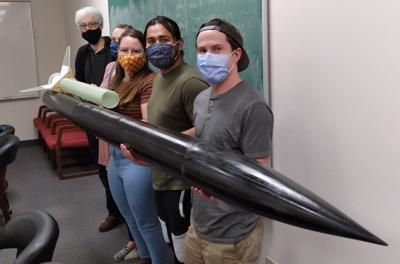

Launch day will be three years in the making for Idaho State University Professor Marco Schoen and his mechanical engineering students.
For the past three years, his student teams have worked on designs, logistics, calculations, software, circuitry, GPS tracking systems and internal cameras on their quest to build a rocket capable of flying 10,000 feet into the atmosphere.
Their rocket has been grounded by the COVID-19 pandemic, but the team expects to witness a long-awaited liftoff this summer.
The students won’t meet their original goal of entering their creation this year in the Spaceport America Cup, which is an international aeronautics competition hosted annually in New Mexico. Teams representing universities from throughout the world usually compete in three categories: a 10,000-foot launch, a 30,000-foot launch and liquid-fuel rockets. For a second consecutive summer, however, the Spaceport event has been canceled due to the pandemic.
Schoen and his students, however, are committed to testing their rocket, nonetheless. They’re exploring options to take flight this summer at any number of scheduled rocket launches in surrounding states organized by a nonprofit amateur high-powered rocketry organization, called the Tripoli Rocketry Association.
“We want to launch. We are sick of waiting,” Schoen said.
Students in Schoen’s senior design class started planning the rocket three years ago as their final project. The students, along with Schoen and Kelly Wilson, who is the lab coordinator for mechanical engineering, also applied for a roughly $15,000 NASA EPSCoR grant, which was awarded to benefit ISU students the following year.
That next class ordered parts and came up with a basic design. The design, however, was never completed, as Spaceport called off its competition due to COVID-19, and some of the parts were ultimately returned. Though the NASA grant specified participation in the Spaceport competition as the ultimate goal, the students were granted a one-year extension.
During the recently completed school year, after Spaceport announced preliminary plans to resurrect the competition, another team of senior design students continued the work for their final project.
COVID-19 slowed their progress as the students couldn’t meet in person. Nonetheless, they proved the concept by building a smaller rocket with a similar design, which they launched 1,000 feet high on the ISU campus.
Yet again, however, the Spaceport competition was called off due to COVID-19. Unwilling to delay launching any longer, the students have begun investigating other launch options.
The current team members — Peggy Beck, Matthew Vadnais, Kyler Bingham, Andrew Anderson, Parker Wegrowski, Shishir Khanal, Nusrat Farheen and Bishal Neupane — have further improved on the design and built the full-scale rocket, which is undergoing final tweaks. They’ve continued to work on the project as a club since the class ended. Greg Spohn, with the Tripoli Rocketry Association’s Idaho chapter, has served as an external volunteer and consultant.
Khanal is a graduate student who has participated in the project for the past two years, overseeing one of the internal cameras that will video the rocket’s ascent. He’s optimistic he’ll get to witness a successful launch this summer.
“They say the third time is the charm I guess,” Khanal said.
He’s working on jet engines for his master’s thesis and plans to make his career in aerospace.
“I’m from Nepal and we don’t have any infrastructure related to aerospace there. It’s been really awesome to learn rocket systems,” Khanal said. “...I feel like I’m living my dreams.”
The fiberglass and carbon fiber rocket will fly into commercial airspace, with simulations showing its peak height will be just under 2 miles, and the flight will require special clearance from the Federal Aviation Administration.
It will pack an 8-pound payload, including six cameras and two GPS recovery systems. A small parachute will deploy initially, followed by a larger parachute when the rocket falls to just 1,000 feet from the ground.
Beck will paint Bengal tiger eyes and teeth on the cone; along the shaft she’ll add the NASA logo and “Idaho State University mechanical engineering.” Beck is the team leader. She designed the GPS tracking systems — one of them utilizes text messaging, and the other is computer guided. She also designed the layout of all of the electronic components.
“The neat thing about these projects is it gives students hands-on experience to learn certain things,” Beck said. “As a mechanical engineer they don’t typically give us much exposure to electronic components. ... It’s going to open doors.”
Beck, originally from Rigby, is a McNair Scholar who has earned an assistantship to cover graduate school at Virginia Tech, where she intends to pursue a Ph.D. in aerospace. The McNair Scholar program offers funding and guidance to low-income, first-generation and minority college students.
“I happen to be all three,” Beck said. “I’ve only met two female mechanical engineers in my life.”
Beck has been mechanically inclined since childhood, when she’d help her father work on vehicles, roof buildings and renovate apartments. She’s passionate about space exploration, physics and science.
Schoen, Wilson and the mechanical engineering students have applied for another NASA grant to continue the project into the next school year. They remain committed to entering the rocket in Spaceport as soon as the competition returns.
“ISU does not really have very much in terms of space exploration or aerospace. It’s a mechanical engineering department,” Beck said. “Working on this project has helped me specifically discover my passion for space exploration. This rocket is my first love in terms of space, and I want to see it fly.”

(0) comments
Welcome to the discussion.
Log In