

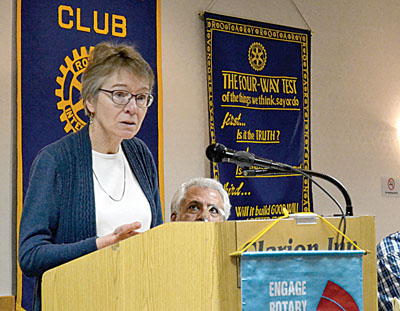
POCATELLO — Clinical psychologist Paula Seikel deals with depression and students who consider suicide as part of her job with the Idaho State University Counseling and Testing Service. Thursday she shared statistics, observations and ways people can help reduce the possibility of suicide with Pocatello Rotary members.
“It’s a serious and difficult to talk about topic,” Seikel said.
And it’s one Idaho can’t ignore because it’s the second leading cause of death for people ages 15 to 34. In 2010 — the most recent year available for statistics — Idaho ranked sixth in the nation for suicides per 100,000 people. Region 6, which includes Pocatello, had 34 people commit suicide in 2012.
The number of suicides recorded from 2008 to 2012 in Southeast Idaho show Bannock County had 96; Bingham, 36; Bear Lake, 8; Caribou, 8; Franklin, 10; Oneida, 4; and Power, 4.
“Everyone in this room has been touched by suicide,” Seikel said.
The psychologist said she was speaking from personal experience. Three of her childhood friends had committed suicide by the time she was a sophomore in college.
“When we think about any young person dying, it’s tragic,” Seikel said, adding that people who are close to a suicide victim are faced with a mix of emotions. They include anger, shame, guilt and a sense of hopelessness.
“It’s so much more painful when it’s someone who is young,” Seikel said.
The ISU counselor said one in six high school students contemplate suicide and males are more likely to complete the act with firearms being the most likely method of choice.
So why do young people commit suicide?
“It’s never one thing,” Seikel said, adding it is usually the result of a “complex set of events.”
Hopelessness is a key component.
“They don’t see their lives getting any better,” Seikel said. “They feel trapped. People who are suicidal get into this tunnel vision.”
According to the psychiatrist, rejection or fear of rejection is a big factor for teens. Seikel said this perceived rejection can come from the peer group, parents or the faith community. Bullying is another factor and Seikel said social media has compounded the realm of young people being the targets of ridicule.
Other factors include being male, Native American, Hispanic or a member of the gay, lesbian, bisexual, transexual or gender questioning community, according to statistics.
“Members of the LGBTQ community are four times more likely to commit suicide,” Seikel said. That number doubles when those young people are rejected by their parents.
What can a community do to help lower suicide numbers?
Seikel said a community needs to be aware of the danger and begin working with children at an early age. She said the state also needs to fund and support school counseling efforts.
“We need adequate counselors and small class sizes so kids don’t fall through the cracks,” Seikel said.
She said adults need to talk honestly with young people and parents shouldn’t shy from addressing the issue if they suspect their child is having a hard time.
“Listen closely and validate how they’re feeling,” Seikel said. “It’s super important to listen. They need to know there’s a future for them.”
Seikel also said it is important to remove access to firearms in a home if someone is showing signs of suicidal thoughts. And she said if someone close seems truly suicidal, it’s time to call 911.
“Don’t wait until tomorrow,” Seikel said.
Resources to help people dealing with suicidal behavior can be secured from the Suicide Prevention Action Network of Idaho at www.spanidaho.org or by calling 208-860-1703. The National Suicide Prevention Lifeline can be reached at 800-273-TALK (8255).
Suicide rates are higher in rural Western states and Seikel said two factors may be at play — more access to firearms and the lack of mental health services.


(0) comments
Welcome to the discussion.
Log In