

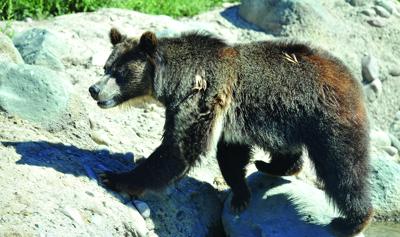
POCATELLO — There's no doubt who wears the big claws at the Pocatello Zoo's Sarah W. Ifft Grizzly Bear Exhibit — it's the old matriarch, Stripes, who has called the zoo home for 28 years.
Since last August, Stripes has shared the exhibit with a young female “problem bear” rescued from the Shoshone National Forest near the Pahaska Tepee Resort outside of Cody, Wyoming. The young 3-year-old bear has been named Shoni. And although the two bears were socialized this spring after spending the winter sniffing each other through steel mesh inside their holding pens, Stripes still calls the shots.
Zoo superintendent Peter Pruett said the larger exhibit in Pocatello, which includes a pond, stream and berm area as well as almost an acre of free space, gives the bears ample room to co-exist.
“They knew about each other for the whole winter,” Pruett said. “When spring came, a day and a half later they were on exhibit with each other.”
The zoo staff is pleased with the relationship the two bears have established.
Shoni has the energy of a young bear and pushes Stripes to be more active. However, the younger, smaller bear knows where the boundaries are.
As Stripes waited for feeding time Thursday afternoon, she would pivot and stand in a stark warning to Shoni that included a muffled growl when the smaller bear came too close too her first-place position in the chow line.
“Stripes is twice her size,” Pruett said.
The superintendent said bears are very intelligent, and Shoni has learned where the boundaries are as well as responding to training from staff, so she shows her paws and lets her shoulder lean against the steel mesh when medical treatments have to be made.
“They sleep next to each other as long as there is the pool or logs between them,” Pruett said about the outside exhibition space. “It's been a really fun time.”
Because they are omnivores, both bears receive a mixed diet of meat, vegetables and fruit. The zoo's bear handler, Jim Bienemann, said Stripes consumes about 12 pounds of special omnivore feed each day, and Shoni eats about nine pounds. In addition, the bears are fed ground beef and vegetables in the spring and summer and are given more fruit in the fall.
“We try to follow their natural diets,” Pruett said.
Because they have easy access to food year-round, the grizzlies don't hibernate like their wild relatives.
Pruett said as climate change has reduced the severity of winters and allowed more accessibility to food sources, even wild bears have stopped hibernating as much, if at all.
The superintendent said having two bears interacting makes the exhibit much more exciting for visitors, and he encourages everyone to take advantage of the opportunity to watch grizzlies up close and personal.


(0) comments
Welcome to the discussion.
Log In