

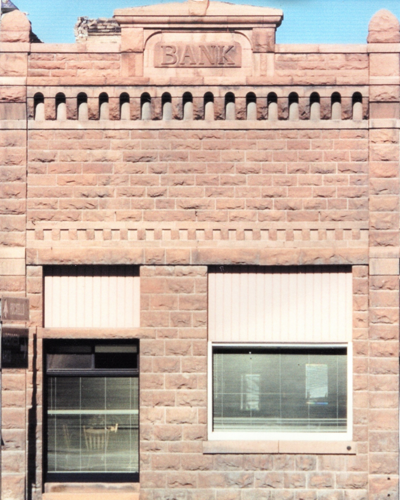
In the very earliest days of Blackfoot, when tents outnumbered wooden buildings along the railroad tracks, the Bank of Idaho, run by Judge Morgan, opened a location in the center of Main Street across from the Steven-Danilson Store. At the same time, Charles Bunting, already the owner of a general store and a forwarding business, opened a casual banking business in a corner of his store — hardly more than a desk and a shelf of the store’s safe. Both these banks met the same end. A check was presented for payment that exceeded the cash on hand at the bank and the presenter refused to wait for his money. Judge Morgan had already realized that he was low on cash and had made arrangements for more to arrive on the next train. He explained this to the presenter, but the man refused to be patient. When this type of thing happened, the court immediately stepped in and the bank was ruined. Bunting saw an opportunity to enlarge his banking enterprise at this time and took over the location of the Bank of Idaho, then later built two splendid buildings that still stand on Main Street — one, a larger, grander store and the other, a handsome, fully appointed bank. After 10 years in banking, Bunting was, himself, presented with a large check that his bank could not cover. Again, the bank went into the hands of a court-appointed trustee. County and state funds were lost in the failure of the Bunting Bank as well as untold dollars belonging to area families, farmers, ranchers and businesses. The year was 1897.
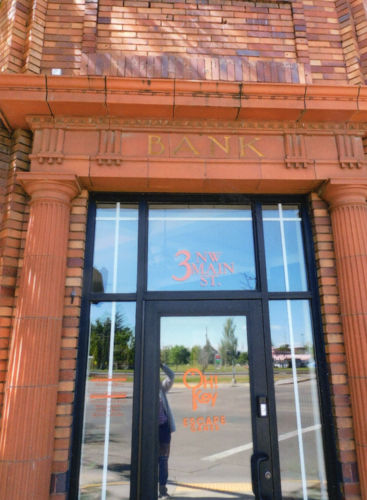
Standrod Bank soon opened in Bunting’s bank building. The newspaper announcement read “our people will rejoice that we again have banking privileges at home.” In 1912, Standrod Bank moved to its new home at 3 NW Main. All went well until December of 1923, when this bank failed. Blame was laid on loans to farmers who suffered crop failures and could not pay out their debt. At the same time, W.F. Berryman, the bank’s cashier, was arrested for embezzlement. He was later cleared of the charges, and though the two events have been linked at times, the newspaper articles of that year treated them as unrelated.
In 1904, Alexander Younie put his cowboy life behind him and opened The Blackfoot Bank. It was structured as an agricultural bank with no consumer lending. T.H. Christy was the manager, and Younie was the president. The name was changed to First National Bank of Blackfoot in 1905, when it was granted a national charter. The bank eventually occupied the beautiful white building on the corner of Bridge and Broadway that can only be viewed in Blackfoot’s older street photos. It was still operating in 1921, according to public records showing a long list of foreclosures filed against borrowers. This bank successfully weathered the Depression and was merged into Idaho Bank and Trust in 1933.
Next up was the Blackfoot State Bank located in the corner of Main and Pacific, opening in May of 1907, with J.O. Morgan as president and Dr. C.A. Hoover as vice-president. This bank faced its first trial in 1911, when it was declared insolvent and placed under receivership. It was widely advertised that this bank carried $20 million in deposit insurance. Whether the insurance paid out, or the investors shored up the bank, could not be determined, but the bank was back in operation by 1913, when the next setback occurred. The cashier was accused of embezzlement. He was convicted at trial, but the Supreme Court found irregularities in the handling of the trial, and the verdict was set aside. One more insolvency claim in 1917 closed the story of Blackfoot State Bank.
Blackfoot City Bank began on July 9, 1917, founded by some of Blackfoot’s big names — Peter G. Johnston, James Duckworth and J.C. Millick. It took the corner spot in the Eccles Hotel Building with its marble and fine woodwork decor. This was a quiet, well-run bank with conservative lending practices, and they remained solvent even through the foreclosure years. Their board contained two members of the Eccles family, and this bank was included with all the other Eccles banks in the formation of First Security Bank in June of 1928.
Of the six banks of early Blackfoot, two have continued into our lifetimes through mergers and name changes, while four others have faded from memory. We are left with two grand buildings in the first block of NW Main — The Standrod Building at 3 NW Main and the Bunting Building at 59 NW Main — that still display the word “BANK” above their doors and still have a vault in the corner as if they are waiting to open for business again.




(0) comments
Welcome to the discussion.
Log In