

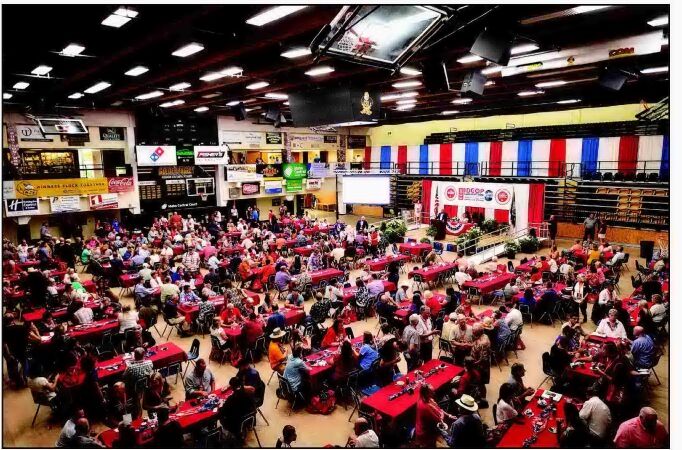

Idaho's dominant political party charted a new direction for itself over the weekend at its state convention, not only replacing all current members of the GOP state party leadership, but also approving an array of resolutions, rule changes and platform modifications favored by the farthest-right wing of the party.
"My concern is a purge has begun," said Gem County delegate Steven Thayn, a current GOP state senator from Emmett who attended his first state GOP convention in 1972 at age 18, the first year that 18-year-olds were allowed to serve as delegates. "What you see here is basically wanting to achieve unity through purity," he said.
The three-day convention in Twin Falls, attended by more than 700 delegates from across the state, approved 14 resolutions, nine platform changes, and one sweeping proposed rule change, which would allow party officials at the county, legislative district and state levels to endorse and donate to candidates in primary elections, and even to block disfavored ones from running by determining they're not really Republicans.
In addition, the proposed rule change, and a matching resolution that also passed, would sharply restrict who can vote in Idaho GOP primary elections. If approved by the state party's standing Rules Committee in January and then by the Legislature, the rule change would block anyone who hadn't affiliated as a Republican at least 12 months in advance from voting in the primary, along with anyone who's disaffiliated from the party, affiliated with a different party, or even donated to a candidate from another party within the last two to three years.
"I think it was inevitable," said Ada County delegate Ryan Davidson, a GOP county commissioner, amid rising concerns about "crossover" voting by Democrats in the closed GOP primary. "The feeling was what we're doing now doesn't work, so they wanted to be a lot more restrictive. Whether this can actually be translated to legislation and enforced remains to be seen."
Twin Falls County delegate Grant Loebs, the current elected GOP county prosecutor there, said he doesn't see any legal or constitutional issue with the proposed change. Under court precedents, he said, the party is essentially treated like a private club. "If the Republican Party club chooses to say that our membership is only open to people who don't give money to the anti-Republican club, then they can do that," Loebs said. "Whether it's wise to do and whether it's a good policy is another question, but I think it's legal."
The rule change goes next to the standing Rules Committee during the GOP state Central Committee's winter meeting in January. "If they adopt that rule, then they forward it to the Legislature," Loebs said. "The courts have said that legislatures have to enact the legislation that expresses the will of the party, if the party expresses a desire to close their primary. And I think this would all be looked at in the same way."
However, Loebs said he doesn't support the move. "I think that it is unwise to put a lengthy period of time that keeps people from changing their membership from one party to another, because I think it restricts the ability of Republicans to attract people from other parties who sincerely want to change," he said. "I think that'd be a real disincentive for people to switch to the Republican Party, because it tells you for that period of time, they can't participate."
That was far from the only controversial change party delegates approved at their convention. After an emotional debate, they overwhelmingly rejected a motion to amend the current platform's vehement opposition to all abortion, under all circumstances, to include an exception to prevent the death of the mother.
That motion was defeated on a 412-164 vote.
"I expected that," Davidson said. "Because passions are so high at the convention, you're trying to get everything you want. You don't want anything watered down. … There's a lot of Republicans that are very pro-life and don't want the exceptions."
He added, "Floor debates are not the best place for a nuanced discussion of a lot of policy issues. You have 700 people there, it's chaotic. … It was hot all weekend. People were sweating, crammed in there like sardines."
Other major proposals approved at the convention include a resolution calling for all elections in Idaho other than judicial elections – including non-partisan municipal elections – to be reclassified as partisan. Davidson said he's long supported that. "State law was that they're non-partisan, but it seemed like at the end of the day, they were non-partisan in name only," he said.
He noted that Ada County Republicans have been increasingly involved in city elections, including successfully pushing for the election of current Boise City Councilor Luci Willits, a Republican.
There also were resolutions approved to remove all Democrats from the currently evenly bipartisan state Redistricting Commission, by disqualifying any party from participating if it hasn't elected at least two state constitutional officers in the last 10 years; opposing the use of student identification to vote and requiring voters to show proof of U.S. citizenship before they can cast a ballot in "any and all elections," which was proposed by new state party Chair Dorothy Moon; and directing the party to dismiss a lawsuit former Chairman Tom Luna filed against the Bonneville County GOP Central Committee for violating party rules in its actions endorsing and donating to primary election candidates. Brian Almon, an Ada County delegate who was attending just his second state party convention, said, "I think most of them perhaps restate, perhaps with stronger language, the philosophy of the Republican Party. Obviously with the change in the officers, the new chairman and the other executive board officers, it shows, I think, a stronger voice from the conservative Republicans."
"I think among some, that there's been some frustration with the focus of the party leadership being on metrics such as fundraising and voter registration," Almon said, "while perhaps paying less attention than they would like to ideological concerns, how closely should our candidates stick to the Republican platform, for example. I think they will have more of a focus on having that discussion, about ideology, about philosophy, about what does the party stand for."
Thayn called that a victory for the "I don't know what you call it, the Wayne Hoffman wing, probably the libertarian wing of the party. … I see them imposing their own form of elitism or tyranny. … They're trying to impose their principles."
"I think it's a different form of tyranny," he said. "I haven't supported the other forms. I don't support this form."
Thayn, who lost his re-election bid in the May primary against fellow incumbent GOP Sen. C. Scott Grow, R-Eagle, said, "I wish the new party leadership well, but I think they have this tendency for 'purity' that is going to cause campaign funds to dry up, and people are going to not feel welcome in the party. And I think that's unfortunate."
Proposals that didn't pass included one to disavow the results of the 2020 presidential election, which didn't get out of committee; and a resolution proposed by Scott Herndon and Cornel Rasor of Bonner County to do away with the primary election entirely in favor of party caucuses, which also didn't get out of committee. Also rejected was a proposed platform amendment from Herndon to declare in the platform's preamble that party members are Republicans because "we place our faith in our Lord Jesus Christ as our Creator, our Defender and as our Provider for instruction in human government."

(0) comments
Welcome to the discussion.
Log In