

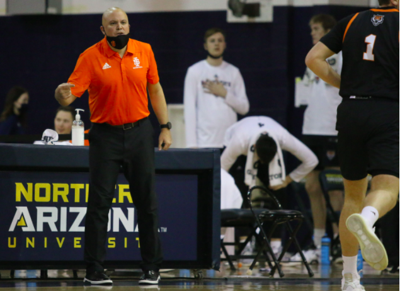
The series wasn’t about nostalgia for Ryan Looney. Just as it wasn’t last year, when the Idaho State head coach added his alma mater Eastern Oregon to the Bengals’ schedule. It was about giving back. This season especially.
Small college basketball programs are hurting in the COVID era. Revenue is dropping. So is scholarship money. Some schools, including a quartet in NAIA, felt they were past the point of no return and just pulled the plug on their basketball teams.
Looney's moved on from Eastern Oregon, fulfilling his dream last year to become a DI coach when he took the Bengals’ head coaching gig. He’s riding up the coaching escalator and as he ascends, Looney looks back at all the places and people who have helped him and wants to repay the favor.
One way he does that is by going out of his way to schedule Eastern Oregon on Idaho State’s non-conference schedule. It not only supplements a small program with a dose of much-needed cash.
Looney, a Mountaineers guard back in the 1990s, understands that the NAIA life is not all that glamorous. Playing a DI school on the road is an experience, one that non-DI programs clamor for.
For Eastern Oregon, it’s good to have friends in high places.
“It’s great because those opportunities are few and far between,” said Robert Cashell, a former EOU Athletic Director who now serves as the Cascade Collegiate Conference Commissioner. “To have people who have had the good fortune to move from our league to the Big Sky or another league and to have them reach back and say, ‘We’re going to help where we came from,’ it’s awesome.”
But this year, no matter how many times Looney has tried to schedule his alma mater to play in Pocatello, something has come up. Idaho State and EOU had a standalone game scheduled for Dec. 15, but it was nixed after Oregon’s governor, Kate Brown, said that the Mountaineers couldn’t travel outside the state without having to endure a 14-day quarantine when they returned.
A few weeks and a few more cancellations later, Looney tried to max-out ISU’s six games against non-DI opponents and bring Eastern Oregon to Pocatello for a two-game set. The reunion was so close. The cash flow was so close. The basketball was so close.
And, it turns out, COVID was so close. The Mountaineers discovered pandemic issues within their program and had to cancel.
We’re just over two months into Looney’s second season at Idaho State and, well, it hasn’t been easy. An assistant coach left the team mid-season. Myriad guys transferred. And COVID seems to disrupt the Bengals every other week.
In a way, that struggle is a lot like Looney’s time in La Grande, Oregon.
****
Before Robert Cashell was Ryan Looney’s boss, he went by ‘Coach.’ Cashell was an assistant at Montana Western in the early-90s, and he recruited and coached Looney for a little bit before a new coach joined the program and led both men out.
Years later, they ended back up at Eastern Oregon together. Cashell was the Mountaineers AD, looking to replace longtime EOU coach Art Furman and transition the program out of dual-affiliation. Back then, Eastern Oregon was a a part of Division III and NAIA, which forced the Mountaineers to follow stricter rules than their counterparts. Most importantly, EOU couldn’t give out scholarships.
In 2004, Eastern Oregon became solely an NAIA school. Cashell needed a fiery, hard-working coach to guide the down-trodden program through its next chapter. He thought of his former player, the 28-year-old in the infancy of his coaching career.
Years later, Looney laughs about his first day on the job. An old teammate at Eastern Oregon walked into his office. He was still in school. Looney was the head coach. Looney said he wasn’t naive to all the extra head-coaching responsibilities — administrative paperwork, recruiting, dealing with off-the-court conduct — but was perhaps a bit innocent about how hard the job was going to be.
But Cashell knew Looney’s appetite for grinding would overcome any lack of experience.
“I knew everywhere he had been — even though he hadn’t been a head coach yet — they had been successful,” Cashell said. “Everyone I talked to that he worked for expressed (compliments about him) … There was no doubt in my mind he was going to outwork — success wasn’t going to be based on a lack of effort.”
Yet, even with Eastern Oregon losing its dual-affiliation status, Looney still wasn’t working with much. Back then, NAIA was split into two divisions. EOU was in NAIA Division II. All that really means is it was capped at a half-dozen scholarships. But, because of a tight budget, Looney was only allowed to give out one-and-a-half scholarships, a number that crept up over time.
Recruiting to La Grande is a lot like recruiting to Pocatello. Not easy. But at least now Looney can hand out ample scholarships. Back then, he was trying to get kids to Eastern Oregon with no financial incentive, only able to sell them on himself, on his new program. Like anything with cash constraints, it led to some creativity.
“We had an interesting plan,” Looney said. “I’m originally from Spokane and my sister, at that time, lived in Seattle, so either myself or (assistant coach Isaac Williams) were driving, staying with my parents in Spokane or driving and staying at my sister’s house in Seattle. Then just camping out and trying to see as many players as we possibly could.
“The interesting thing EOU had going for it was it had no out-of-state tuition,” he added. “So our plan was to go to the state of Washington, identify as many kids as we could from that state and bring them to EOU.”
It worked. In Looney’s five seasons at Eastern Oregon, the program graduated its all-time leading scorer, rebounder, passer and pretty much everything else. After a 6-20 season in Looney’s debut, the Mountaineers ascended. They won 20 games two years later, then won the school’s first NAIA Tournament game and, in Looney’s final season, reached the NAIA Elite Eight.
La Grande started to care about EOU basketball, about Looney’s program.
“It was standing-room only. We never turned anyone away, but we were jam-packed. The student section was like three feet from the court and it was a wild time,” Cashell said. “He turned us around … We went from non-existent to a powerhouse.”
Looney replicated that prosperity at Seattle Pacific and Point Loma Nazarene. Now he’s trying to build it at Idaho State.
“Those experiences make me believe that we can do it here,” Looney said. “Whether you’re a player or coach in this profession, especially at this level, you have to have a lot of confidence in yourself.”

(0) comments
Welcome to the discussion.
Log In