

POCATELLO — Potential use of force is part of police work. Continual officer training and an understanding of the law help keep that force from being excessive, according to Pocatello Police Capt. Roger Schei.
In addition to being in charge of the patrol division at the PPD, Schei is one of Idaho’s few master instructors in police defense tactics.
The recent incidents in both Ferguson, Mo., and New York City that led to the deaths of two black men and grand jury decisions that the officers involved did not commit a crime has heightened awareness for the need to train officers, according to Schei.
In Ferguson, white city police officer Darren Wilson shot 18-year-old Michael Brown, who was black, multiple times after a confrontation escalated on a city street in August.
In New York City, white police officer Daniel Pantaleo applied a neck restraint on black suspect Eric Garner after responding to a July call that Garner was illegally selling cigarettes on a city sidewalk. After Pantaleo and several other officers wrestled Garner to the ground, Garner died of an apparent heart attack on the way to a local hospital.
A grand jury cleared Officer Pantaleo of any wrongdoing
A video of Garner’s arrest has gone viral, and protests have taken place in several cities since the grand jury reached its decision earlier this week.
“The question has to be: Was it a reasonable use of force, regardless of the race of the people involved?” Schei said.
Schei said he has problems with the actions police took in New York City considering the petty nature of the offense. Instead of physically engaging Garner, he would have instructed his officers to use tools such as pepper spray or a Taser if they deemed a custody arrest was necessary.
The police captain said the 1989 U.S. Supreme Court decision in Graham v. Connor has set the standard for the use of force by police.
“It established the reasonable officer doctrine,” Schei said. “What would a reasonable officer do with the information they have at that time? It determines the reasonable amount of force needed to complete an arrest using the totality of the circumstances.”
Schei said several factors are critical when assessing a situation. Among them are the type of call the officer is responding to, any known history of the suspects involved and the circumstances and environment at the scene.
“When they (officers) get to the scene, they should be constantly evaluating it,” Schei said.
Among those evaluations should be recognizing pre-attack signs from the people at the scene such as extreme agitation, clenching of fists or threatening stances. Deadly force is always a last resort, Schei said.
If a Pocatello police officer has to use any force on a call, it results in a force response report. In that report the officer has to capture the events leading up to the use of force, what force was applied and the outcome of that force. An important component is finding out what the officer was thinking at the time, according to Schei.
This report is then reviewed by a sergeant, a lieutenant, Capt. Schei, Maj. Jim Peterson and ultimately Chief Scott Marchand. Schei said everyone is responsible for making sure the report is complete and the actions taken by officers fit the department’s policy guidelines.
If any supervisor finds the use of force was excessive, discipline is possible, and remedial training will likely occur.
Training is the key, according to Schei.
New Pocatello officers complete a mini-academy at the police department and 16 weeks of field training before going to the Idaho POST Academy in Boise. When they return from POST, they complete their field training and then are assigned to a patrol team with a specific sergeant and corporal in charge.
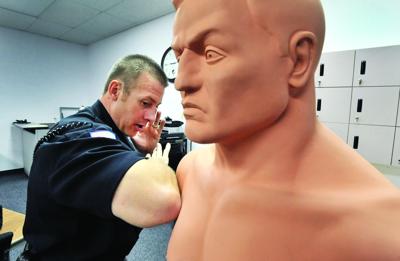
And all Pocatello officers continue training with sessions on arrest control techniques and weapon retention completed annually. The training covers the use of Tasers, impact weapons like flashlights and collapsible batons and firearms.
Officers are subjected to scenario training where they are placed in high-stress situations and practice how to react properly.
“It’s scenario-based training that goes through all levels of force,” Schei said.
The training also includes instructions for how to diffuse a situation and recognize when medical or mental issues may be at play.
Three things must exist before any officer can consider the use of deadly force, which is not limited to using a firearm. Blows with a baton above the collarbone fit the category.
The three conditions are a real threat, an opportunity for the suspect to cause great bodily harm with any weapon or object and a demonstrated intent to hurt someone either through verbal statements or demonstrated actions.
The PPD revisits its use of force policy every six months and makes adjustments if deemed necessary.
Officers often have to make split-second decisions, but Schei said good training helps shape their actions.
“The training gives their brain a place to go,” Schei said.
The patrol division commander has one more piece of advice for his officers.
“I tell our officers, ‘I want you to handle all calls as if your family was involved,’” Schei said.

(0) comments
Welcome to the discussion.
Log In