

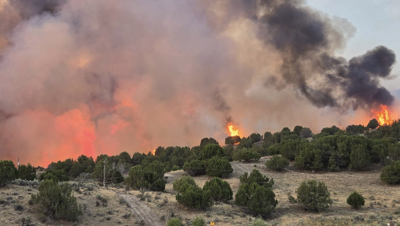
The hottest temps ever. Bone-dry skies. Three lives lost. And now, wildfires exploding across the region.
East Idaho just endured its hottest July on record — and forecasters and fire officials say the danger isn’t easing, as drought-parched land, punishing heat and multiple fast-growing wildfires collide heading into August.
If July felt warmer than normal across East Idaho, it wasn’t your imagination. The National Weather Service reported this past month was the hottest July ever recorded in the region, with 100-degree days becoming almost routine after last summer never saw the mercury crack triple digits.
And the heat isn’t pausing for August. The National Weather Service reports that multiple East Idaho cities set high temperature records to start off the month.
Pocatello was East Idaho’s hottest city in July, according to weather service data released Saturday. The Gate City posted an average July temperature of 75.4 degrees, breaking the previous record of 75.2 degrees set in 2007 and 2021. Pocatello also endured five days of triple-digit heat last month.
Idaho Falls logged its warmest July ever too, averaging 73.4 degrees and shattering the old record of 72.4 degrees set in 2007 and 2021. The mercury hit triple digits twice in the city last month, including a record-breaking 103 degrees on July 12 — the hottest day in Idaho Falls history.
Rexburg also set a new July record, averaging 74 degrees compared to the previous mark of 73.5 degrees set in 2021 and 2022. The city hit its hottest day ever on July 12, when temperatures reached 101 degrees.
Burley came close to a record but fell just short, posting the second-warmest July on record at an average of 75.3 degrees — behind only the 76.1-degree average set in July 2021.
Average daily highs told the same story. Pocatello’s daily high averaged 94 degrees last month, five degrees above the normal 89. Idaho Falls averaged 93 degrees against a normal high of 87. Rexburg averaged 91 degrees, six degrees above its normal 85. And Burley averaged 92 degrees compared to its usual 88.
When the calendar turned to August on Saturday, it was more of the same for East Idaho.
The mercury rose to 103 in Pocatello on Saturday, breaking its previous Aug. 1 high temperature record of 101 degrees set in 2020 and coming just one degree short of tying its hottest day ever record of 104.
Idaho Falls saw a high of 101 degrees on Saturday, breaking its previous Aug. 1 high temperature record of 98 also set in 2020.
Saturday’s high temperature was 100 degrees in both Rexburg and Burley, breaking Aug. 1 records in both cities that again dated back to the hot summer of 2020.
The extreme heat has already turned deadly. The Idaho Department of Health and Welfare reported that three Idaho residents, all older than 55, died in the past week amid temperatures exceeding 90 degrees. The people who died lived in different communities across southern Idaho, according to the department.
Public health officials say anyone can suffer heat-related illness, but those at greatest risk include young children, adults older than 50, people who are overweight or have underlying health conditions, those taking medications that reduce the body’s ability to cool itself, and people who work or exercise outdoors.
Health officials urge anyone experiencing symptoms of heatstroke — a medical emergency that can include high body temperature, hot and red skin, confusion, seizures, nausea, dizziness or fainting — to call 911 immediately if they can’t quickly get medical care.
The heat hasn’t just threatened people — it’s turned the landscape into a tinderbox and two fast-moving East Idaho wildfires have driven that danger home.
The Big Rock Fire broke out Friday evening near Heise, a small rural community northeast of Idaho Falls, and has scorched over 2,400 acres, according to fire officials. The lightning-caused blaze has prompted evacuations, threatened structures, and forced the closure of roads into Heise and Kelly Canyon. Firefighters from Bonneville, Madison and Jefferson counties, along with federal agencies, are battling the fire, and an evacuation shelter has been set up at South Fork Elementary School in Rexburg.
At the same time in Power County, the lightning-caused Lake Channel Fire has burned over 2,500 acres, according to the U.S. Wildland Fire Service. The fire, burning west of Massacre Rocks and north of Interstate 86 and the Snake River, was fully contained on Sunday night.
There were no evacuations resulting from the Lake Channel Fire, though the flames threatened structures.
Neither of the blazes had resulted in any injuries as of Sunday.
These are just the latest East Idaho wildfires in a summer that’s already seen numerous large and small blazes ignite.
The National Interagency Fire Center’s latest outlook offers little comfort. Federal fire forecasters say above-normal significant wildfire potential — already gripping much of the Great Basin region to Idaho’s south — is expected to spread steadily northward into Idaho and Wyoming as summer wears on, driven by deficient snowpack, early-cured grasses and carry-over fuels from the past two years, conditions the agency says are especially pronounced in southern Idaho.
And there’s little sign of a break in the heat, either. The weather service’s 90-day outlook calls for above-normal temperatures across East Idaho through October, continuing a pattern that’s held for much of the year. AccuWeather’s extended forecast echoes that outlook, projecting Idaho Falls could challenge record highs in the coming days, with forecasters warning of gusty winds, low humidity and dry brush fueling a high fire threat in the region. Pocatello’s own August forecast shows average daily highs climbing as high as 96 degrees, well above the historical average of 89.
One ray of hope: for the first time in months the weather service’s 90-day forecast shows a slight chance for above-normal precipitation for East Idaho. But officials say it’s unlikely to be enough to break the cycle of drought and wildfire that’s gripped the region this summer.
Precipitation was scarce in July despite some late-month thunderstorms. Pocatello received just 0.18 inch of rain, well below its 0.51-inch average. Idaho Falls saw 0.32 inch against a 0.46-inch average, and Burley collected only 0.15 inch compared to its 0.26-inch norm. Rexburg was the exception, picking up 0.44 inch to beat its average of 0.26 inch.
Health and fire officials alike are urging caution as the heat persists: limit outdoor activity to the coolest hours of the day, stay hydrated, avoid open flames where restrictions are in place, and never leave children or pets unattended in a parked vehicle, where interior temperatures can climb to dangerous levels within minutes even in mild weather.
July is traditionally the hottest month of the year in East Idaho.
Here’s to hoping against hope that August offers some sort of reprieve from the heat and flames.

(0) comments
Welcome to the discussion.
Log In