

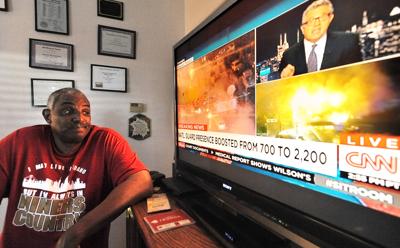

Pocatello seems far removed from the mayhem that has gripped Ferguson, Mo., following a shooting of a black teen by a white police officer, but members of the Gate City’s black community waited and watched with anticipation Monday for the grand jury's decision in the case of Michael Brown's death in the suburb of St. Louis last August.
According to autopsy reports, 18-year-old Michael Brown was shot six times by Ferguson police officer Darren Wilson.
Brown could have survived the first five shots, but the sixth shot to the top of his head was fatal. The examination indicated that Brown was bent over when the fatal shot was fired.
Ferguson officers do not wear body cameras and much of the incident that led up to Brown’a death was out of the range of the officer's patrol car dash camera.
Russell Sanders of Pocatello said his mother actually called to tell him the news after the grand jury decision was announced Monday.
Sanders said the situation in Ferguson demonstrates how little things have changed since the civil rights movement of the 1960s.
“When there is no justice, then there is no law,” Sanders said. “It’s not just a race issue. It’s a broken-system issue.”
Protest marches against the decision were held in other cities Tuesday, including Washington D.C., and the case has also sparked national debate about the militarization of police.
“I think the military-style police tactics induce fear,” Sanders said. “People think they have to defend themselves. It’s us against them.”
Sanders said Pocatello enjoys a unique, blended culture beginning with the many ethnic groups that settled into the Iron Triangle neighborhood when Pocatello was a young railroad town, but he said race is an issue nationwide including Southeast Idaho.
Sanders said President Barrack Obama will play a crucial role in resolving the situation in Ferguson, but he said the problem is much bigger and residents of the predominantly black community want justice.
“Racial profiling has created a subjugated population. It’s time to look into this,” Sanders said. “We are revisiting something that we’ve already put away.”
Avery Griggs is originally from Pocatello, but he’s lived in the St. Louis area for the past 17 years. Griggs lives in the suburb of Kirkwood with his wife Nancy Griggs, a native of St. Louis, and their two children.
Avery, who is black, said that residents in the St. Louis area were warned at noon Monday that the grand jury in the Ferguson shooting case was expected to come back with a decision by 8 p.m. Monday.
“The racial divide here is and always has been great,” Avery said. “Last night was an indication that it’s getting worse.”
Obama and Brown’s family pleaded for peace Monday night, but protestors threw bricks and bottles at police in Ferguson after the grand jury's decision to not file an indictment against Wilson was announced.
Ferguson police responded with tear gas and Missouri Gov. Jay Nixon said more than 2,200 National Guard troops, triple the number from Monday, were on the streets Tuesday to prevent another night of arson and looting.
“Part of me believes that the presence of the militarized police stimulated the violence, but I don’t know what else (the police) can do,” Avery said.
Following the decision Monday night, looters smashed store windows and several buildings and cars were set on fire in Ferguson, a mainly African American community of 21,000 people.
Avery said the violence is currently contained to Ferguson and Dellwood, but he’s being cautious anyway and keeping his family close to home.
“I personally believe they are not going to allow the violence to get outside Ferguson and Dellwood,” Avery said.
Along with the violence and looting, which garnered most of the national attention, Avery said there were a number of peaceful protest in the St. Louis area Monday and Tuesday.
“I trust the justice system and trust that they got all the facts right,” Avery said.
His uncle, Charles “Butch” Griggs of Pocatello, said the only people who actually know what happened the day Williams was killed are the people who were there when the shooting occurred.
“I feel really bad for his family, but they weren’t there either,” Griggs said.
Butch said racial tension in Ferguson, like many urban areas, has festered for decades and the killing of Brown brought the situation to an explosive head.
“There always has been a racial divide and there always will be,” Butch said. “I don’t see that being resolved in my lifetime. That’s my personal opinion anyway.”
Salt Lake City NAACP president and CEO Cornell William Brooks said Monday that the group was disappointed with the decision not to pursue charges against Wilson.
“We stand committed to continue our fight against racial profiling, police brutality and the militarization of local authorities,” Brooks said. “The death of Michael Brown and actions by the Ferguson Police Department is a distressing symptom of the untested and over-aggressive policing culture that has become commonplace in communities of color all across the country.”
Brooks said the NAACP will continue to lobby for passage of federal legislation to end racial profiling.
NAACP Attorney Jeanetta Williams said Tuesday that Missouri has a good anti-racial profiling law that is currently not being enforced fully.
“The NAACP calls for the improvement and enforcement of this law and demands accountability and transparency not only in Missouri but in Utah,” Williams said, citing the killing of Darrien Hunt by police in Sarasota Springs, Utah.
Hunt, a 22-year-old black man, was shot to death by cops in Utah in September. An independent autopsy revealed that Hunt was shot four times in the back.
In total, six gunshot wounds were found. The officers in the case, Cpl. Matthew Schauerhamer and Nicholas Judson, are both white.
Police in Cincinnati shot a killed a 12-year old African American boy this month who had a toy gun.

(1) comment
It is very sad that we live in country where race is such a big thing but it's not. Certain people make it that way. I haven't heard two words in the journal or any national news media about the black cop that shot a unarmed 20 year old white kid in Salt Lake City 2 days of the brown shooting in Ferguson. You don't see white people tearing up Salt Lake City. I'm sure the president hasn't reached out to his family. So I ask who is prejudice
Welcome to the discussion.
Log In