

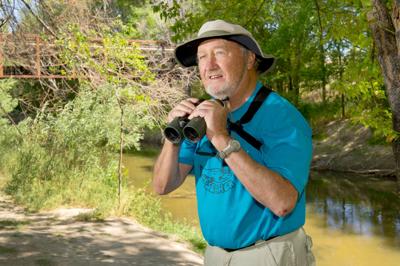
Retired Idaho State University professor Chuck Trost has always had birds on the brain — 5,000 to be precise.
Last month during a bird watching trip to the Philippines, Trost reached this milestone in ornithology few will achieve by documenting 5,000 distinct species of birds. The last two species he identified were the massive Philippine eagle, know as the “monkey-eating eagle,” and a tiny sulfur-billed nuthatch.
“I wanted to see the Philippine eagle,” Trost said. “They're the largest eagle in the world. I was so excited to see that.”
Philippine eagles can grow to more than three feet in length and has become an endangered species because of loss of habitat caused by deforestation. Getting a first-hand look at one proved difficult.
Trost's trip into the jungles of the Philippines was guided and his guide had received information that a group of people had been feeding an immature male eagle with domestic rabbits. The young raptor's father had been the victim of poaching, but the mother was still in the area and trying to feed the young bird.
It was the young male's screaming that alerted Trost and his group that they might have hit pay dirt.
“We listened to it screaming for his mother for an hour and it finally came out to the edge of the woods,” Trost said.
He had his camera and its zoom lens ready.
“It was solstice day, Dec. 21,” Trost said. “It was pretty special.”
The retired professor has traveled the globe for years studying birds and the environments they call home. Since his retirement as a professor and ornithology expert at ISU in 2000, Trost has stepped up his travels. He had already documented 2,500 species of birds by the time he left the classroom.
“I'm having the time of my life,” he said about his latest adventures.
Trost grew up living on a farm in Colorado as a boy, but his family moved to Pennsylvania when he was a young boy. He missed the rural West, but a high school teacher came to the rescue.
“He got me excited about counting birds,” Trost said about an activity that took root.
Trost joined the U.S. Army in 1952 and was sent to Germany where he spent most of the time in the deep woods doing reconnaissance on Russian troop activities. He had a good pair of binoculars and his passion for birds. There were not field guide identification books for European birds published at that time, so Trost took notes.
“I knew enough about birds to narrow down the families,” he said.
Once Roger Tory Peterson published his “Field Guide to the Birds of Britain and Europe” in 1954, Trost was able to compare his notes to the guide to confirm his identifications.
After leaving the army, Trost earned his bachelor of science degree in zoology from Penn State and his master's degree from the University of Florida where he published a study of the decline of dusty seaside sparrows.
To control mosquitos in the salt marshes, dikes had been built to flood the marshes and DDT was applied.
“The birds' habitat was getting wiped out,” Trost said.
Looking to move back to the western U.S., Trost earned his doctorate at UCLA and took his first teaching job at ISU in 1968. He never left and his passion for birds never waned.
In 1974 Trost started the Portneuf Valley Audubon Society. He said he had become concerned about the fact commercial fish hatcheries and Idaho Fish and Game were killing herons that were raiding hatcheries to feed on small trout. The new Audubon chapter was able to bring pressure to stop the heron killings.
“We were a pretty healthy crew,” Trost said about the chapter which still holds monthly meetings in Pocatello.
During his tenure as an ISU professor, Trost became deeply involved with the study of magpies. His work led to a sabbatical so he could study birds of paradise in New Guinea because they are related to crows and magpies. One distinction is that crows and magpies and monogamous while birds of paradise are polygamous.
“I lived in a tent in New Guinea for five months,” Trost said.
During his academic career, Trost had become fascinated with the work of Alfred Russell Wallace who had traveled 14,000 miles spanning islands from Borneo to Australia in the 1800s. The British naturalist collected more than 25,000 birds, mammals and insects and was the first to recognize a distinct break in the types of fauna that exists midway between Borneo and Australia.
Wallace wrote some of the first papers about natural selection and the evolution of species along with Charles Darwin.
Trost has been able to explore some of the same islands where Wallace did his work like Flores and Halmahera.
Although the Philippines provided Trost with the final two species to reach the 5,000 mark, Colombia is still his favorite place on earth to observe birds.
“It has 1,800 species of birds,” Trost said. “Every mountain in the Andes is different.”
His worldwide quest to observe winged creatures also has taken Trost to Brazil, Ecuador, Peru and Argentina.
His next stop? Africa.
“I've been to Africa, but not to the Serengeti,” Trost said with a smile. “We're going to go up in a hot air balloon at dawn.”

(1) comment
That photo of the sulphur billed nuthatch was taken by me. I DO NOT APPRECIATE people using my photos without asking permission from me when they use my photos. THAT is JUST NOT RIGHT. Please take that down.
Thank you.[sad]
Here is the link to my photo...
http://www.tinasarmientomallari.com/Phillippine-Birds/By-Species/Nuthatches-Family-Sittidae/i-scPjZqS/0/L/93556107.B4uslKuM.IMG_0438rw-L.jpg
Welcome to the discussion.
Log In