

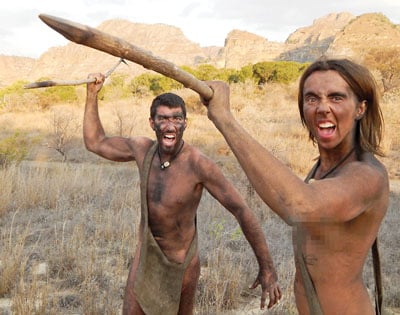
POCATELLO — Naked and starving, Pocatello’s Jeff Zausch found himself in the Madagascar desert for 21 days last October and November.
The 2011 Idaho State University and 2005 Century High School graduate had to rely solely on his survival skills and those of his naked companion, Eva Rupert, of Flagstaff, Ariz., to endure the ordeal.
“I’ve always been the kind of person to push things to the next level,” Zausch said.
The Pocatello native managed to survive three weeks exposed to one of the harshest environments on earth, and the triumph will be broadcast on the Discovery Channel’s “Naked and Afraid” television series Sunday, March 23, at 7 p.m.
There is no monetary reward for what Zausch and Rupert accomplished. It was a “Hunger Games” without external motivation.
Zausch works as psycho-social rehabilitation specialist at A to Z Family Services and as a GIS specialist at ISU, where he spends his time in the Museum of Natural History complex. But it was his long history of tackling mountains, learning primitive survival techniques and strategies and teaching survival courses to others that led him to the Discovery Network.
Last summer, Zausch said he became hooked on watching season one of “Naked and Afraid.” He said he related to the struggle of the participants — a naked man paired with a naked woman — had to face in the elements without any outside help. When the show began seeking people for its 2014 season last fall, Zausch filled out an online questionnaire.
“They called me the very next day,” Zausch said.
What followed was a Skype interview and then Zausch producing a 15-minute video that demonstrated his skill set when it comes to survival. He chose to show the producers of the show his ability to start a friction fire with sticks, building a shelter without tools and demonstrations of his marksmanship abilities.
They were impressed enough to fly Zausch to Los Angeles for a personal interview.
It was there that Zausch shared his qualifications to face death in the buff. It didn’t include the fact he was the school mascot for Century for a year during high school.
Zausch has his bachelor of science degree in earth and environmental systems with minors in ecology and geo-technology. An experienced mountaineer, he has climbed all 10 peaks in Idaho over 10,000 feet in elevation and has scaled mountains in Wyoming, Washington state and Alaska. The 27-year-old is also an expert on primitive shelters, tools and weapons and an avid hunter.
“This is just who I am,” Zausch said. “I’m a big outdoors person.”
Zausch returned to Pocatello following the interview and was leading his Boy Scout Troop 319 in a meeting when the Discovery Channel called.
“Hey Jeff, you’re going to Madagascar,” they told me. “And you’re leaving next Monday.”
For the next six days Zausch started going everywhere barefoot to toughen up his feet. It wouldn’t be enough when he found himself in a Madagascar desert.
“It was the worst possible environment imaginable,” Zausch said. “Being barefoot in that environment was one of the most difficult things I had to overcome.”
With the help of Eva’s craft skills, Jeff was able to don rudimentary footwear, but both he and Eva had feet that were “bloodied, bruised and beaten.”
The pair had met for the first time when they were both in their birthday suits on day one.
“I just walked up and shook hands,” Jeff said, adding it took less than an hour in the hot desert to completely forget about nakedness — except for his tender feet.
Jeff said he knew Eva was a tattoo artist from Arizona with extensive experience as a survival trainer and someone skilled in primitive crafts. He didn’t know how strong her inner spirit would be.
“We spent all day hunting for food, searching for water and trying to gather firewood,” Jeff said. “She was always positive and uplifting.”
The desert was not a land of plenty. Fortunately, the pair found a cave on day one, and it would save their lives. The cave gave them a place to get out of the direct sunlight and something much more — a source of water.
“When I noticed the sand was damp inside, I knew we were in luck,” Jeff said.
He constructed a series of little ditches to catch moisture escaping from the cave’s walls and devised a drip system. The output was about two ounces of water every 15 minutes with no way to store it. The survivors would simply cup a bamboo leaf under the drip and catch enough to wet their throats and keep them alive.
As Eva made footwear and primitive twine, Jeff crafted a spear and built snares from that twine. But nearly every day was filled with one mission — find enough to eat. And the desert was not a land of plenty.
Grubs and other insects were just as important as reptiles and snakes.
“Anything that was edible, we ate,” Jeff said.
By day 7, the two survivors were feeling the effects of starvation. Pounds had been shed as they hunted in the heat of the day when the temperature hit triple digits. Their muscles shivering against the cold air of 40-degree nights just added to the drain. And a promise that Jeff made to his wife, Gabby, before he left Pocatello about “no hugs or spooning” was not easy to keep as he watched Eva struggling against the cold in the darkness.
“We both woke up a lot of nights just shivering,” Jeff said. “With no clothes it was brutal.”
The end of that first week is when Jeff said he began to question his resolve and had to channel memories of his father, Matt, who died after fighting a lifetime of heart issues last May.
“My dad was the greatest survivor I’ve met in my life,” Jeff said. “When Jeff’s father was born, he had a heart defect that required 11 surgeries as a child. Jeff said no one gave Matt a chance of survival, but he kept pushing on.
“He kept overcoming what people told him he couldn’t do,” Jeff said. “He raised me like that.”
Jeff’s inspiration to keep going was matched by the resolve inside Eva.
“Her greatest strength was her mental ability to stay strong and confident no matter what we faced,” Jeff said.
As they reached Day 14 and finished a fruitless hunt for food, Jeff said their shared sense of humor became critical. Hunger and fatigue had them both seeing spots and movement became difficult.
“We looked at each other and wondered out loud that if a member of the camera crew went down, what part of their body would we eat,” Jeff said.
Visions of food stayed in Jeff’s head constantly. He said it was like those cartoons with clouds containing hamburgers and hotdogs appearing above a character’s head.
“I can’t tell you how much I mentioned American cheeseburgers,” Jeff said.
Despite the constant hunger, heat and cold, the Pocatello survivor said he and Eva did have time to talk about faith and belief in God. Jeff had become a Mormon at age 16 and Eva didn’t identify with any particular faith — just the power of the universe. Both were hoping for extra strength from something greater than themselves.
“Her faith is just as strong as mine,” Jeff said. “We were both having the same kind of internal prayers.”
As a pickup rolled into sight the last day of the ordeal, Jeff said both he and Eva reacted with abandon. They had reached their extraction point and the test to survive was over.
“The greatest moment was sprinting across the desert at full speed toward that pickup truck on day 21,” Jeff said.
But despite the heat and cold, human stink, lack of food and hard work, Jeff said the experience was the ultimate challenge and he’d do it again.
“I took away from this a new view of life,” Jeff said. “It really made me appreciate what we have here. And I encourage others not to be content with being ordinary.”
Although it was a transformational experience surviving 21 days in the Madagascar desert, the first thing Jeff did when he reached American soil was to find a sports bar at JFK International Airport and order two large cheeseburgers.
He said he savored that taste of victory.


(1) comment
Idaho has more than 400 peaks over 10,000'. You probably mean over 12,000'.
Welcome to the discussion.
Log In