

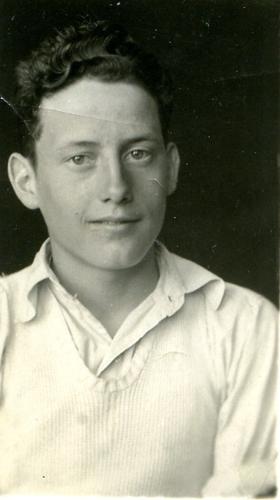
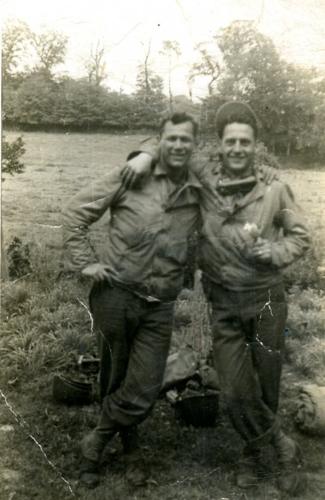

“The story really starts with my dad in Normandy,” said Linda Wolfe. “My dad was in the first wave of assault on Omaha Beach on D-Day, in the 16th Army Infantry Regiment. My dad was in the thick of it.”
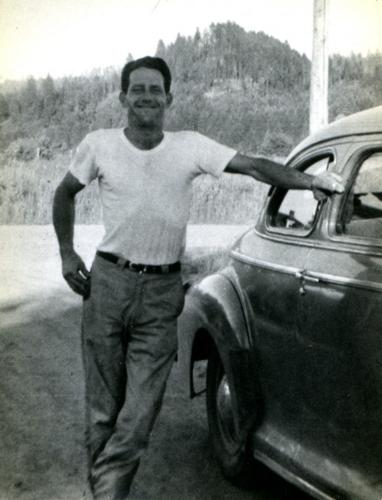
Wolfe is a Pocatello resident and artist. Her father, Boyd Garth Klingaman, was among the first on Omaha Beach in the pivotal D-Day invasion on June 6, 1944.
This June marks the 68th anniversary of the massive invasion effort, which put Allied forces on the ground in Europe, to begin their push into German territory. The D-Day invasion began at 6:30 a.m. on the beaches of Normandy, in southern France, with over 160,000 Allied troops, landing in five separate sectors; Omaha, Juno, Utah, Sword, and Gold. Omaha Beach will forever be remembered as a killing ground where wave after wave of soldiers fell to entrenched German forces.
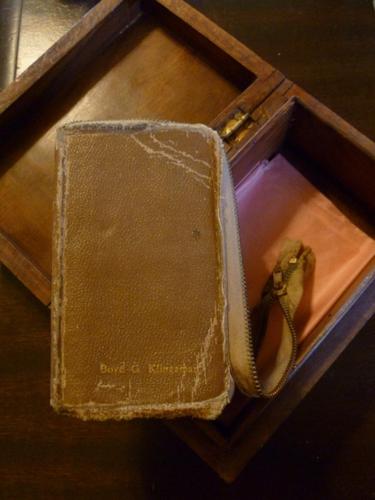
Klingaman carried his weapon and a rucksack into battle. In his rucksack was a small Bible. Somewhere along the way, he lost that little Bible on the sands of the beach. Klingaman survived the assault on Omaha Beach, and went on to participate in the further land campaign in the push toward Berlin.
But the little Bible was left behind on Omaha Beach, protected by its zippered binding, apparently in some relatively dry and protected spot where it lay for years.
It was 1998 before the Bible ended up in the hands of local D-Day historian, Henri G. Levaufre, by way of an unidentified beachcomber. Levaufre had made a life-long study of the historic events that took place in the vicinity of his village of Periers, and had amassed a huge collection of items that had been collected from the beaches, including helmets, guns, boots, and anything else related to the D-Day invasions.
Now he had Boyd Klingamon’s Bible.
When the beachcomber happened upon the weathered book, it was a natural choice for him to take the item to Levaufre. He put the Bible in his collection of items, which had grown to take up 13 rooms in a building not far from his home. If any personal information such as or addresses appeared on an item, he made an effort to contact the owner or the owner’s family.
As for Klingaman, he had returned to the U.S. at the close of the war after marrying his sweetheart, Doris Bartlett. The couple had met in Britain while Bartlett was in the British Women’s Land Army. After his war experiences, however, Klingaman needed specialized care to recover from both the physical and emotional wounds the war had inflicted on him.
He spent the next several years in a Veteran’s hospital in Oregon, and in 1959 died of accidental drowning when his daughter, Linda, was only six years old. She clearly remembers her father’s funeral, along with the military honors and gun salute that accompanied it. She was particularly impressed with the presentation of flag.
“I remember the men standing there shooting the guns,” she recalled. “I remember them folding the flags just like in the movies. I was mesmerized. It made me feel as if they were taking care of my dad, the way they were folding the flag so carefully. Then I remember my mom and us being presented with the flag.”
“I wasn’t able to see my dad very often,” Wolfe continued. “But the memory I have of him was that he was really a good person. He was good dad, and was fun to be around. He had a good sense of humor.
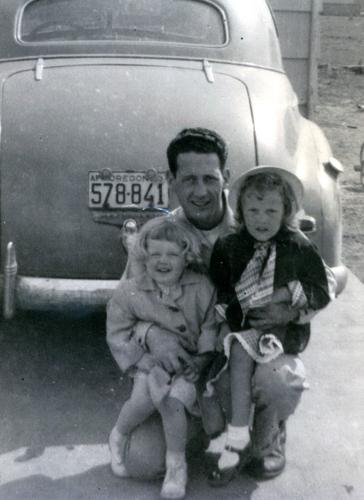
A year after her father’s death, Doris Klingaman passed away from cancer, and Linda and her sister were raised in an orphanage. Linda, who later married and became Linda Wolfe, was left with nothing of her parents except a few photographs and her childhood memories.
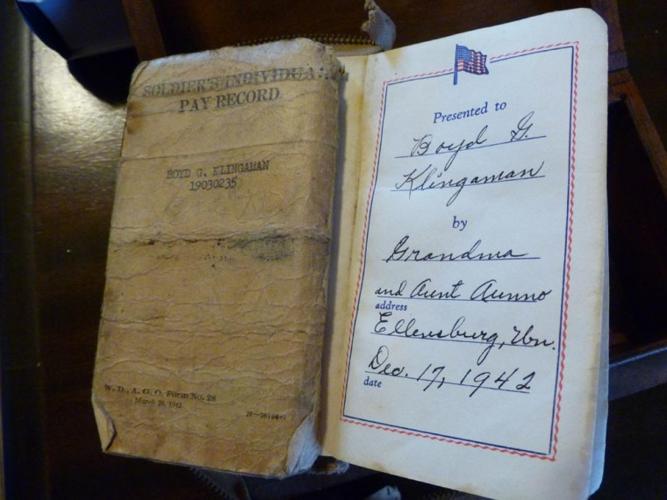
At some point, the French historian, Levaufre, noticed that the little zippered Bible that had been brought to him had some names recorded on the dedication page, and on the flyleaf.
The Bible also had an Army pay record booklet tucked in its pages, bearing the name of Boyd Garth Klingaman. Levaufre then took it upon himself to try to find the family of this soldier named Klingaman, who so many years before had lost his Bible on Omaha Beach.
Levaufre’s search started on the east coast of the U.S., but finally led to Wolfe’s relatives in Boise.
“He found my father’s sister in Boise,” explained Wolfe, “and they called me and said, ‘We have some interesting news.’ I got the news about my father’s Bible on my birthday in March, 1998.”
That was 54 years after the Bible was lost on Omaha Beach.
“My aunt contacted Henri (Levaufre) and they started emailing back and forth.”
In the meantime, the Bible stayed in Levaufre’s collection in Periers.
When the phone call from Boise came about her father’s Bible, Wolfe was overjoyed. As soon as she was able, she arranged a trip to France to visit Levaufre and retrieve the Bible.
“It was perfect timing for me to go,” she said. “I have relatives in England, so I met my cousin John, who speaks French, and we went from Southamptom to France, to meet Henri. It was 2004, in time for the celebrations of the 60th anniversary of the Normandy Invasion.”
Wolfe described her trip to France to retrieve the Bible her father had left on the beach so many years before.
Wolfe and her cousin were met in the village of Periers by Henri Lavaufre, his wife Janet, and a French journalist. There Wolfe was interviewed by the journalist for an article in the local newspaper.
Then she was presented with her father’s Bible, which had been placed in a handcrafted wooden box for safekeeping.
“It was an emotional time,” recalled Wolfe. “I tried not to break down, but I did. I thought, ‘He actually held this,’ and it meant so much to me to be a part of such a story and such a trip, with so many people involved.”
The Bible, actually a New Testament with the Book of Psalms, was in amazingly good condition, with an inscription on the presentation page of “Presented to Boyd from his mother, December 17, 1942.”
In all probability, Klingaman kept that Bible with him in his early military career, until the day he landed on Omaha Beach. He earned two Silver Stars for his service, which included participation in the Africa, Sicily, and Normandy invasions and the Battle of the Bulge. Among his other commendations were six Battle Stars, a Purple Heart, and a Presidential Unit Citation with two clusters.
No one can ever know exactly how that little Bible was dropped and left behind to rest under the sands of Normandy, Perhaps in a quiet moment Klingman had removed that Bible from his rucksack to find solace in it’s pages. Perhaps he gazed on the names of his family members inscribed in it to find strength in the memories of hearth and home.
Perhaps it had fallen out, unnoticed, while he dug in his rucksack for rations or ammunition. Perhaps in the rush of oncoming battle, Klingaman hastily snatched up his gear, and the Bible was overlooked.
In any case, 60 years after her father had dropped that Bible on Omaha Beach, Wolfe was presented with it in France, just as her mother had years before been presented with the carefully folded flag that had draped her husband’s coffin.
Wolfe now treasures that Bible as personal link to the father she lost as a child.
“This was a surprise I never knew was coming,” said Wolfe. “It was a connection to my dad I hadn’t had in a long timeafter losing my dad. He had died, but there was a part of him that still lived through this Bible. It’s as if he was waiting for me to come and get it and say goodbye.”
The following information, and more historical information about D-Day can be found at www.ddaymuseum.co.uk/faq.htm:
The Allied casualties figures for D-Day have generally been estimated at 10,000, including 2500 dead. Broken down by nationality, the usual D-Day casualty figures are approximately 2700 British, 946 Canadians, and 6603 Americans.




(1) comment
I am Henri Levaufre who made research about Boyd Klingaman Bible, as I am used to do for many veterans and families. I came thought this article just by chance and wish to add a few details or corrections.
The bible was not found on the Beach, but found soon after it was lost because the integral good shape of the paper that looked almost new. An items collector from Paris gave it to another collector, friend of mine (I am not a collector) believing I was able to find the bible owner or his family. What I did.
i can tell you I don't have 13 rooms to house my collection but a corner in my office where I kept the artifacts I found on the local battlefields, just after the battle - I was then 13 years old (82 now !) To be able to give back this bible to Boyd Klingaman daugter was quite rewarding. Henri Levaufre
Welcome to the discussion.
Log In