

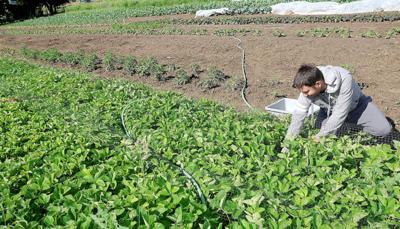
Just off of 800 East in Logan lies a one-acre stretch of green run by Utah State University students, featuring a variety of vegetables ranging from tomatoes to blue peas (which students have appropriately dubbed “converted Aggie peas”).
Founded in 2008 by USU professor Dan Drost and run under the advisement of associate professor Jennifer Reeve, the USU organic farm provides produce to the USU community and general public as one of the few student-run organic farms in academia. It was certified organic by the Utah Department of Agriculture and Food in 2011.
“Many students have tried that model (of a student-run farm) and failed with lack of student commitment,” Reeve said, noting that other universities will have students work under a hired farmer. “But we’ve been able to make it work for whatever reason.”
Production manager Nate Staker, CSA manager Eric Manrique, and three interns — Brik Anderson, Cambria Bree and Tracey Monson, run the farm.
The farm uses the community-supported agriculture model, which allows people to buy shares of crops and pick up a box of produce once a week. All shares are taken for this year, but interested customers can contact the farm next year to participate. The cost $380 for a half share or $600 for a full share, and the program is offered for about 20 weeks.
Staker said the farm is coming along well.
“The greatest thing about this farm is that it’s run by students … That’s a big accomplishment,” he said.
Reeve is pleased with the way the students are running the farm.
“I think it gives them fantastic life skills — self-initiative, problem solving, all of these things employers are looking for in the well-rounded employee,” she said. “They’re really getting a chance to practice running a small business.”
The Herald Journal sat down with Staker to talk about the ins and outs of running the Student Organic Farm, what he sees in the farm’s future, his take on the organic agriculture debate and more.
Q: What can we expect this year with the farm as far as produce?
A: You can expect a lot of really good produce. There’s so much to kind of sum up. We have a lot of greens, lettuces, tomatoes, peppers, sweet corn — everything that people love. We try to do 20 percent unusual items you wouldn’t see at a grocery store — heirloom varieties like blue peas. I like to joke that they’re “converted Aggie peas.”
Q: Why do you think it’s important for USU to have an organic farm?
A: I think with the way the world is changing, people are opening up to the idea of we need to use less pesticides — we need to use less fertilizer and go back to real organic practices. I think it’s becoming more trendy. We really started opening up our eyes as a population saying, “We need to look at what we do and make sure we’re being safe for the environment.”
One thing I like is organic is a safe food. … It’s all about traceability; we have to prove that we grew it and that it’s safe for the public.
They tried before to start an organic farm, and at the time it wasn’t appealing to the general public. Now you’re starting to see more USDA-certified organic products out on the shelves of your supermarket. I do think our farm will double in size within the next few years.
Q: What does it mean to be organic?
A: That’s a very good question, and how to sum it up is pretty hard. It’s abiding by the practices and principles that you’re going to use chemicals that don’t hurt the environment and don’t hurt people. On the farm, we have a buffer zone, even. We have to be 30 feet away from the road and our neighbors, and we have to make sure they’re not using fertilizers or pesticides and things like that.
Q: Why do you think it is important to be organic?
A: For each individual, it’s different why organic is important to them. A good point is food safety and the environment.
A lot in our news, you hear of salmonella outbreaks across the U.S. It goes back to maybe someone didn’t wash their hands or clean their tools properly.
For the point of the environment, organic farmers like to plant a lot of bio-diverse plants. In front of our farm, we have a wildflower row, and that helps bring in good insects and helps better pollinate our farms. What’s neat about having those flowers is they’ll bring in good insects to fight off bad insects. Some of the plants — the pansy or yarrow — those help attract ladybugs, and they eat aphids, eat by the hundreds per day. It just helps keep down on using pesticides. It’s just Mother Earth’s natural way of going about it.
Q: There is an ongoing debate about whether or not organic is really better for people. What do you make of that and where do you come down?
A: Looking at it from a scientific standpoint, if we picked one head of lettuce from an organic field and another one from a conventional field, and then compared nutrition levels, they would be the same. The only difference I have seen in my studies as a student was doing a taste test. In our class we tried oranges, one organic and the other was conventional. When I tasted the two, I could tell which was which. The conventional was really sweet. The other was sweet, but had a well-rounded flavor. Sweetness is derived from nitrogen levels in the soil. It’s easy on a conventional (farm) to fertilize to that level. After all, only in America does our fruit have to compete with the sweetness of candy! What I believe it boils down to is what an individual’s preference is to taste and food safety.
Q: What has the response to the farm been like?
A: The two years that I’ve been here, we’ve got a lot of volunteers — almost double the amount last year. We have a stand on campus that we sell (produce from) every Wednesday from 11 a.m. to 2 p.m. We started in March and have almost broken the record from what we did last year. We started early, but we have gotten the students, faculty and public involved, showing that we do have produce, we are here during the summer, and we do exist, you know. We’re north of Logan; 800 East is a little bit busy, but having the knowledge that we’re here on campus really does help.
Q: So you guys feel like the farm is in a pretty good place right now?
A: Yeah. 800 East is busy, we’re close to campus, so students can get down here easily. We have quite a few students actually bike down here and volunteer at the farm.
Q: Think about the fact that you’re a student. What are you learning from doing this?
A: Oh, man! (Laughs) There’s a lot that I’ve learned in these last two years — some of which has been experimenting with variety trials. Some I have not grown in my home garden. And, (this experience) is a little bit different for me. I’ve been in a lot of different fields — one of which I was an intern at Epcot at Walt Disney World. So learning the organic practices in class, but being able to apply my knowledge and be able to experiment — see what works, what doesn’t — is good. There were some trials and errors we made last year, and I’ve been able to kind of fix that and make it better for next year’s students. The greatest thing about this farm is that it’s run by students … that’s a big accomplishment. We train our interns so they can be managers next year so they can take on the role and make it run and make it fly. Hopefully we learn and do better than we have in the past.
Q: What do you see everyone else learning from this experience?
A: You know, they’re all at the point where if I had to leave for a week or two they could take over my role and they could make the farm function. It takes a couple months, but they know how to run it. It’s great that we can bounce ideas off of each other — figure out ways to make the farm stand run smoother, what can we do to attract the public.
Q: What are you hopes for the farm in the future, even after you’ve graduated?
A: My hope is we can double in the next 10 years — be a more productive farm. Maybe we can increase our shareholder amount. Maybe hire more students and give them the opportunity. We’ve had many graduates from the farm, and two, I think, are running CSA programs of their own.
Q: What else would you like to say about the farm?
A: It’s been a great experience. I hope that students will continue to become more involved, and so will the community. Maybe in a few years, we’ll start seeing more CSAs start popping up around Cache Valley and Salt Lake City.
Q: What’s your personal enjoyment being out here with the plants and “playing with the dirt,” so to speak?
A: I get a lot of enjoyment. People say, “Oh, it looks sad when you have to till in your cover crop and make it look brown and start new.” I think of it as the farm is kind of a picture. Here I have in my brain an idea of what I’m painting, and to actually see that picture or that dream fulfilled is a big fulfillment. It’s fun to see it roll out and take place.
————
Twitter: KevJourno

(0) comments
Welcome to the discussion.
Log In