

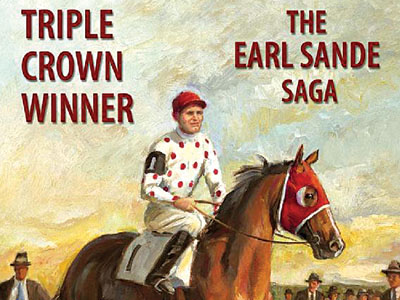

Ever heard of Earl Sande?
At one time, the former American Falls jockey made national sports headlines as large in type as Babe Ruth and Jack Dempsey.
Now author Richard Maturi, of Cheyenne, Wyo., is on a quest to remind the country of the remarkable feats Sande made during the 1930s, and the classy manner in which he accomplished them.
Riding Gallant Fox, Sande became only the second jockey in history to win the storied Triple Crown during the 1930 season. Sande’s thoroughbred resume includes winning the Kentucky Derby three times in a five-year span and the Belmont Stakes five times in a 10-year span.
Upon retiring from racing, he became a trainer. Notably, he trained Stagehand, the horse who defeated Seabiscuit in the Santa Anita Handicap in 1938. That same year, he finished as the top money earning trainer. He’s still the only person in the history of American horse racing to be a year’s top money winner as both a jockey and a trainer.
Maturi discovered what he considers one of the great forgotten sports hero stories three decades ago while living in Idaho. At the Boise Public Library, he found a folder filled with clippings on old western jockeys, and he was mesmerized by the articles on Earl Sande, rife with adversity and a protagonist who never failed to overcome it.
“He started with nothing,” said Maturi, author of “Triple Crown Winner: The Earl Sande Saga.” “He left American Falls. He ran away with a guy who traded horses and raced horses. He didn’t finish high school. He didn’t even tell his parents he was leaving.”
He released his book in 2005 as part of a series of five biographies on individuals who were once at the top of their respective fields but have largely faded from the public’s memory.
“People forgot who they are, and we’re trying to resurrect their careers,” Maturi said.
He re-released a new version of the Sande book in 2010 with several previously unpublished photographs, including several he found in archives at a horse racing museum in Lexington, Ky.
In his bid to rekindle interest in Sande, he’s shopped around a 3-minute movie trailer for a film he hopes to produce to 40 tracks in 25 states and Canada. His book was also the impetus for the legislatures of Idaho and Sande’s birth state of South Dakota to pass proclamations commending the jockey for his contributions to racing.
Maturi also spoke about Sande’s career when he served as keynote speaker at a hall of fame induction ceremony in New Orleans, where Sande achieved his fame.
In 1908, at age 9, Sande moved to American Falls.
In the process of researching his book, Maturi spent three years traveling the country and attending various racing museums. He also interviewed several sources, including friends and family members, with knowledge about Sande. Among those sources was a woman named Josephine Scott (her maiden name), a former American Falls resident who now lives in a Las Vegas nursing home.
Scott responded to a plea for information Maturi included in the Power County Press. She provided Maturi with several photographs and invaluable information about her uncle, Burr Scott, the man who convinced Sande to run away from American Falls with him in 1915.
Upon leaving Idaho, Sande joined the Leaky Roof Circuit for three years before heading to New Orleans, where he made his fame.
As impressive to Maturi as Sande’s accomplishments were, he believes the story is in “the way he won.”
“A lot of guys used their whips to beat their horses to get more out of them. Earl was what you call a hand-rider. He used his hands more than a whip,” Maturi said. “He just had an affinity with horses. When he went around the country to race, he’d stay in the stable with his horses. That’s how close to them he was.”
Maturi notes the Triple Crown is one of the most coveted distinctions in all of sports. It hasn’t been accomplished since 1978 when the horse Affirmed placed first at the Kentucky Derby, the Preakness and the Belmont stakes.
Adding to the difficulty of the feat, the Belmont is a full quarter-mile longer than the Kentucky Derby, and many of the best sprinting horses lack the endurance to win the third leg.
The first two races are also hosted within two weeks of each other, limiting the recovery time.

(0) comments
Welcome to the discussion.
Log In