

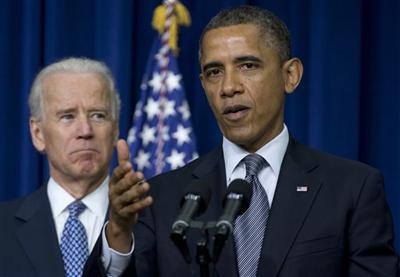
President Barack Obama signed 23 executive orders that address gun violence Wednesday, but none of them will directly impact the sales of firearms or ammunition in Idaho. The president is pushing the American people to put pressure on Congress to implement regulations that will.
If reactions to Obama’s proposals issued by Idaho’s Congressional delegation are any indication, it will be an uphill battle to pass legislation restricting weapons.
The president is asking Congress to reinstate the assault weapons ban that expired in 2004, restrict ammunition magazines to no more than 10 rounds and require a background check on anyone buying a gun, whether at a store or in a private sale or gun show. These changes that impact gun ownership in the country would require passage by the House and Senate.
Idaho’s two Congressmen and two Senators were critical of the calls for more gun control measures in the wake of the Sandy Hook Elementary school shooting in Newtown, Conn.
“Our natural instinct in response to a tragedy is to try to do something, but action that does not help the problem and restricts the constitutional rights of law-abiding Americans is not the answer,” said Sen. Jim Risch.“I am troubled by the continuing efforts of this president to legislate by executive order when his responsibility under the Constitution is to execute laws enacted by the legislative branch. All proposed legislation should be put before the people’s elected representatives, fully debated in Congress and then voted on under the specific procedures clearly provided by our Constitution.”
“The President’s proposal on gun control is very disappointing,” said Sen. Mike Crapo. “Any discussion about restricting the Constitutional rights of law-abiding Americans deserves, at minimum, a full and public debate in Congress. Burdening law-abiding citizens of this country with additional gun restrictions is not the answer to safeguarding the public from further attacks.”
Skepticism about the president’s actions were also voiced by Idaho’s representatives in the House.
“Our Founding Fathers believed the right to bear arms was essential to the cause of freedom,” said Congressman Raul Labrador. “Those same Founders also gave the executive branch the authority to enforce the laws protecting this right and our security—and this is the authority the President asserts today.
I will review these proposals to ensure that the President’s actions and proposals do not violate our constitutionally protected right to bear arms.”
“I will take time over the coming days to fully review each of the executive orders and consider them with the Constitution and the concerns of my constituents foremost in my mind,” said Congressman Mike Simpson. “I am not seeing any significant support among my constituents for new restrictions on gun rights nor am I seeing any momentum building in Congress for additional federal gun control measures.”
Here’s what the 23 executive orders will do:
1. Require federal agencies to make all relevant data available to the federal firearms background check system.
2. Eliminate legal barriers, particularly relating to the Health Insurance Portability and Accountability Act, that may prevent states from making information available to the background check system.
3. Provide incentives for states to share information with the federal background check system.
4. Direct the attorney general to review categories of individuals prohibited from possessing guns to make sure dangerous people are “not slipping through the cracks.”
5. Give law enforcement the ability to run a full background check on any individual before returning a gun seized in an arrest.
6. Have the Bureau of Alcohol, Tobacco and Firearms (ATF) send federally licensed gun dealers guidance on how to run background checks for private sellers.
7. Create a national safe and responsible gun ownership campaign.
8. “Review safety standards for gun locks and gun safes with the help of the Consumer Product Safety Commission.
9. Require all federal law enforcement agencies to trace guns recovered in criminal investigations.
10. Make reports on lost and stolen guns widely available to law enforcement.
11. Nominate an ATF director.
12. Provide law enforcement, first responders, and school officials with additional training for active shooter situations.
13. Increase enforcement efforts to prevent gun violence and prosecute gun crime.
14. Direct the Centers for Disease Control to research the causes and prevention of gun violence.
15. Direct the attorney general to issue a report on the availability and most effective use of new gun safety technologies and challenge the private sector to develop innovative safety devices.
16. Clarify that the Affordable Care Act does not prohibit doctors asking their patients about gun ownership.
17. Tell health care providers that no federal law prohibits them from reporting threats of violence to law enforcement authorities.
18. Give financial incentives to schools to hire school resource officers.
19. Develop model emergency response plans for schools, houses of worship, colleges and universities.
20. Clarify the scope of mental health services that Medicaid must cover.
21. Finalize regulations on essential health benefits and parity requirements within insurance exchanges set up under the Affordable Healthcare Act.
22. Finalize mental health parity regulations.
23. Create a national dialogue led by Secretary of Health and Human Services Kathleen Sebelius and Secretary of Education Arne Duncan on mental health in this country.
In reaction to the call for more federal weapons restrictions, states like Wyoming and Utah have generated pressure for state legislatures to prohibit the enforcement of federal gun laws within their boundaries.
According to the Associated Press, Republicans in Utah’s Washington County will ask state lawmakers there to enact a law that would levy a $5,000 fine on any federal agent who takes a gun away from a Utah resident.

(1) comment
Idaho needs to follow Wyoming and Utahs lead but take it a step further. We need to get gun co. to move to idaho and produce there products here
Welcome to the discussion.
Log In