

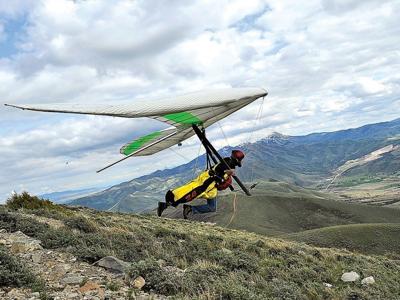
Every time Pocatello hang-gliding enthusiast Dr. Paul Allen perches on a launch site on the slopes of King Mountain about eight miles north of Arco, waiting for the wind to carry him aloft, he wonders if his flight will be one for his personal record book.
Allen’s farthest flight is 145 miles.
“Years ago, I had launched from King Mountain, and by the time I was ready to land, I was lost over some mountains. As I circled lower, I smelled sulfur from hot springs, saw huge elk and heard the cameras of Japanese tourists clicking away. I realized I had landed in Yellowstone National Park.”
In 1982, when Allen learned to hang glide, he fulfilled a childhood dream.
“Every kid has dreams of birdlike flight, and I was enough of a kid even as an adult that it appealed to me, and it’s never worn off,” says Allen, who flies on his days off from working as an emergency room physician at Bingham Memorial Hospital.
“Birdlike flight sums up hang gliding,” Allen says. “Other forms of aviation involve mechanics — such as a motor, a cockpit, instrumentation, a joystick — that isolate you from the experience of flying.”
He describes piloting his hang glider as “a primal, whole-body experience: feeling the air through outstretched wings, with the muscles of your back, with the wind and the smells in your face, like a raptor, prone, flying slow, sharing their air, learning from them, becoming one of them.”
Then there is the challenge of finding a thermal.
“A glider is constantly falling through the air. To stay aloft you have to find rising air. But the air is invisible, so you become a student of the winds to find those currents. Sometimes, we find lift against a mountain where wind is diverted upwards. Sometimes we see a dust devil that marks the root of a powerful column of solar-heated air. Sometimes we see just the right cloud that shows us the top end of a thermal. Sometimes we see a circling hawk. Sometimes it is the smell carried upwards from a field far below,” Allen said.
Allen plans to fly at the Spring Fling at King during Memorial Day weekend, a seasonal warm-up event, and also the 2010 King Mountain Hang Gliding Championships, an event that attracts hang gliders from around the world every July.
The spring fling from May 29-31 is hosted by Alan Paylor, the only hang gliding instructor in Idaho certified by the U.S. Hang Gliding and Paragliding Association.
“This will be my eighth year to host it,” says Paylor, who lives near Moore within eyesight of King Mountain. “The number of pilots varies each year, depending on the weather. This year, I’m expecting about 30 to 40 pilots camped around here in the yard.”
The spring fling is also a warm-up for the 2010 King Mountain Hang Gliding Championships, scheduled July 19 to 24.
“Pilots from throughout the U.S. and all over the world come, some from as far as away Europe and Australia, to compete,” says Paylor, who describes hang gliding as an adrenaline addiction of 27 years and dreaming with your eyes open. “We should have about 100 pilots, plus their support crew. They set up camp in Moore’s town park.”
Hang gliders in Southeast Idaho are an “eclectic group,” Allen says. “We have very little in common except for a passion for hang gliding. Yet that is enough, and we’re instant best friends. We compete about anything: the highest flight, the farthest flight, the longest duration and most of all, the best story.”
In 1998, Paylor moved to Moore after retiring from the U.S. Air Force, so he could be near King Mountain.
“I heard about King Mountain when I was stationed at Mountain Home Air Force Base. There are only two places in the U.S. where the Federal Aviation Administration allows hang glider pilots to fly at 23,000 feet — King Mountain, Idaho, and Sandia, New Mexico,” says Paylor.
“Normally, the highest an aircraft that does not have a transponder device, such as a hang glider, can fly is 17,999 feet. But when we have a competition, we call the FAA in Salt Lake City to activate an altitude waiver of 23,000 feet and to close a 10- by 15-square-mile area of airspace here.”
Unusual geology and intense micrometeorology create powerful thermals at King Mountain, making it world-renowned among paragliders and hang gliders. Hot air from the Snake River Plain flows between 12,000-foot-high mountains that rise along the east and west sides of the valley, creating an ideal flying corridor.
From April to November, Paylor flies as often as six times a week, whenever the wind blows about 10 to 20 mph. He often cruises downwind and downrange to Challis, the valley’s famous “milk run” named because it can be so easy. The 70-mile run can be as fast as 45 minutes or as slow as two to four hours, depending on wind speed.
“Sometimes, I’ll share a thermal with a golden eagle,” he says.
Temperatures plunge as his altitude rises.
“It can be 80 degrees on the ground and 30 degrees at 17,000 feet with a 40 below zero wind-chill factor. If it gets too cold, I’ll slowly glide down. It may take about 40 miles, but it’s all part of the game.”
Paylor’s students learn “the game” and become competent enough to fly after seven to 10 days of lessons, with each lesson lasting about four to six hours, depending on a student’s stamina and coordination.
“If you’re the type of person who likes extreme roller coasters, you’ll like hang gliding,” he says.
Paylor became infatuated with flight in 1983, when he was stationed in Germany.
“A bunch of us were watching TV when a commercial about hang gliding came on, and we all thought we should try it. I’ve been flying ever since.”
More information about King Mountain may be found at www.kingmountaingliders.com or www.flykingmountain.com.

(0) comments
Welcome to the discussion.
Log In