

POCATELLO — Idaho’s Legislature has killed attempts to enforce the collection of millions of dollars in sales tax on Internet purchases for six straight years, yet the Idaho State Tax Commission is apparently looking for stray pennies from fruit stands and charitable events.
Recently, the Tax Commission made sure people who purchased donated items at a fundraiser held for Pocatello native Angie Smoot — who was seriously injured May 14 in a Boise mall parking lot while breaking up an alleged attack on another woman — paid the 6 percent sales tax.
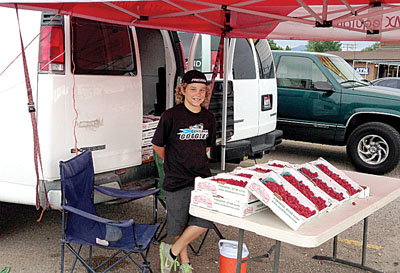
And employees of the Tax Commission confronted a youngster selling raspberries from a stand on Yellowstone Avenue in Pocatello this summer and told him he had to collect sales tax and turn it over to the state. The boy, 12-year-old Tayson Weeks, who was trying to earn enough money to buy a small motorcycle, was a little shook up, but continued his operation in front of the Red Wing Shoes store.
“They confronted him first and he called me,” said Tayson’s father, Jason Weeks. “It was the second day that Tayson was in business.”
Jason had his son hand the phone to a female tax commission employee, and she explained that the raspberry stand needed to charge sales tax and send the proceeds to the state of Idaho. She gave the father an Oct. 15 deadline. She also handed Tayson an official state tax form.
Jason said he was shocked about the sales tax requirement because the berries came from the Utah farm of Tayson’s grandfather, Merv Weeks.
“My dad grows raspberries and blackberries on about 100 acres,” Jason said. “When I was young, I would sell farm-grown produce from a stand in Park City and no sales tax was involved.”
Weeks said that was in Utah, where the sale of farm-grown produce by family members is apparently exempt from sales tax. Idaho has no such exemption among the 75 sales tax exemptions that do exist.
Some of those Idaho exemptions are designed to help with good causes. For example, sales of meals by churches to its members and FFA and 4-H sales at fairs are exempt, as are school lunches. Larger exemptions involve equipment and supplies used for production, irrigation and publishing equipment and supplies, sales by outfitters and guides, lottery tickets and pari-mutuel betting and ski chairlift tickets and caskets.
“The dollar amount isn’t huge, but it’s kind of a hassle,” Jason Weeks said about calculating the sales his son made.
And Tayson has had his fair share of challenges this year without tax problems.
“He rides motocross and he’s really, really good at it,” Jason said about his son. “But he had a bad accident and ended up with a brain concussion.”
The young Weeks spent time at Primary Children’s Medical Center in Salt Lake City, but has been recovering from his injuries. The berry stand was a way for the boy to earn some money and stay busy this summer.
“He wanted to buy himself a little Honda pit bike,” Jason said. “I told him he’d have to pay for it himself.”
State Tax Commission workers also visited an Aug. 4 fundraiser for Smoot.
The morning that fundraiser was held at Prime Time Auctions, owner and good friend of Smoot, Staci Hernandez, received a call from the commission.
“They just wanted to make sure I was charging sales tax,” Hernandez said. “I know they (the tax commission) look at our website all the time.”
Prime Time has held fundraising auctions in the past and has a system for collecting the sales tax.
Sales tax must be collected when people take possession of “tangible items,” according to Hernandez.
Straight cash donations or gift certificates are not subject to a sales tax.
The Idaho State Tax Commission explains its policy on its website: “Many nonprofit organizations believe they’re exempt from paying Idaho sales tax because they qualify for tax-exempt status with the Internal Revenue Service (IRS).
However, the IRS exemption applies only to income tax. Therefore, most religious, charitable, and nonprofit groups must pay sales tax on goods they buy for their own use and must collect tax when selling goods.”
However the commission website goes on to explain that “an auctioned item at a charitable event is only subject to sales tax on its fair market value.”
If someone buys an item with a market value of $50, but pays $150 as part of the fundraising effort, they are only charged 6 percent of the $50.
Saul Cohen, a tax policy specialist for the State Tax Commission, said the state does not collect sales tax on the price paid for items that have “clear donative intent.”
Cohen also said the commission has no power to suggest making charitable auctions exempt from sales tax or taxing items purchased online.
“The fact is the Tax Commission isn’t charged with having an opinion on that,” Cohen said. “It is the purview of the Legislature.”
Cohen also said that making fruit or vegetable stands collect sales tax is necessary.
“What the youngster is doing is selling tangible products,” Cohen said. “The tax code defines what a retailer is. Our mission is to advance fairness in collection. Some people don’t know they’re retailers.”
Cohen said compliance officers approach seasonal vendors to help “educate” them.
According to the National Conference of State Legislatures, Idaho had about $103 million in uncollected sales tax revenue in 2012 because of online purchases in the state. It’s unknown how much the state collects from produce vendors or people who successfully bid for items at charity auctions, according to Cohen.

(0) comments
Welcome to the discussion.
Log In